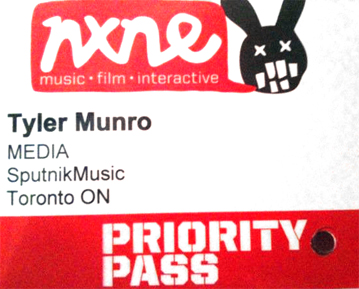
North by Northeast is not South by Southwest. Not yet, at least. They’re on separate scales, so when you’re reading what will ultimately be a three part write up, keep that in mind. With that out of the way, I’ve got another disclaimer: NXNE ran, officially, from June 14th to June 20th, and I’ll have three day-each write-ups. The math doesn’t make sense because not every day was worth writing about. The 14th and 15th were part of NXNEi, the festival’s inaugural interactive conference series.
Onto the 16th, the opening day of performances. I came in from Hamilton, which is about a 45 minute bus-ride from Toronto, to get my pass. Having seen Shad—who was as incredible as ever, by the way—the night before, I was at least a little bit hungover, but since NXNE is an event filled with media and musicians, I was definitely not the only one. I got my pass and looked at that night’s schedule and, well, it sucked. Wednesday night was barren. There was an ‘invitation only’ event featuring k-os, Kathleen Edwards and the Arkells. I wasn’t invited. The Eagles of Death Metal were playing the Phoenix, but it was a regularly ticketed event with only the first 200 wristbands guaranteed admission. I had a priority pass, not a wristband, so I could probably have gotten in, but not only is the Phoenix out…
All of a sudden, it’s starting to look a little worrying for Africa in the World Cup – South Africa’s bravery and spirit hasn’t seen them through, Portugal’s embarrassing demolition of North Korea have made Ivory Coast very unlikely to qualify, and Algeria and Nigeria simply weren’t good enough. Ghana’s qualification yesterday makes them the continent’s only representatives, then; the subject of today’s blog, Cameroon, were the first team to be eliminated from the competition after two disappointing defeats to Japan and Denmark. If only today offered an easy chance to restore pride; instead, they’ve got to play Holland. Gadzooks.
Perhaps it’s time to start planning for the future, then?
When asking for a list of genres Cameroon brought to the world, you probably wouldn’t expect ‘disco’ to be one of the answers. And yet, it was Cameroon’s own Manu Dibango that conjured up Soul Makossa, the album – and song – most frequently credited with sparking the disco craze. A rare venture into the Billboard charts by an African musician, it became one of the most sampled, referenced, and copied songs of the era – Michael Jackson fans especially may recognise the opening vocal refrain. The album itself is well worth having, incidentally – it’s a brilliant funk record, fleet-footed and melodic throughout.
That song shares its name – or at least the ‘makossa’ bit – with one of Cameroon’s most popular genres of music. The other – a more danceable, off-kilter affair that hasn’t found…
For all the criticism Blink-182 copped in the 90s for their supposed lack of punk credentials, they walked the walk when it truly mattered. Tom Delonge went mad in his castle, flew off on a coke-binge and produced three of the worst albums in major label history, Travis Barker died in a plane crash before coming back to life and Mark Hoppus hung around at the skate park. They were, essentially, Motley Crue for 9-year-olds.
What, then, of Jedward? Twins John and Edward Grimes, too, embody the true spirit of punk. Look at the evidence: 1) impossibly shit, spiky hair; 2) ugly co-ordinated outfits; 3) complete lack of musical ability; 4) impossibly shit, spiky hair. They have, quite simply, invented a whole new genre of karaoke – fans have all the fun of listening to tone deaf amateurs without the hassle of being drunk or being around moderately interesting people.
Here’s Jedward putting their uniquely punk slant on blink-182’s ‘All The Small Things’:
Before getting in depth about the Isis’ performance, let me say that Isis are without a doubt one of the most consistent bands this decade has seen. In fact, they are generally the first act linked with quality post-metal, as their influence has been that defining. After all, they practically own the genre. It all started with their first full-length, way back in 2000, when the gritty and often brutal Celestial was released, but the tidal wave of followers had not come until after Oceanic dropped in 2002. Ever since, Isis never looked back at what they were doing and how they approached their music, until last month, May 18th to be exact. That date was the end of Isis and the end of an era, and they certainly were not leaving quietly.
Due to Webster Hall’s petty dance parties that begin at 11:00 P.M., the show started and ended rather early, and Isis took much of the grunt from that(approximately three songs cut short from their standard tour setlist). Unlike many bands, Isis performed their own soundcheck and set up most of their equipment, showing their business-like approach to shows. Once everything was in place, they wasted no time, beginning with the tremendous closer from Wavering Radiant, “Threshold of Transformation.” From that moment on, the crowd moved with every beat and crushing riff, and while Isis hardly prance around on stage, they are fully enveloped in each song, headbanging as far back and as far…
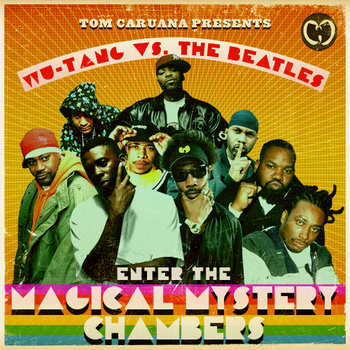
Enter the Magical Mystery Chambers is a fucking genius idea for a mash-up album. I mean The Beatles and the Wu-Tang Clan, does it get any better than that? Yep. Not only are some of the best raps in hip-hop showcased, but the tracks they are put over aren’t just pulled from the Fab Four’s studio takes, they are culled from a range of Beatles covers that offer up a new and unique experience not only for Beatles fans, but for Wu fans as well. Case in point, “Forget Me Not”. Originally found on Inspectah Deck’s Uncontrolled Substance, the track is completely transformed when put up against Jamaican guitar legend Ernest Ranglin’s jazzed up cover of “You Won’t See Me”, making the original practically obsolete.
Wu-Tang vs. The Beatles – “Forget Me Not”
Audio clip: Adobe Flash Player (version 9 or above) is required to play this audio clip. Download the latest version here. You also need to have JavaScript enabled in your browser.
Oh dear. As an Englishman I’ve clearly got enough to worry about myself without casting pity on other nations, but Australia haven’t really had the greatest World Cup, have they? Not only were they torn to shreds by Germany in their opening fixture, and not only have they collected two red cards to key players already, but they’ve also has to suffer an embarrassing rift between journalist Michael Cockerill and the permanently injured Harry Kewell, which has left Kewell looking just a little stupid (Cokerill asked Kewell to ‘actually DO something’ against Ghana, and Kewell promptly got himself sent off for a senseless handball), and left Lucas Neill reduced to announcing that actually, they’re not whingers and bottlers. What’s more, after New Zealand’s heroics against Italy, the Socceroos now face the very real prospect of going out of the tournament having been outplayed and outscored by their bitterest rivals. Still, some tunes might help, eh?
And here’s a picture of a sport they’re actually good at, too!
Everybody with ears knows about the major Australian acts, so there’s not really much anybody will get out of their videos being posted here, but just for the sake of the people who will undoubtedly complain anyway, here they are: AC/DC, Crowded House, Nick Cave, The Saints, Kylie Minogue, The Go-Betweens, Natalie Imbruglia, Bee Gees, The Avalanches, INXS, The Church, The Triffids, Sia, You Am I, The Vines, Hilltop Hoods, whatever Luke Steele is pretending to be this week, Silverchair, Wolfmother.…
It’s all getting a bit exciting now, isn’t it? Today sees the real meaty end of the tournament kick off, as teams start to drop out of the running altogether; by close of pay on the 25th, we’ll know exactly who will contest the knockout stages and who will be joining the likes of Cameroon in flying home. In Nigeria’s case, it’s do-or-die time – nothing but a victory over South Korea and some help from Argentina against Greece will stop them from becoming the second African nation to drop out of the first African World Cup. Still, if it’s any consolation, they can boast probably the best individual performance of the tournament so far in the shape of goalkeeper Vincent Enyeama’s Messi-defying heroics in their opening fixture against Argentina.
Mad respect for the blackest man in Tel Aviv.
The role played by Nigerians in the development of modern Africa’s musical consciousness simply can’t be ignored. While each African nation had its own folk forms – and with Igbo and Yoruba, Nigeria is no exception – it was Nigeria that was the first to embrace new styles and promote hybrid forms, bringing those folk sounds into a contemporary context. Nowhere was this more telling than in the development of Afrobeat, a crucial genre of music pioneering by Nigeria’s most famous son and probably African music’s most beloved figure – the legend that is Fela Kuti. This music – a blend of highlife, pyschedelia, funk, and sociopolitical fire – displays…
Before you read on, I’d like to qualify my definition of a musical, in relation to Tremé, to clear up any possible confusion. Tremé is a musical program in that it heavily features musical performances. These performances are, uh, performed, by the shows characters—its guest stars, its cameos, its extras…you get the point. But Tremé is not a musical in the same vein as Glee. There are no impromptu bursts of song, replete with back-up dancers and an invisible backing band. Tremé is a dramatic program. It just happens to centre around the musical city of New Orleans. For the uninitiated, the tremé is a New Orleans neighbourhood known primarily for its musical heritage. Scroll to the bottom for some clips.
I'd do anything for her to look at me with such longing. Or at all.
Glee is a lot of fun. I like it, unironically, and I have no problems putting those words to print. But having just watched the tenth episode—and first season finale—of HBO and David Simon’s Tremé, I’ve got to put something else into print, something I’ve known pretty distinctly since I watched the first episode some weeks back—Tremé, not Glee, is the best musically oriented show on television. I’m sorry, Channing. It’s not personal.
No, what it is is (is!) the honest to blog truth.
Yes, Glee is a lot of fun. I think I’ve already said this. But that’s more or less all it is. That’s not…
You know, I can’t even explain how Flying Lotus’s music is so good. For all intents and purposes, it takes a fairly standard hip-hop beat, slightly Dillafied, and puts subtle jazz music over it. It’s subdued, subtle, and somehow powerfully effective. For those of us who want something more immediate, something more aggressive, Flying Lotus’s imprint label Brainfeeder has released something fresh. Lorn, a 23 year-old producer from Illinois, has just released his debut album Nothing Else, which uses the same format as Flying Lotus–an album of shorter cuts of repetitive beats–but instead of using a heavy jazz influence, Lorn uses elements of glitch, dubstep, and breakbeat electronica. “Automation” is a longer cut on the album, and perhaps one of the most aggressive and dark found on the consistently excellent album.
And for all intents and purposes, that might as well be this entire blog post done with.
Music is effectively banned in North Korea. That is to say, unless it expressly praises the great leader and talks about how absolutely awesome communism is, it doesn’t get played. At all. On the one hand, it’s terrifying to think that there is actually a country on Earth that gives itself over to the nightmarish visions of George Orwell and Yevgeny Zamyatin. On the other, some of the propaganda music citizens of the Democratic People’s Republic of Korea are forced to listen to is pretty awesome. It’s difficult to listen to this and not imagine you’re leading an army into battle, isn’t it?
To look for anything beyond that in terms of popular music is a waste of time, quite frankly. Any music with any sort of freedom of expression is either so heavily oppressed that it will never be found by Westerners, or is made by artists who have long relocated to Japan or South Korea, and perhaps cannot really be seen as North Korean any more. This also applied to all the artists that existed in Korea before it split in half – all of them became South Korean, almost by osmosis. Unfortunately, the culture of strict hegemony is the only culture, and somehow, anything that breaks from that isn’t really a part of the original culture any more. For more North Korean music of note, then,…
As I walked across the ruins of the What Stage early Sunday afternoon, I had no envy for the cleanup crew of Bonnaroo. Bottles of water, beer, and god knows what else lay scattered across the immense area, trampled upon, despite Bonnaroo’s valiant efforts to get the concertgoers to take care of their own waste. I never remembered, in 2009 or 2010, seeing so much waste anywhere in Bonnaroo the day after a big show. Even the Flaming Lips confetti extravaganza seemed much less of a shock. Perhaps Bonnaroo was trying to send a message to the 80,000 strong who seemed to care very little about the sustainability portions of Bonnaroo. The sight was frightening.
Equally dirty, grimy, but in a very different way wonderful was the first set I saw at the Sunday portion of Bonnaroo, Japandroids. Perhaps it is a curse I have, but I only manage to see the second half of any Japandroids set. My day started later than I anticipated, so I got there a half hour late. A similar thing happened to me a few months ago at South by Southwest, when I found myself wandering Austin looking for the venue. I showed up in time for “Heart Sweats”, and saw most of the end of their breakthrough album Post-Nothing. Thrown into that set, however, was a surprise performance of “Darkness at the Edge of Gastown” from their compilation of old EPs, No Singles. With a stronger, fuller repertoire, Japandroids were able to present…
It’s one of the more overlooked international rivalries in football, but Slovakians must have been absolutely delighted with the way the European qualifying went for this World Cup. Ever since Czechoslovakia split into two nations, the newly-formed Czech Republic have left their new neighbours in the dust in footballing terms – in fact, they were the defeated finalists in their first ever major tournament, in 1996. Yet, in 2010, it was Slovakia themselves, with a little bit of help from Slovenia, that stopped the Czechs from appearing. The two countries remain closely related collaborators in political terms, but regardless, it must have been sweet. In a group that kicked off with two draws and thus remains wide open, they may yet do even better, even if their star player is terrified of his own tattoos.
He also looks a little bit like the chestburster from Alien. Just saying.
Slovakia’s most common contributions to the record collections of music obsessives in America have tended to be progressive rock acts of various description, and while special mention should be given to the jazz fusion of Fermáta, the name that crops up more than any other is Marián Varga. As a solo artist, in collaboration with Pavol Hammel, and as a member of Prúdy and Collegium Musicum, his is a legacy that reverberates throughout Slovakia’s prog rock and art rock movements. Here’s Collegium Musicum, a band whose catalogue is largely built on instrumental rock arrangements of classical pieces, wih a spot of…
After a long, exhausting, and unbeatable Friday at Bonnaroo, Saturday paled in comparison. Even before attending, it was clear that Saturday had the weakest lineup of any of the days, and this held true when the day finally came. Seeing nothing enticing on the lineup until 3:30 PM with Isis, I showed up at 12:30 PM to get in line to see Conan O’Brien. Unfortunately, due to a poorly communicated (read: not communicated at all) ticket system made me get in the stand-by line, only to see them let about fifty people in, and I get fifteen people from the front of the line. So, unable to see O’Brien, I had two and a half hours to kill before seeing Isis.
I spent most of my time at the Troo Music Lounge, a small stage for lesser known groups, mostly because of the misting fans, seats, and shaded areas. While I was there, I heard the last song of Elmwood, a jam band that offered nothing new to the palette in terms of sound and structure, but their solos were some of the most proficient, impressive jam band solos I’ve heard. The drummer only had a few tricks up his sleeve, mainly Danny Carey-inspired tom fills, but the bassist, guitarist, and saxophonist all turned in long, impressive solos that kept the audience interested despite their length. Following them was Truth and Salvage Co., a fairly boring country band that started promising with great vocal harmonies, but hardly progressed from there.…
I would imagine that of the few of you following this blog intently, most will have been looking forward to this entry more than any other. There is a serious fascination in the Western world when it comes to Japan, to the point where it borders on fetishism – we even have specific derogatory terms for people who are obsessed with anything and everything Japanese. Music may not quite command the same fanbase that anime does, or computer games do, but you still don’t need to look very far to find an excited fan of Dir en Grey, or Mad Capsule Markets, or Nobuo Uematsu.
Oh yeah, here’s a footballer too.
Japan’s national character suffered a little when Western music crossed the Pacific and took over, which is a real shame; the nation’s folk and classical forms are documented as well as in any country in the world. Clearly nothing I can type into such a short space will sum all of that up, so we’ll focus on just one such form; gagaku, which is perhaps best understood as an equivalent of sorts to European chamber music, traditionally played by small-ish ensembles for the rich and royal in private performaces. It went on to be a big influence on avant-garde Western classical music, informing the drones, the microtonality, the primitivism, and even the electronic textures that permeates the works of composers as famous as LaMonte Young, Karlheinz Stockhausen, and Krzysztof Penderecki.
The National stood on the Which Stage with foreshadowing of The Flaming Lips’ fluorescent orange set standing like a monolith behind them, a constant reminder that The National wasn’t the only reason I came to Bonnaroo, wasn’t the only reason why the thousands standing and listening to them kill their set found their way to little Manchester, Tennessee. The mud on my shoes. The dryness in my throat. The aching of my feet. Everything hinted that after the final melodies–no, primal screams–of “Terrible Love”, I would simply move onto the next show, as if that ninety minute set did not quench my thirst for great live music. And perhaps the biggest compliment I can give to The National’s incredible set is that, despite all of these hints at two and a half more days of Bonnaroo, I never once thought about what came before and after them. I simply remained transfixed by what took place on that stage (and, in the more incredible moments, in the crowd when Matt Berninger turned the show into what a friend of mine brilliantly termed “a punk show with wine”).
Yet, the biggest compliment I can give Bonnaroo 2010 is that despite the transcendent set of The National late Friday afternoon, Friday would get even better. Friday was easily the longest, most grueling day of Bonnaroo, seeing a total of eight different groups from 12 PM to 2 AM. Not to mention the 100°F heat index destroying the crowd for most of the afternoon.…