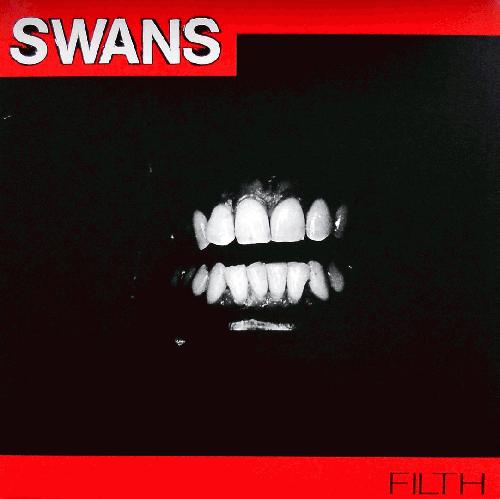
Review Summary: Never has an album lived up to its name like this one has.
If I were to tell you that the band that made this album would go on to make such strange and broadly orchestrated albums like
Soundtracks for the Blind or
The Glowing Man, and if for some reason your only experience with
Swans has been their 2010s material,
Filth might seem entirely out of place within their discography. I think it is a necessary album, though, at least for historical context alone. Back in the early ‘80s Swans were associated with no wave, a bizarre and short-lived variant of post-punk endemic to New York City that I assume was named in mockery of the new wave. NYC was in such a dire pecuniary state in the ‘70s that their citizens became deprived of several crucial services and crime rates soared. The nihilistic lyricism of no wave bands was strongly informed by the grim state of affairs, as was their sound, which tended towards atonality and unpredictability. If you’re at all interested in this movement, do check out the compilation
No New York; it has a surprising variety of sounds, and it was produced by
Brian Eno of all people. So where does Swans fit into this? Depending on who you ask, they don’t, because they became active during the tailend of the no wave scene, but either way they were certainly inspired by that movement, and I think it could be a potentially good primer for no wave.
The album starts off with “Stay Here”, a bruiser of an opener with pounding bass, someone randomly whipping sheet metal in the background, and frontman Michael Gira shouting exaggerated displays of masculinity. After two minutes the drumming assumes a more discernible groove, and Gira continues demanding that we flex our muscles. The background vocals, which have had a phaser effect applied, only make the song seem sillier than it already was in my opinion, but if nothing else it is a decent introduction to the confrontational and, well, filthy world that this album inhabits.
The next song ,”Big Strong Boss” (or “Boss! Big Strong!” as Gira would have us believe), continues Gira’s belligerence, and also has a strange fascination with black blood. I don’t find this song particularly satisfying to be honest; the guitars sound like they’re constantly winding up in anticipation of something, a climax of some sort that never arrives on account of the song ending abruptly. Apparently the band ran out of recording tape at this point, so I at least shouldn’t hold the sudden ending against them.
“Blackout” is a far sparser affair, with minimal drumming and Gira screaming at us not to talk until we’re spoken to, which is punctuated by stabs of guitar noise and discordant soloing. It’s kind of like
Unknown Pleasures by Joy Division, but far more atonal. “Power for Power” is about exactly that, accruing power for power’s sake, and what really makes the song is the drumming; the toms are struck so mightily that they have a weighty resonance that complements the atonal guitars quite nicely. The next song, “Freak”, is easily my least favourite song on this record; it is a maelstrom of bass that stands in stark contrast to the rest of the album, but not to its benefit; it sounds more like
Discharge to my ears than early Swans, and it’s short enough that I don’t think it adds much to the experience.
“Right Wrong” has a deeply twisted groove complemented by squalls of feedback, and it at least a strong enough melody that I don’t tire of its repetitive rhythm. The drumming also helps, it gets increasingly chaotic towards the end and there’s an increasingly strong presence of whipped sheet metal too. “Thank You” almost sounds like straight punk to my ears, albeit punk that has received an almost similar treatment to “Big Strong Boss” in that it sounds wound up, except this time it at least has a slightly more satisfying ending; slight feedback is a better alternative than simply ceasing to exist, as far as I’m concerned.
“Weakling” features a driving hi-hat rhythm, and out of every song on this album this is probably the one that’s the most successful at employing noise as music, as far as I’m concerned; the song features unpredictable stabs of feedback, and every hit of the bass is accompanied by what sound like deflating guitars. The closer, “Gang”, is a curiously empty finisher; the drumming is more metallic, to the point of almost sounding industrial to my ears, and the guitars sound like they’re getting whatever energy they once had drained from them. An interesting choice of a final statement, considering how much more forceful the rest of the album has been up to this point.
Filth stands in stark contrast to most of the rest of Swans’ discography, though I can almost hear ideas that would get further refined years down the road. Right from the beginning they’d always had a philosophy of using repetition as a means to hammer down ideas, though at this point said repetition feels just as much like a crutch as it does a tool with real compositional intent. Though I wouldn’t consider it nearly as sophisticated as most of Swans’ other albums, it has taken on some new context after checking out their 2010s material; after all the changes the band’s undergone, it seems to me that Swans is as much a philosophy as it is a band, though I’ve never been entirely sure what that philosophy is. Anyone who discovered Swans through such later albums as
To Be Kind or
The Seer will probably be disappointed, but it’s certainly worth checking out just for historical context alone.
Favourite tracks: “Weakling”, “Power for Power”
Least favourite tracks: “Freak”, “Big Strong Boss”