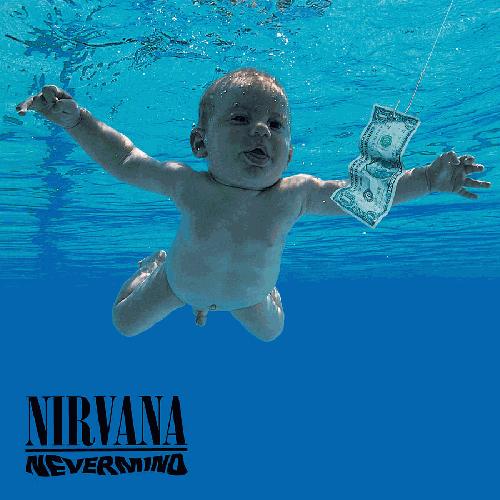
Review Summary: For an album that declares 'come as you are', a lot of people see it as they want it to be. The praise it gets is fair, but in retrospect it carries a wistfully massive weight.
So much has been said about Nevermind of course that it would be hard to articulate any other perspectives, but I'll try. The summary is a good preview into how I feel about this album. The way Nirvana's second record paved its impact has gone down in history to create its own myth. Which in turn creates a problem. Yes, it was and is an alternative milestone. But because of that, lots of fans of that sort will expect it to sound like the corporate watered-down sound that came later. And it doesn't, because Kurt Cobain wasn't trying to imitate much in his writing. He didn't mean for stuff like 'Teen Spirit' to get massive, but he was crafting a lot of - what were at heart - pop songs. Producer Butch Vig is quoted as saying "one of the reasons Kurt wanted the record to sound heavy was because he knew the songs were really hooky." And a fair few of them do have a real sing-a-long quality to them. As that chorus on 'In Bloom' says, 'he's the one who likes all our pretty songs', which was a message to their audience at the time. While Cobain didn't foresee what the band's sophomore release would do, he had a real aversion for the hair metal of the eighties and was downright fed up with it. This can backed up by the concerns he expressed later on in 1993 that the sound of Nevermind reminded him more of a Mötley Crüe record than a punk record. I personally don't hear anything like that in the sound, and there's no doubt denying the rock and metal scenes surely shifted. But I am not looking at it from a brown-nosing perspective.
My perspective is a result of giving it a LOT of thought. The way I describe my outlook towards this album is as a cynical optimist. I am not however, part of the generation that grew up with it as a sonic answer to their teenage angst. The fact of the matter is, that while I think the first half is plain brilliant, some of the second half happens to leave a slightly bitter taste in my mouth by comparison. You'll understand what I'm getting at properly if you have Nevermind on vinyl. The first side ends with 'Polly', and after a nice mixture of variety within the grunge sound and a good flow, 'Territorial Pissings' could throw you off the first few times. There a few good moments, but a lot of the latter side is fairly samey, a let-down after a pattern like the uptempo hardcore feel of 'Breed' following the mellow power-balladry of 'Come As You Are'. I suppose what would throw most people off right at the end is 'Something in the Way', especially after the furious goth-type songs that precede it - at least, that's what the ones in question sound like to my ears. On the other hand, both halves end with acoustic tracks. But I can only assume that the unconventionality of this was a glimpse into Kurt Cobain's psyche. While the tone is all grunge-like, when you break Nevermind down in terms of style, you get pop, ballads and varying rockers. Something which pleases me quite a lot. Putting the verbose power-pop of 'Smells Like Teen Spirit' as the opening track was, I feel, a good move. But was it also a laugh at the listeners' expense due to the lyrics?
A fairly good album with a handful of dour moments. Is it responsible for changing the face of nineties rock? Not on its own, a few other records helped with that. Is it worth the zealous spite that came afterwards? No, because the band knew how to write fairly catchy tunes that managed to work. You couldn't have something go popular without frequent airplay - this basic principle still holds true - and I'm sure Kurt Cobain knew that when he wrote the follow-up ideas to Bleach. Critical fingers may point at Nevermind as a 'pop album', but I think with Butch Vig lending a cooperative hand, the band ended up with something right in the middle - just polished enough to make raw music easy on the ear a lot of the time. It's my personal opinion that a few alternative bands afterwards ended up being either too raw or too polished, but that's neither here nor there. The fact is that Nirvana's second album seemed to come along at just the right time to be a piece in a musical jigsaw that made a mark. The two halves of the album are as different as black and white, but the juxtaposition somehow manages to mesh together when you look at it from a distance. There's a different perspective to be had on something that (from a mainstream point of view) created the bandwagon, and didn't do the proverbial act of jumping on it. This album may not deserve MASSIVE praise and to be looked at like an aural shrine that destroyed the eighties, but it still stands as a good, heavy while diverse rock album with pleasing earworms.
Number of tracks: 12
Accumulative score: 48/60
Average score: 4/5