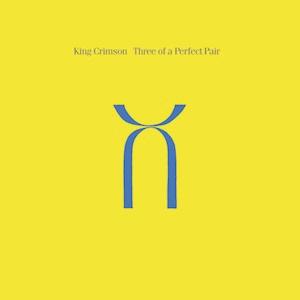
Review Summary: King Crimson's third era comes to a close, although not in a particularly satisfying or unsatisfying manner.
Just like
Larks’ Tongues in Aspic,
Starless and Bible Black and
Red are often seen together as a trilogy of albums, the three 80’s works King Crimson made can be easily seen as such as well.
Discipline,
Beat and this third and last entry of a finally stable formation,
Three of a Perfect Pair, would forego a second breakup of King Crimson, which would re-emerge for a second time in the 1990’s, although Adrian Belew has remained the front figure of the group ever since (something which is arguably unfortunate, as the ever-changing Crimson sound made the act so very compelling in the first place). The interesting feature about
Three of a Perfect Pair is its division into two sides. The first Left Side continues the trend of the more accessible tunes of
Beat, while the Right Side picks up old habits and ensures a more dominant reappearance of old-fashioned Crimprovisation of the Larks-era.
Although The Left Side contains some inspired tunes, such as the relaxed title track opener, the somewhat catchy
Man with an Open Heart, and the atmospheric instrumental
Nuages, you can’t help but notice something is missing. The problem here is Adrian Belew, who, on both
Discipline and
Beat proved to be the new main asset of King Crimson. Where his lyrics and vocals could be called well-thought-out and positively quirky in the past, his work on this record seems stale in comparison, and there is nothing here that can come close to touching the greats of this era such as
Elephant Talk,
Frame by Frame and
Waiting Man. Fact is, while
Discipline was more of a group effort (and therefore the best of the three albums),
Beat and
Three of a Perfect Pair’s first half lives or dies by Adrian Belew.
Ah, but what about that Right Side then? To say it is so good it completely makes us forget the slight disappointment of the first half is too much, but this four-track endeavour falls somewhere in between masterful Crimprov and utterly boring Crimprov. The 7-minute
Industry is a great theme-introducer and is home to more dark sounds, with especially great outbursts from the rhythm section.
Dig Me adds to the theme with mechanical sounding effects and ditto vocals, while
No Warning relives the menacing, piercing guitar lines and manic drumming. Closing off is a continuation of the old Larks-theme,
Larks’ Tongues in Aspic, Pt. III. The most upbeat and satisfying piece on the album, the track succeeds not only as a frenetic and constantly twisting instrumental, but also really
sounds like a more modern version of Part I and II, which makes it succeed on another level just the same. Later, Part IV would appear on
The ConstruKction of Light. Altogether, the four tracks weave a stylistically consistent and solid journey.
Three of a Perfect Pair is just that album most groups run up against at some point in their career: the so-so album. King Crimson’s tenth just lacks enough either really good songs or really bad songs to weigh it up or down, and it really depends what side of the band you love most that will decide what half of this record is most enjoyable (if you love both though,
Three of a Perfect Pair will score some bonus points for you). Though any more-than-casual Crimson fan will undoubtedly find their share of enjoying material on it, they’re not bound to play this over too many times.
Three of a Perfect Pair’s King Crimson was:
- Robert Fripp ~ Lead Guitar
- Robert Steven ‘Adrian’ Belew ~ Lead Vocals, Rhythm Guitar
- Tony Levin ~ Bass Guitar, Chapman Stick, Backing Vocals, Synthesizer
- William Scott Bruford ~ Acoustic and Electric Drums
TO BE CONTINUED...