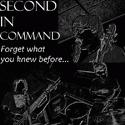
Review Summary: Second in Command continue to grow and change in their latest peice, Amnesia. Fresh from their adolescent pop-punk roots, they begin to branch out into other forms of the trade, inducing many melodic hardcore and grunge reflections.
A boorish Italian-American balances on a steel beam, high above the New York City skyscape. He eyes a brick, the next in a series, taunting him, reminding him of his wearisome and tumultuous work ahead. Feeling mischievous, he decides to toss this mocking symbol of capitalist oppression over the edifice. A passerby below, minding his business with a staunch swagger, hears the whistle mere seconds before the misguided projectile clobbers him square on the noggin. Returning to our world several hours later, family in tow, the passerby immediately asks himself a question burning in his mind:
Who am I?
…And so the recipe for
Amnesia was born. Second in Command’s newest social outing,
Amnesia profiles a shift in the band’s sound and direction, no matter how difficult to catch to the naked eye, or rather, naked ear, it may be. From their adolescent roots in pop-punk mimicry, they have branched out to touch on heavier yet melodic sounds and grunge stylistic elements, akin to Taking Back Sunday or Rise Against. Distortion commands the music, along with feedback and white noise to add ambience, as if one had their ear right up to Gilchrist’s old punch-drunk Marshalls in the basement. The riffs pouring from that same amplifier have taken a heavier turn, crackling through the beat of the drums to drive the music forward. Vocally and lyrically, the near-hardcore influences truly stand out; Downer’s pitchy shout fits like a glove around the stronger tracks, especially Jock’s own brainchild,
Caught at the Witching Hour:
Quote:
|
Originally Posted by Caught at the Witching Hour
You were my elevator
My sole motivator
Now there’s no telling how much I hate her
You were my elevator
But I am on the top now
And it’s a million miles down…
|
Why does a guitar, a simplistic piece of melodic plastic and wood, tend to facilitate the expression of our deepest emotions, or darkest fears, our highest highs and lowest lows? Apparently, Jock Gilchrist and Zaki Shafi found out, because it’s become like a family member to them. The guitar work on this album has taken a leap technically and stylistically from the band’s last album, able to be more complex and still catchy. Of course it suffers from Punk-itis; that is, a horrible tendency to repeat just a little too often.
On the Edge and its partner-in-crime lead in,
The Untouchable, virtually mirror each others’ riffs. Their incredibly catchy hook, on the other hand, is able to compensate by getting the dry-as-sand duo stuck in your head for days. I’ll even admit to be sitting in math class and suddenly realize I’m whispering the words, “I’m feeling lucky, no one can save me, not even God,” to myself over and over. Of course, there are many superior moments to this diagnosis, the greatest of them being a toss-up between
Sparrows of Prey and
Under the Bright Lights. Both are exceedingly well done, ambient ballads with creative riffs.
UtBL’s riff is especially interesting, in that it changes slightly every verse. The bridge of the song is full of stop-go licks and lots of distortion (in contrast to the rest of the song.)
Sparrows’s simple yet endearing riff is an enigma, causing the listener to almost drift into the song in faux-inebriation. It’s almost as if the guitar’s integrally beautiful flow is facilitating the writer’s expression of his deepest emotions, darkest secrets, his highest highs and lowest lows…
Bassists have it tough. They slave all day over a tepid chunk of wood and coils for what? To stand in the back and deliver a pulse-pounding, essentially cornerstone-worthy piece of music? Coming from a bassist, yeah, pretty much. Thankfully, Duncan Gilchrist doesn’t let such an injustice (or anything, for that matter) get to him. His potentially masterful bass pieces are definitely fine behind songs like
On the Edge The Untouchable and
Under the Bright Lights. The shining example of Duncan just going to town, though, is on
Card Shark. Beginning with a slow bass intro, the song builds up a very murky air about it. As the rest of the crew files in for the buildup, the bass swoons on, crooning its unique song behind the others. Suddenly, the pace begins a steady ascension and the vigor of the buildup increases. Finally, the sound stops on a dime and all goes quiet on the western front. Out of the darkness, a simple slap of the old E string sets off Duncan’s fuse. He explodes into a flurry of notes, taking control like a drill sergeant on reckie day; it almost seems like it is speaking to the other instruments, saying, “Try to keep up.” Further explosions usher in the bridge, which surprisingly has even
more energy pumped into it than the verse. Apollo himself would be beaming at such a songbird’s incredible lament. Unfortunately, the album also has a dark side prepared for our little hero; songs like
Red Sun Rises and
Sparrows of Prey nearly disregard the bass, bullying it directly behind the guitar. As if to add insult to injury, the hihats subsequently drown out any excess licks creeping out from behind Mr. Les Paul. Thankfully, these few moments of retreat don’t detract from the class work of Duncan Gilchrist and, in my native tongue, “la sua chittara bassa.”
Hmm, drums… I honestly don’t have a good aphorism for a bunch of leathery boxes and gold dishes getting hit with sticks, sorry. Nonetheless, Downer does his craft an injustice on most of the album. The beats tend to run together frequently, all sounding basically the same. Abuse of the cymbals tends to scar the few glimmers of hope for this primitive instrument on
Amnesia, often drowning out the entire rest of the band due to low-par sound quality. Yet, sometimes the grand old bird does fly, namely on
Sparrows of Prey. At the epoch of the second verse, a tiny drum roll ushers in a soft tapping of hihats and snare, syncopated to the aforementioned hypnotic guitar in an awe-inspiring power play, so to speak. Unfortunately, the bad heavily outweighs the good due to reused and boring beats to most of the songs. Yet, it indirectly works for them in a different light: the uncouth drumming on the rest of the album makes
Sparrows that much better to listen to.
Firey bursts propel the jetliner forward, urging it faster and faster.
The hospital is near, ma'am, an EMT flatly utters, in hopes of calming down the hysterical woman in his stead. And like the flip of a switch, everything goes black on this young man's world... Seven days later, our passerby awakens, lying in an odd white room like he has been for the past week. He is still learning to cope with the strange new world around him, almost like a drifter in an old Western saloon. Like Second in Command, he continues to learn the flow of life; he continues to keep with the pace of this fretting world; most importantly, though, he is finding himself every step of the way. And all he can say to everyone else is…
Forget what you knew before…