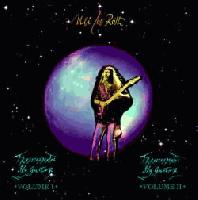
Review Summary: Roth’s classical aspirations, finally come to fruition
There are Cathedrals in the sky, high up on the beam…
The internal image of beauty is reflected in the clouds below…
There is no end and no beginning in the world of the truly transcendental…
Only the celestial music of the spheres… - dervied from the linear notes of the album
For years, Uli Jon Roth’s music seemed to be reaching for a form that his records could only partially accommodate. Electric Sun followed that impulse from psychedelic hard rock into operatic extravagance, leaving some extraordinary guitar playing and a few awkward collisions along the way. On
Transcendental Sky Guitar, the destination comes into view. Released in 2000, this double album gives his classical preoccupations an extensive programme of their own, placing interpretations of established works beside original compositions and improvisations. There is a considerable sense of fulfilment imbued in these performances; Roth has found a setting in which the melodic eloquence of his playing can flourish, although his eagerness to share everything still makes for a demanding listen.
The years after Electric Sun had taken him further into composition for orchestra and piano. That background helps explain the seriousness with which he approaches the repertoire here. Mozart, Paganini, Beethoven and Massenet become opportunities to examine what an electric guitar can convey when entrusted with music conceived for other instruments. The obvious danger is novelty: familiar melodies decorated with distortion and enough rapid notes to make their transplantation seem impressive. Roth’s attention to their melodic character prevents that from becoming the prevailing impression. He treats these pieces as music worthy of dwelling, and the distinction is audible in the affection of his phrasing. Their appeal survives the change of instrument.
The collection divides into
The Phoenix, devoted to concert pieces, and
The Dragon, comprising encores and improvisations. It draws on both concert recordings and sessions at Roth’s studio in Wales, where he and Don Airey also recorded spontaneous exchanges between guitar and keyboards. That is a more intimate undertaking than the scale of the project might suggest. Keyboards and strings supply orchestral color, while other motifs call on the direct accompaniment of a rock band. Airey’s contribution is particularly pertinent to this approach, providing a keyboard counterpart to Roth’s transcriptions and explorations. The clear production lets the intricacies transcribe without turning the recording into a remote, clinical document of musicians at work.
The Sky Guitar’s extended range is central to its enterprise. Roth can pursue melodies into the universe of a violin without continually pulling them back into the familiar compass of a rock solo. Equally impressive is the ease with which he moves from those darting, elaborate figures into a sustained melodic line. His touch keeps the succession of notes intelligible, and the quieter passages have a tenderness that all the dexterity in the world could not supply by itself. There is plenty here to astonish another fellow guitarist or a colleague, but I find the strongest performances just as persuasive when I stop considering their difficulty. The predominantly instrumental setlist gives the guitar much of the expressive responsibility usually assigned to a singer. Roth seems unusually well suited to that task as well.
This is also why the presence of so much borrowed material does not diminish the record’s value. Interpretation is a substantial part of the achievement. The program can accommodate
Rondo alla Turca and
Meditation de Thaïs alongside Roth’s own
Sky Overture and
Earthquake without making his compositions seem like obligatory interruptions between famous selections. Returning to the Electric Sun material is especially revealing in this context. Those early classical inclinations now belong to a broader musical practice, giving the familiar compositions a convincing home among the transcriptions. Most of
The Phoenix sustains that fascination. Its more deliberately shaped pieces give his imagination something substantial to explore, with melody remaining the reason to follow him.
The freer playing on
The Dragon is a less dependable source of gratification.
Spanish Fantasy and
Air de Bach would be welcome additions to even a severely pruned edition, but some of the extended improvisations leave me admiring the player while losing interest in the performance.
Freeflow Gem illustrates the problem. There is no shortage of facility, yet the unfolding ideas do not always justify the time spent following them. The long
Voodoo Child tribute raises a different reservation. Roth’s attachment to Hendrix has never been difficult to hear, and the execution is capable enough, but this familiar homage contributes less to the album’s identity than the classical interpretations. After hearing how far he can take the instrument elsewhere, I find this return to such well-travelled ground rather upsetting.
Across twenty-five tracks and just over two hours, those lapses accumulate dangerously. Even playing of this caliber can become tiresome when so much of it arrives without sufficient discrimination. I would happily exchange several of the looser excursions for a shorter programme centered on the first disc and the strongest selections from the second. That reservation concerns the listening experience more than the scope of his interests. The breadth is often exhilarating, and reducing the whole project to a conventional rock format would sacrifice much of what makes it distinctive. It simply needs a firmer decision about which performances deserve to remain after the recording has stopped.
For all that,
Transcendental Sky Guitar stands among Roth’s most accomplished statements. The music gives substance to the celestial imagery surrounding it, and the classical repertoire brings out a sensitivity that the language of guitar heroics scarcely describes. I hear the satisfaction of a musician finally articulating something he had been pursuing for decades. A few omissions would make it easier to revisit in full. What remains indispensable, however, is the sound of Roth discovering how much his guitar can communicate.