Review Summary: Baby, I know who I am
Obliqueness is not always a desirable trait in music, a piece of media that most people consume for its proximity to the human experience. In other words, we (mostly) listen to music as a means to validate our own feelings and experiences and we turn to artists who sing with either clarity or vivid language about topics that relate to our own everyday lives. Being an elusive artist is something that can only work so many times before we get tired of the mask. That's Aldous Harding in a nutshell; she has remained opaque since her inception and that's evident both in the bizarre, dream-like lyricism she employs and in her chameleonic vocal delivery that changes between songs or even verses. She chooses to withhold more often than she shares and her cryptic storytelling puts more focus on the performances and atmosphere to carry the songs. Such a commitment to providing mystique is admirable, but the effect cannot hold up across many albums to the point that her last full-length release (2022’s
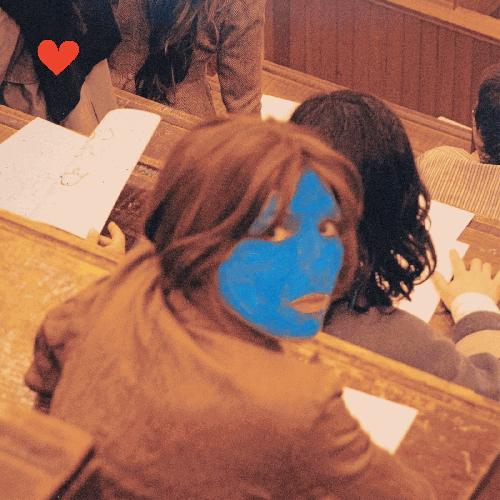
Warm Chris) didn’t provide any new layer of identity to peel off behind its otherwise lush instrumentation. Her career thus far is perfectly captured in this new album's cover: Aldous sitting in a lecture hall staring directly at the camera with her face painted blue. The image of someone who is visible yet unreadable.
On her latest offering, she doesn’t rectify those core elements; this is the same Aldous as before and those divisive artistic traits of hers aren’t up for negotiation. By and large, I should be disappointed or indifferent towards this release. But the more time I give to it, the more breakthroughs (both sonic and thematic) I receive back. For such an ever-elusive performer and record, it’s one of the year’s most unexpectedly inviting bodies of work. Up until this point, you may be someone who finds Harding’s self-curated image and musings to be beautifully strange and surreal—or maybe you lie on the other end of the spectrum and view all this as too contrived or too self-conscious to offer any tangible enjoyment. But you’d be hard-pressed to not let
Train on the Island win you over just a little bit, whether on the strengths of its production or its songwriting.
The former is the easiest to discuss: Harding's fourth consecutive partnership with frequent PJ Harvey collaborator John Parish is not only
still successful but the most fruitful it's ever been. And complexity is not the key; most of these songs linger on rather simplistic compositions that would count as meandering—if they weren't so consistently pretty. Take ‘One Stop’, which coasts on a set of eerie piano keys that allow Harding's voice to take up all the space before landing on bright acoustic guitar chords for its last minute. Tipping over five minutes, the title-track bounces off the same restrained bassline and sparse percussion for its entire length; so do most of these songs, especially on the second half. An overall stillness and unease is present through
Train on the Island’s compositions, whether in the gentle but unnerving electronic sounds on opener ‘I Ate The Most’ or the aforementioned slow-burning tracks on the back half (‘San Francisco’, ‘What Am I Gonna Do?’) that rest on sparse progressions of drums, piano and bass guitar. It's a deliberate choice, all in service of putting Harding’s vocal performance front and center; her voice has never sounded as strong as it does here and it remains fascinatingly elastic, attacking some songs with a throaty delivery, approaching some as singing through her teeth and laying down some beautiful falsettos and harmonies in others. The hypnotic nature of most songs helps to also spotlight its more upbeat spots in ‘If Lady Does It’’s playful cabaret-style sound and ‘Coats’’s country-rock twang. A few missteps throughout don't ruin the album's atmosphere or experience, but could have been smoothed over: most notably, the missed opportunity to incorporate H. Hawkline more prominently on ‘Venus in the Zinnia’ and ‘Riding that Symbol’’s snail-paced composition that comes after a streak of slower tracks. However, if your first listen’s impression is that of a musically anemic record, don't let it fool you; subsequent listens reveal a lot more sonic elements to latch yourself onto and even the weaker spots add to the narcotised effect of the entire project.
The record's immediate appeal certainly lies in how alive and full these soundscapes are; there's ample discussion to be had, however, about the layers Harding sheds and the person she reveals here. Her writing remains elusive, off-kilter—but the character study is there, if you're paying attention. The relationship with her mother pops up multiple times throughout the record, but so do themes of neurodivergence and self-image and her trademark surreal imagery enhances their staying power instead of perplexing you. The title-track's opening verse of "Mommy said my inception was like eating a pearl / I blew all glass out the home / Reflections steal my mind" is as strange as it is poetic and revealing: suggesting childhood trauma as a source of her struggling with self-perception, something
Train on the Island reinforces in other songs, like 'What Am I Gonna Do?''s devastating "Who brought me up the stem with no love in their heart?" line. That track also provides the springboard for unusually overt questions about identity that burden us all, especially neurodivergent people ("What am I gonna do if I can't break out of it?"). On the title-track, she regulates herself with medication; on another, she makes literal reference to the autistic spectrum. Mentions of teachers, tests and social isolation show up on 'Worms', where Harding imagines herself as one ("I'm saving myself by eating rocks and plants") and paints a primal image of survival. The opening track's visceral couplet of "Sometimes I eat 'till I vomit / There's heavy and heavier" is heavily suggestive of disordered eating that, by the closing track, isn't resolved but alleviated by the track's subject ("Can't buy the remedy / But I'll eat if you're next to me").
On top of that, Aldous confesses her struggles as an artist who intensely feels the expectations of her audience. She proclaims to want to write about her experiences on 'One Stop' but beneath the humorous John Cale vignette, she offers a peek into the artist-audience relationship: "I'll never do it again / Unless you wanna do it again". Then once again, on 'Riding That Symbol', she presents her oblique identity as a deliberate performance ("No one knows what I'm into / I'm only riding that symbol"). In that sense, her shape-shifting vocals aren't just an aesthetic feature, but
another layer to peel off: offering different performances of identity in search for selfhood. Underneath it all, there's the piercing need for connection—to get on the same wavelength as the people surrounding you, let alone the ones who adore you. The question of "Why wouldn't I wanna meet you?" repeats itself across two separate songs; one of the last lines on the album isn't just a cheeky reference to the cover art but a layered one towards the perception others have of her:
What do you say when you meet blue women?
For listeners like me, who gain a great deal of enjoyment out of dissecting the lyrics from a project, there's a surprising balance of ambiguity and candor throughout
Train on the Island that invites analysis, interpretation and, like Aldous herself, reading slightly too much into things. But not everyone is interested in picking apart Harding's mythology and themes and that's an equally valid approach to engaging with art. Fortunately, the compositions on display are entrancing and explode with unforgettable hooks and vocal cadences for you to grab onto. And just shy of 40 minutes, it doesn’t waste a minute of its runtime. It’s been a while since I’ve had a singer-songwriter record speak to me with the humanity that Aldous brings to her latest offering—and what a gorgeous one it is. She’s still an enigma, but her chest is wide open for us to witness the heart.