Review Summary: You’ll never be forgotten, Bonnie
Bonnie Tyler’s voice was a big part of my childhood. Writing about her following her death this summer feels personal in a way that an ordinary album review rarely does, and
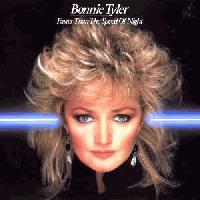
Faster Than the Speed of Night offers plenty of reasons to celebrate the singer I grew up with. Released in 1983, it is a gloriously excessive record, full of enormous dramatic weight and arrangements that seem determined to give every gesture the space of an entire stage. It can be ridiculous, but Tyler’s unmistakable singing gives all that commotion an emotional gravitas.
Her partnership with Jim Steinman gave that voice a setting worthy of its force. Tyler had already enjoyed international success with
It’s a Heartache, and the country inflections in her singing might seem an unlikely fit for the producer behind
Bat Out of Hell. Yet there is an emotional directness in her delivery that suits his theatrical instincts remarkably well. Steinman produced the album but wrote only the title track and
Total Eclipse of the Heart, with covers accounting for most of the remaining material. His presence nevertheless extends across the whole collection. A song entering his studio could apparently expect to leave with a choir, a much larger drum sound and several additional reasons to lose its composure.
The scale is exhilarating when the writing can accommodate it. Pianos propel the music with almost as much urgency as the guitars, most immediately in the title track’s fascinating introduction, played by Steve Margoshes. Elsewhere, Roy Bittan’s keyboard work and Max Weinberg’s bombastic drumming help give the record its familiar Steinman character. Cymbal crashes and electric flourishes keep arriving, while the multi-layered voices occasionally bring Queen’s
A Night at the Opera to mind. For all its rock instrumentation and operatic ambitions, though, this remains readily approachable pop. The hooks are immediate, and the performances invite you to enjoy the spectacle without having to take every gesture quite so seriously.
Tyler herself sings with a conviction that makes such extravagance easier to believe. Her rasp carries weariness as naturally as defiance, and when she pushes harder, the grain in her voice makes the petition feel almost physically demanding.
Total Eclipse of the Heart depends on that quality. Across its full album length, the tentative piano opening and answering vocal lines gather into a performance that keeps finding another reserve of desperation. The chorus is familiar enough to risk becoming background music, yet her delivery restores the aching plea beneath it. The duet with Frankie Miller on
Tears offers another pleasure: two weathered voices finding a natural fit, with an audible warmth that survives the surrounding production. In both settings, Tyler makes the feeling behind the song difficult to dismiss.
Her handling of the borrowed material gives the album much of its variety. More specifically, the transformation of Creedence Clearwater Revival’s
Have You Ever Seen the Rain?, whose brisk piano and forceful accompaniment provide ample room for her to let loose. It has a headlong enthusiasm that makes the familiar melody feel newly animated. Blue Öyster Cult’s
Goin’ Through the Motions fits surprisingly comfortably into the same company. Its melodic drive reminds me of Boston, especially
Peace of Mind, a resemblance I hear in the original as well. The children’s chant is a stranger addition, one of several flourishes that leave me wondering whether Steinman ever felt a song had quite enough going on.
Some of the shorter material has to compete with a production considerably more ambitious than the song underneath it.
Getting So Excited contains plenty of activity without the emotional pull of the major set pieces, and the persistent urge to enlarge everything can become tiring across a full listen. Even an appealing melody such as
Straight from the Heart might have benefited from a little more breathing room. This is emphatically a product of its decade, complete with some overstuffed arrangements and commercial gloss that have aged less gracefully than Tyler’s singing. The best passages make their excess feel necessary. Elsewhere, another vocal layer or instrumental flourish can seem like something added because there was still room on the tape.
Those reservations do little to diminish the thrill of hearing Tyler take command of this material. Few songwriters could make a heart race quite like Steinman, and she had the strength and character to meet him at his most indulgent. The album’s finest moments are moving on a scale that would be embarrassing without someone capable of committing to them so completely. Her performance also keeps the less distinguished songs enjoyable, giving a collection drawn from several writers a recognisable personality. I still find it easy to get swept up in the enthusiasm that Tyler inspires with her charismatic presence.
Faster Than the Speed of Night remains a hugely enjoyable record, unabashedly dramatic and blessed with a singer who could take its gloriously excessive material and propel it into the stratosphere, all while making even its wildest gestures feel completely genuine. Jamming the album now in its entirety, makes me fully appreciate just how much Tyler gave of herself in these performances, from the roughness of a held note to the sheer force of a chorus. She was one of the voices that accompanied my childhood, and this album is a fitting way to remember what made her so special.
Rest easy, Bonnie. Thank you for making my childhood so awesome!
Recommended tracks:
Have You Ever Seen the Rain
Faster Than the Speed of Night
Total Eclipse of the Heart
RIP Bonnie Tyler
RIP Jim Steinman