Review Summary: A triumph preserved on tape
For a demo, Pagan Altar’s 1982 cassette leaves remarkably little unfinished business. Its six songs belong to a band already comfortable with extended compositions, capable of making an occult ceremony sound almost alluring before revealing something considerably nastier underneath. Even the recording’s shortcomings cannot disguise how carefully the material has been assembled. What fascinates me most is the confidence of it all. These musicians had developed a world of their own, complete with its rituals, grievances and visions of destruction. The difficulty was getting anyone outside their small following to notice.
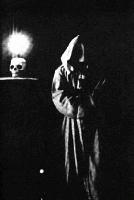
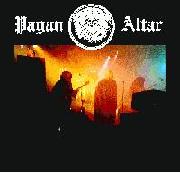
The group emerged in southeast London in the late 1970s around Terry Jones and his guitarist son Alan. Stonehenge and Avebury helped inspire the name, while Nunhead Cemetery provided a setting for some of Terry’s darker imaginings. Sessions in 1978 and 1980–81 preceded the cassette, recorded at their own studio with engineer Phil Hearne and a lineup completed by bassist Trevor Portch and drummer John Mizrahi. Their live presentation was similarly developed. Robes, smoke and candlelight surrounded a stage dressed for a ritual, with recorded chants announcing the musicians’ arrival. In the context of the NWOBHM, this was an unusually elaborate proposition from a band still trying to secure a foothold.
For all that ceremony, the cassette can be strikingly approachable. Beneath its solemn delivery are melodies that linger with surprising ease, especially in the shorter pieces.
Night Rider and
In the Wake of Armadeus bring a welcome immediacy to a recording otherwise comfortable taking its time. The heavier passages have a deliberate, almost ceremonial pace, but the musicians never seem trapped by it. There is an earthy looseness to the playing, and the occasional wistful turn allows a little daylight into the gloom. Sabbath’s presence is obvious enough. The darker corners of Uriah Heep and Blue Öyster Cult also come to mind, particularly in the uneasy relationship between attractive melodies and the things being sung about.
Much of that balance depends on how the quartet plays together. Portch’s bass gives the recording a substantial midpoint despite the comparatively stiff guitar sound. His steady lines leave Mizrahi free to vary the percussion, and their coordination keeps the changes in pace from feeling laborious. Alan’s leads enter this exchange with the same melodic purpose as Terry’s singing, sometimes joining it directly, as in the middle passage of
In the Wake of Armadeus. These meetings are more revealing than any isolated display of dexterity. Terry’s placement of a phrase and the accents around it help a passage take shape as surely as the guitar does. Terry spent hours arranging Alan’s taped ideas, which makes the closeness of their musical conversation easier to understand.
That attention to detail extends to the stories themselves. In
Judgement of the Dead, the victims of war convene to sentence the authorities who sent them to their deaths. The graveyard scene gives a disturbing physical presence to anger at leaders who escape the consequences imposed on everyone else.
Reincarnation takes that concern with human failings into a world rebuilding after catastrophe, where the temptations that caused its destruction remain. The more reflective melodies allow beauty into this desolate picture without making the future reassuring. Several selections came from larger sequences of related songs, giving the cassette a sense of events continuing beyond its boundaries. Yet each piece remains satisfying in itself. I appreciate how naturally the band accommodates these expansive interests without sacrificing the pleasures of a memorable tune or a well-placed riff.
The performance occasionally shows its seams. Some lead passages could be cleaner, and a fuller guitar recording would have given the heavier sections greater force. Terry’s delivery will also be an obstacle for some listeners, particularly when its nasal edge becomes pronounced. Some authorities recall a bout of flu during the sessions, although the attraction for me lies in the conviction of the performance regardless. The voice seems to inhabit the murky surroundings, and the understated keyboards deepen that impression. The result can feel eerie even at its most tuneful. I would not want every rough edge polished away, but the few that interrupt the spell keep this just short of perfection.
Unfortunately, the band's preparation did not translate into comparable opportunities. An encounter with Whiplash editor Sam Kress brought favorable coverage and requests from American listeners, which the group answered by sending out cassettes. Demand existed, though it never supplied the momentum they needed at home. By the mid-1980s the original band was coming apart. Alan pursued other projects, including the more Celtic-influenced Malac’s Cross, while Terry largely withdrew from performing. Copies continued circulating, and unauthorized editions sustained the music’s reputation while exposing fans to inflated prices.
That history eventually led to the 1998 Oracle release,
Volume 1. The original performances were recovered for CD from deteriorating tapes, making their preservation a rather more urgent matter than the familiar story of a cult rediscovery suggests. The added acoustic miniature appeared as
Acoustics; Its intended name was
The Dance of the Banshee before a printing mix-up. Its absence here leaves six substantial compositions that need little assistance in establishing the range of the band’s imagination.
This demo possesses a sense of self-assurance that I find every bit as impressive as its strange atmosphere. The musicians know how to sustain a scene, when to disturb its stillness and how to make a melody worth carrying away from it. Their modest resources occasionally show, but the care behind the music is audible throughout. This was an exceptional recording long before it became a collector’s prize, and it remains one that deserves to be played far more often than its rarity is discussed.
Recommended tracks:
Every
Single
One