Review Summary: Class
As with my first CD, I am once again focusing on instrumental pieces. I believe they offer the bouzouki a certain sense of "freedom" nowadays, allowing the instrument to be played in a way that brings out its true character while freeing it from the formulas and conventions it has acquired within contemporary laïko music.
I see this as a way for the bouzouki to reclaim the very qualities that once made it so immediate and vibrant - the qualities that endeared it to the public and helped establish it as Greece's most popular folk instrument.
At the same time, solo pieces can serve as studies of the bouzouki repertoire, much like the works written by great virtuosos that have become reference points for us as players. In fact, much of the instrument's evolution can be traced through pieces like these, documenting the different stages of its development throughout its history and into the present day.
For that reason, I believe it is essential that similar work continues today, alongside an effort to expand and renew the bouzouki's technical and expressive possibilities. - Vangelis Trigas
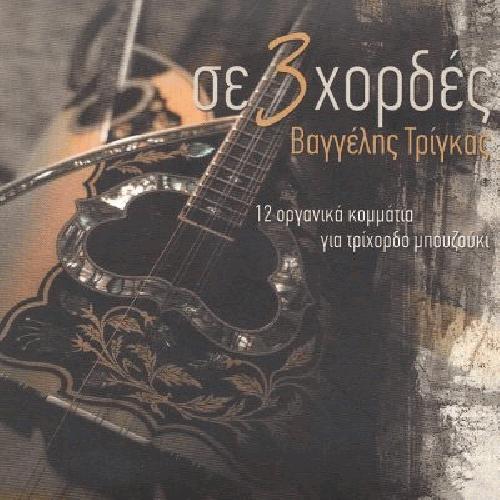
On Three Strings finds Vangelis Trigas in a playful mood. His affection for the older Greek repertoire remains unmistakable, but there is a looseness to his approach that gives this record a different appeal from his debut.
12 Instrumentals had drawn together a wealth of rebetiko and laïko traditions, and his second album, released in 2007, returned to older songs through predominantly vocal performances. With this third record in 2009, he resumed the fully instrumental format. Listening to it now, I hear someone increasingly comfortable following his own inclinations, with less concern for keeping every phrase close to its traditional model.
Trigas’s accompanying statement helps explain that freedom. He saw instrumental composition as a way to release the bouzouki from the standardised roles it had acquired in contemporary laïko, restoring some of the immediacy that had made it so beloved. These pieces also had a practical purpose. Like the solo works of earlier virtuosos, they could enter the repertoire as studies for other players, extending the instrument’s technical and expressive possibilities. That is a serious undertaking, although the music seldom feels weighed down by it. There is an almost cheeky pleasure in his playing, as though having paid his respects to his predecessors, he can now enjoy himself a little more.
Much of the material consists of recognisable rearrangements of compositions from the debut, alongside new pieces. Familiar melodic foundations, accents and rhythms return, but the structures have been substantially reworked. Solos appear in different places, and the balance between the instruments changes how the compositions develop. It is fascinating to recognise a passage and then hear it take a different course, especially when the accompanying musicians assume a larger share of the conversation. Trigas understands how much can change around a melody without making it unrecognisable. The earlier versions remain worth knowing, and these arrangements offer plenty of reasons to become acquainted with the music again.
Trigas's touch of the bouzouki is gentler here. There is less of the sharp, staccato attack that I associate with the first record, and the phrases sound more relaxed in their delivery. To borrow a guitar comparison, it feels a little like switching from the bridge pickup to the neck: the outline softens and the tone takes on a warmer body. The bouzouki retains its character throughout. Trigas simply draws more tenderness from it, and that change makes even familiar material feel surprisingly intimate.
The piano has much to do with this impression as well. Its more prominent role gives the bouzouki a responsive partner, answering a lick or supplying a complementary phrase instead of remaining beneath the lead. I particularly enjoy the ease of these exchanges. The playing is exact, yet the musicians sound comfortable enough to let a little mischief into it. There is something of a chamber ensemble’s poise in the arrangements, with a balance that allows the other instruments to register as personalities. For all its dexterity, the album is a remarkably tranquil company. The attention to detail becomes more apparent when I listen closely, without disturbing that initial feeling of ease.
That combination of composure and playfulness sends my imagination wandering. The music can advocate a narrow alley on a Greek island, then acquire the cosmopolitan charm of a cabaret or a café somewhere along the French Riviera. Occasionally, I hear a touch of gypsy jazz that brings Django Reinhardt to mind. I cannot say whether the resemblance is intentional, and Trigas’s phrasing remains recognisably his own. It is the lightly teasing manner of the playing that prompts the association. Beneath it lies an autumnal melancholy, giving the romance a wistful edge. Some passages evoke the European settings of Woody Allen’s films from the mid-2000s onwards: half-remembered streets, inviting cafés, and the feeling that an unfamiliar city might disclose something unexpected if I stayed a little longer. Trigas conjures that atmosphere with an intimacy that makes the imagined places feel inhabited.
I still favour the debut by a small margin. Its closer attachment to Greek tradition speaks to me more directly, and being my first encounter with Trigas gives it a nostalgic advantage that I cannot pretend to set aside. The amount of revisited material also makes
On Three Strings less of a discovery, however thoughtfully the compositions have been rearranged. Those reservations leave my admiration for the performances largely untouched. This is a superb album by a musician with an exceptionally assured sense of what his instrument can express and capture, and the ensemble gives his ideas a generous setting. I'd happily recommend it to someone with no prior interest in the bouzouki, or really to anyone who's simply a fan of good music. The pleasure of hearing musicians perform with this much affection and imagination needs little introduction. With this album, Trigas brought his studio output of the 2000s to a close, returning seven years later with
Optima in 2016.
Recommended tracks:
Every
Single
one