Review Summary: You know no restraint.
It’s not a secret that the worst examples of mainstream pop music are supposed to be as omnipresent as they are obnoxious. The most stupid and annoying songs are always the ones that follow you around or jump at you unexpectedly when you can’t run away, stuck in a hairdresser’s chair or a supermarket queue. It’s the same all around the world, and the current crop of Ukrainian pop divas is no different. Try listening to one minute of Artem Pyvovarov or Anna Trincher song and I cannot vouch for your sanity. Maybe the fact that you don’t speak the language would partly shield you from this assault of vapid cringe, but that’s not a given.
Luckily, this fountain of *** reached its peak back in the 2000s and has been subsiding ever since. It’s not like the dumb unoriginal dross that dominated the airwaves back then is gone completely. It’s just that there are more alternatives now. Whoever prefers to listen to intelligent and inspired pop music with indie and/or folk leanings now has ample choice, as new artists have been emerging steadily since early 2010s through the power of the Internet and small independent studios, bravely challenging the schlock. But what to make of a band that falls squarely in between the indie and mainstream?
That would be The Hardkiss. Their frontwoman Yulia Sanina is reasonably hot, possesses a very distinct and powerful voice, and writes decent lyrics that are deeply personal and quite intelligent. She is backed up by the band’s guitarist and main songwriter Val Bebko, who is an endless trove of earworm melodies and big pop-rock riffs. The band’s music is heavily rooted in synth pop but with a healthy dose of rock thrown in, their songs are quite multilayered and engaging, never dumbed down to rely on catchiness alone.
At the same time, The Hardkiss are still a pop band at their core, and their sound is as straightforward, big and pompous as they come. I mean, seriously pompous. Like, Lady Gaga, plus Amaranthe, plus the most ridiculous Eurovision songs you can imagine such as Rambo Amadeus or similar stuff. On top of that, the band tends to bloat their tracklists. Like, their first album “Stones and Honey” contained seventeen songs! Okay, two of them were just interludes, but fifteen super-bombastic songs are still a lot. My original plan was to review all The Hardkiss LPs, but how am I supposed to sell an overlong album of extremely loud and intense synth pop? That goes way beyond my abilities as a reviewer.
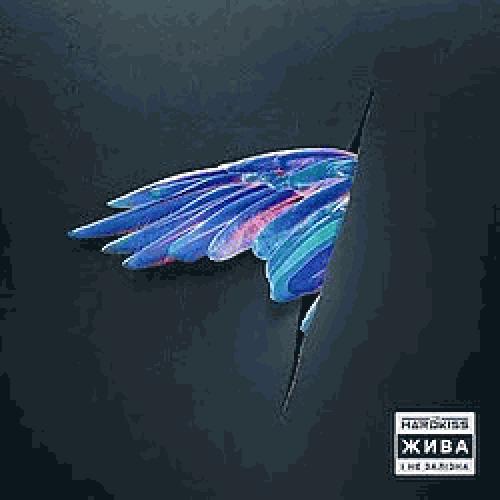
However, the Hardkiss’ third LP, “Alive and not Made of Iron” is the perfect place to start for a new listener, even though it’s the band’s only album sung entirely in Ukrainian. All previous albums already contained a lot of great songs and the band kept growing and improving their songwriting talents, but this LP represents a culmination of their efforts. To deal with the obvious first, the tracklist is lean and reasonable this time, featuring only 10 songs, but that’s not even the key factor in terms of going easier on the listener. For instance, the synth-pop mammoth that was the band’s first album was actually divided in two sections, “Hard” and “Kiss,” with the first one containing faster and energetic songs, and the second one focusing on romantic ballads. But that still did not really help to diversify the sound, as both faster and slower tracks were done in the same hyper-intensive, over-dramatic mood. Since then, The Hardkiss learned to alternate between various moods and styles for real.
Although, of course, there are still some classical guitar-based but synth-heavy The Hardkiss songs to be found here. These are extremely well-done, and you don’t have to wait too long for them to “work.” Probably the best feature of music like this is its inherent immediacy. Just wait for the first guitar riff of the opener “Alive” to hit supported by some very juicy synths and you should get hooked immediately, even before that big chorus arrives, propelled into stratosphere by the kinetic energy of Yulia’s gorgeous singing. About half of the album consists of these loud and plentiful rock songs, although the band already shows some variety here, alternating between bouncy pop-rock riffs of the first two songs and tracks like “7 Winds” (song No.3) or the especially catchy “Kobra” (song No.7), where the guitars are just as energetic, but lean more towards grunge.
However, it is the songs where The Hardkiss experiments with different styles that define uniqueness and greatness of “Alive and not Made of Iron.” One of the best examples is “Dahlia” (song No.4) where Yulia’s voice is calmly telling a story of a girl who loved the sea over ambient synths and acoustic guitars, while the drums are gradually picking up their speed and urgency in the background. However, just as you expect the song to explode with yet another bombastic chorus, the tension is released through a spry and memorable, but not pretentious synth melody that serves as a transition to the second chorus. Meanwhile, the drums maintain their nomadic rhythm, but the song retains its reserved nature. Only for the last section of the song Yulia speeds up considerably, delivering one of her most infectious vocal melodies in faster sequence, thus closing the song on a high note.
The band’s ability to subvert the listener’s expectations is one crucial factor for this album. The other one is lyrical content, although international listeners will of course struggle to appreciate that, but the lyrics still influence the album’s vibe and atmosphere, which is something you can get even without understanding the language. Like I said, Yulia’s lyrics are always decent, but until this moment they were always focused on rather trite subjects of romantic relationships and love (mutual or otherwise), which added an extra layer of excessive drama to already loud and bombastic songs. This time, however, there is a clear feministic theme running through the songs, and not in any blunt “girl power” fashion. Unfortunately, not every woman has that power. Not every one of them is ready to speak out and stand up for themselves, at least not on their own, without a helping hand. So, Yulia is speaking about those women in her lyrics, offering to become the voice of those who can’t speak for themselves yet, to be their sister, their source of inspiration and support. I believe that the subject explored in the lyrics this time had its own tacit influence on the songs, making them more versatile and inspired.
For my closing remarks, I would like to turn the reader’s attention to the two final songs on the album which are, in my opinion, particularly strong and appealing. Especially the penultimate song “Orca” that treats us to wistful guitar melodies, ambient soundscapes, and a story of a sad and lonely orca playing among the icebergs and dreaming of “fields beyond the horizons that she will never see.” At some point, the violin joins in as well, reinforcing the vivid imagery of “rainy cities and cosmic temples” that the orca is dreaming about. As for the closing song “Embraces,” it is a more traditional ballad, but its piano melody is extremely warm and sweet, as are Yulia’s vocals, more girlish than usual. She is singing about love again, but this time the feeling comes out raw and sincere, when it’s not buried under layers of synths and over-the-top singing. Indeed, the emotion beyond these songs feels more real this time, which is probably why this album is special to me. However, if you ever choose to give it a listen, you might end up wanting to explore the band’s other stuff, which is highly recommended despite all the flaws that I mentioned. The skill, the talent, and the passion were present from the beginning, it’s just sometimes there was too much of everything. Also, their first albums are sung in English, so you won’t have to deal with the language barrier. Still, “Alive and Not Made of Iron” just hits differently.