Review Summary: Through the threshold of the world
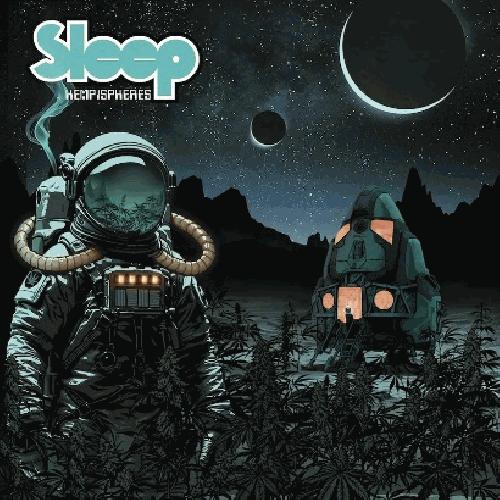
Across a span of three decades, Sleep’s back catalog represents near-apotheosis: Matt Pike’s massive guitar work and Al Cisneros’s pummeling bass as the two main forces holding the unsplittable atom of stoner metal together, at times achieving sustained hypnotic riffing even for hour-long compositions (dope!). The recent departure of Pike raised an almost existential question for the band, and whether it would even be possible to continue without such a fundamental part of its own (and a whole genre’s) identity. Eight years after the last full-length album, the latest record,
Hempispheres, undergoes a natural transformation and presents Sleep noticeably looser and more psychedelic, as they themselves discover what they might sound like in this new form.
Lineup repositioning finds Cisneros joined by guitarist Bubba Dupree (of the DC hardcore band Void) and Melvins drummer Dale Crover for a considerably altered, but also interesting equilibrium. The album’s title remains rooted in Sleep’s smoke-fueled cosmicism, a smart word play atop the band’s comically unchanging devotion to the thick clouds of the earthly cologne. Recordings also took place at the Melvins’ studio with longtime engineer Toshi Kashai, and the production reflects the inherent changes well. A bit cleaner than what the band has been so far, the record’s sound is more direct and has a slightly vintage, almost garage-like element that makes the new lineup approach even more distinctive.
As long as
Hempispheres plays, it feels like Ozzy Osbourne will start singing at any moment, as all the riffs in these tracks are, both musically and often lyrically, a spaced-out homage to Black Sabbath and especially Iommi’s foundational play style. Instead of Osbourne, what you’ll get is the familiarly detached, conversational singing of Cisneros that drives the record’s concept quite clearly, with a lot of hefty lyrical chunks for you to appreciate while listening to the fuzz. Sleep has always managed repetition well and there are not many attempts for dramatic contrasts here, as a certain temperature is established that provides an adequately pleasant experience when approached in the right state of mind.
Everything feels hazier, more laid-back, and the band’s known colossal guitar sound is no longer quite as dominant as in previous releases. Hence, there’s more room for psychedelia, the bass assumes greater importance, and melodies sometimes wander into vintage-rock territories. This is probably the closest Sleep has ever sounded to a heavier extension of Om, which is now basically impossible not to draw a correlation with. The opening “Have Spacesuit Will Travel” must be inspired by Robert Heinlein’s sci-fi novel with the same title from 1958, but also hints at Cisneros's new extraterrestrial comic book series, to be released later this year. The track appears restrained but aims to float with wonderful Sleep riffs at its core, even at this deliberately trippier and more relaxed fashion, as the whole album moves in the same manner.
Fluid grooves evolve and connect to the second track, “The Morrisist”, as the listener gets more and more accustomed to the band being less intimidating than before. Some of the record’s best moments can be found in the sequence of the third and fourth track, specifically the guitar solo on “Hempispheres”, and the semi-jam section that goes on at the second half of “Arrival of the Industry Ships”. The latter, at eleven minutes duration, effectively becomes a miniature voyage through the band’s new aesthetics. If you want to listen to one song from
Hempispheres, it can safely be this one. The band saves the best title for last, nicely named “Whole Weat Mountain / Well Baked”, another exercise in tension-building, rocky psychedelic doom. Guitars become more animated for a moment as the piece develops, but eventually drift away much like the disappearance of smoke after the party has ended, concluding things accordingly.
Taking everything into account, the incense is still burning but the walls don’t feel immovable anymore. Pike’s absence has inevitably changed the band’s physical impact, which is something I admit I missed from this album. At the same time, I enjoyed Crover’s rhythmically creative drum work, as well as the ample available space for the voice and bass to narrate the record now that there’s no absolute guitar force. It’s unlikely I’ll pick
Hempispheres over their classics, as it’s the least overwhelming and that’s mainly what I want to experience when I listen to Sleep. However, that doesn’t mean it is not a legitimate, well-thought work by committed musicians who evidently navigate a new era.