Review Summary: Heavier, not greater
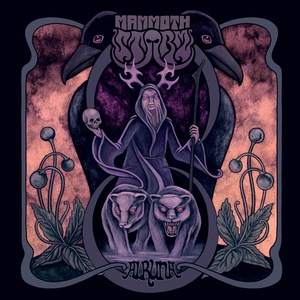
In the evolution of a band, progress can be a deceptive concept. It rarely follows a straight line from simple to complex or from raw to polished. More often, it manifests as a deepening of focus, a sharpening of familiar tools, or a newfound mastery of an already established language. Mammoth Storm’s second full-length album,
Alruna, represents this more subtle form of artistic growth. Released four years after their debut,
Fornjot, it does not attempt to reinvent the Swedish trio’s monolithic sound so much as perfect its delivery. The result is a more accomplished, powerful and finely detailed record, although one whose relentless pursuit of grandeur occasionally leaves the listener wishing for a few more memorable landmarks.
At its core,
Alruna is a refined continuation of the path established by
Fornjot. Mammoth Storm remains firmly entrenched in a fusion of sludge and doom, defined by glacial tempos and riffs that resemble tectonic plates shifting beneath the surface. The influence of drone is also present, though not in the minimalist, sustained-tone tradition of artists such as Boris, Earth, or Sunn O))). Here, it can be heard in the vibrating aftermath of each crushing chord: a textural layer that envelops the music in atmospheric fog while its central doom structures advance with deliberate force. This is music designed to be felt as much as heard.
The most immediately noticeable improvement lies in the album’s sound. Recorded by Johan Ericson at Dead Dog Farm Studio and mastered by James Plotkin,
Alruna grants the guitars the colossal scale they demand without allowing them to collapse into an indecipherable mass. Each distorted chord arrives with palpable low-end impact, while the separation between the instruments enables the listener to follow the subtle melodic lines woven through the heavier exterior.
The rhythm section benefits immensely from this clarity. Daniel Arvidsson’s bass supplies a seismic foundation, while Emil Ahlman’s drums sound massive and authoritative. Their deliberate, pounding patterns carry an almost ceremonial weight, lending even the most repetitive passages a sense of gravitas. Compared with the occasionally murkier
Fornjot, Alruna sounds more controlled and better equipped to communicate the physical power of Mammoth Storm’s music.
That clarity, however, is also a double-edged sword. While it allows the listener to appreciate the force of the performances, it makes the music’s inherent uniformity more apparent. The drums, for all their sonic might, rely on a relatively limited palette of patterns, creating a predictability that was easier to overlook beneath the rawer roar of the debut. Mammoth Storm knows how to construct an imposing atmosphere and produce riffs that feel heavier than lead, but the album’s greatest challenge lies in sustaining engagement across its considerable running time. Not every composition contains enough distinct ideas to justify its length, and passages that should deepen the atmosphere through hypnotic repetition can sometimes merely extend it.
Thankfully,
Alruna contains several moments that rise above this occasional inertia and reveal the possibilities within the band’s established sound. Fleeting melodic turns -some carrying a subtle middle eastern character- introduce an unexpected colour into its otherwise distinctly European doom palette. The spacious instrumental passage in
Shores of the Dead and the shifting textural outro of
Raven Void demonstrate an understanding of contrast. By allowing the oppressive atmosphere to breathe, these sections reform the surrounding mass and give the listener a renewed sense of discovery.
Such deviations are simply vital. They demonstrate that Mammoth Storm’s most potent weapon is not just the crushing riff itself, but the band’s ability to control the tension and release surrounding it. When
Alruna creates room between its heaviest passages, its scale becomes more impressive rather than less so. The weight acquires context, and the music feels purposeful instead of merely overwhelming.
Consequently, Alruna rewards patience. It is not an album that reveals everything in its initial phase. Its pleasures -the layering of the guitars, the force of the production and the subtle interaction of its melodic ideas- emerge gradually as the listener acclimates to its monumental pace. It is a more technically accomplished and sonically imposing work than its predecessor, finally achieving the clarity and scale that Mammoth Storm’s music always seemed to demand. Nevertheless, it does not possess as many indelible moments as
Fornjot or the concentrated two-part grandeur of the
Rite of Ascension EP.
What Alruna ultimately offers is refinement not revolution. Mammoth Storm has constructed a more imposing and carefully engineered cathedral of sound, but not every corridor contains something equally memorable. It remains an impressive structure -occasionally an awe-inspiring one- whose individual details do not always match the grandeur of its architecture.
Recommended tracks:
Giants
Shores of the Dead
Raven Void