Review Summary: A great effort that pushes the band into new pastures, but, like Hushed and Grim, misses the mark in places.
When Mastodon fired Brent Hinds in 2025, not knowing the facts about why they did it, I completely understood their decision. After all, as any long-time Mastodon fan can attest, Hinds was always a wildcard that brought an inimitable layer of complexity and allure to the band’s sound. The price for that element however was having the rest of the band constantly trying to rein him in. It didn’t take a documentary explaining why they fired him to know Brent Hinds was a free spirit and a feral party animal, it was obvious he'd pushed the other members to their limits and to me, if they kicked him out, there must have been a good reason for it. Yet, watching
The Mastodon in the Room and hearing the reasons why, with a timeline explaining where it all started going off the tracks, confirmed a lot of suspicions I’d had over the years. It’s a very raw and earnest film that shows the same kind of raw vulnerability Metallica’s
Some Kind of Monster had, really putting things into context as an observer. One of the most tragic and gut-punching moments was the reveal that they’d only faux fired him; the idea was to “fire” Hinds in an attempt to get him back on the right path, hopefully coming back into the band shortly after he’d straightened himself out. That, of course, didn’t happen, as Hinds died in a motorcycle accident shortly after leaving the band. Brent Hinds walked out of Mastodon’s practice space after being told the news and that was the last time any of them saw him. It’s really tragic stuff.
If you’ve not watched
The Mastodon in the Room, it’s worth doing so. Outside of the immediate drama, the documentary actually explains a lot about my feelings towards any record after
Crack the Skye. For me, the band peaked at
Crack the Skye – the album was a dramatic foray into this atmospheric progressive metal space that showcased their songwriting skills over instrumental proficiency (which, of course, the album also displays). After
Crack the Skye, the quality of their output is volatile, to put it lightly, and as the documentary touches on, a lot of that was down to Hinds’ commitment towards writing, something he started to lose interest with after the brutally taxing tour promoting
Crack the Skye. This left Bill in the driver’s seat, and I’ll be honest;
Emperor of Sand is the only album post
Crack the Skye coming close to that level of greatness.
Hushed and Grim has an album’s worth of solid songs stretched across a double LP,
The Hunter is a fun enough little album, and
Once More 'Round the Sun is their worst offering to date. Yet, in spite of Hinds’ commitment issues throughout his tenure, when he left the band – despite understanding the reasons why – I had genuine concerns for their sound, as Hinds brought such a unique skillset to the table and elevated and kept them away from being generic, even at their worst.
Nevertheless, the proof of the pudding is in the eating, as they say, so how does
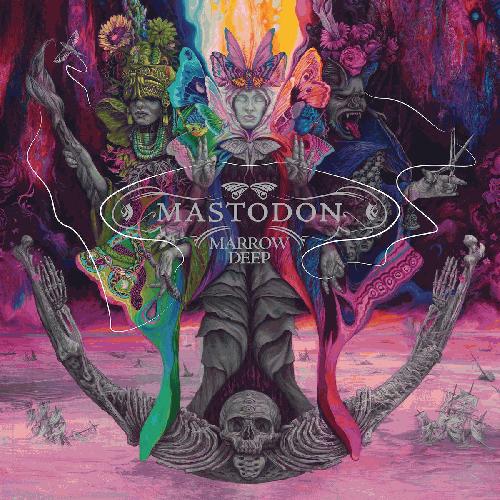
Marrow Deep hold up without Hinds? Well, as I said earlier, the admission of how little input Hinds had in the writing process of recent albums genuinely explains a lot about the apathy I’ve had when listening to recent Mastodon music. Even though
Hushed and Grim had flashes of amazing moments, the energy felt off-puttingly flat throughout most of it and missing that spark of magic
Blood Mountain had, say.
Marrow Deep isn’t a bad album by any stretch of the imagination, but it doesn’t come anywhere near their best work. It’s an interesting progression for the band as it incorporates a lot of psychedelic and classic 70’s progressive rock and metal tropes, with synths playing an eminent role in the album’s overall sound. “The Vanishing”’s reverence for Black Sabbath’s 1970 debut,
Black Sabbath, is palpable and does a great job of integrating that influence into the band’s sound; it’s easily the best track on here and does a good job of encompassing everything the record sets out to achieve. “The Three Fates” draws from a wealth of ideas, most pertinently Rush, King Crimson, and Yes, creating this glorious closer: a fantastic journey with moody, celestial passages with plenty of heavy grit thrown in there to make a very satisfying conclusion. The Dream Theatre styled riffing in “Your Ghost Again”, the Genesis-tinged synths dotted around songs like “Out Like a Lamb”, “Moth and Bone”, as well as the classic synth-y sound on “Snakes for Dinner” – it all does an excellent job of capturing the 70’s zeitgeist well here, and doesn’t feel gimmicky.
Unfortunately though, like
Hushed and Grim, there is a core component missing here that doesn’t resonate with me like their earlier works, and the more I look into that reason the more I realise it was Hinds’ contributions that made the band interesting. I didn’t really pay much attention to the writing credits or vocal contributions of
Hushed and Grim at the time, but it’s only recently occurred to me that Hinds only sings on two tracks for that record. With Hinds not present here too it really contextualises why their last couple of albums felt a little off to me. Given the situation and what the band have gone through, it feels awful and rather obvious to highlight Hinds’ importance in the band and the inimitable dynamic those three vocalists made, but for everything
Marrow Deep gets right, it’s still missing that special piece to bring it all together.
Marrow Deep is a solid effort from a venerable act, with fantastic musicianship and some great new ideas to move the band forward, but for me personally, it doesn’t quite land like it should.