Review Summary: The most refined Thurnin sound yet.
Who’s played
The Legend of Zelda: Majora’s Mask? Even back when it first came out, my thirteen-year-old self always thought it stood out as a tenebrous, misunderstood masterpiece. The game went into development as an expansion for
The Legend of Zelda: Ocarina of Time during the last gasping breaths of the N64’s life, under the title
“Gaiden” for the failed N64DD hardware. When the writing was on the wall for the N64DD, the game was scrapped and director Eiji Aonuma was given the challenge of delivering a standalone The Legend of Zelda title in just twelve months. Despite being under the cosh Aonuma not only accomplished his goal for Nintendo, he created, arguably, the greatest The Legend of Zelda game in the entire series. Obstinate and complex, especially if you were playing it back in 2000, it certainly wasn’t for everyone. Couple that with its desperate and bleak tone, psychological horror lashings, philosophical themes of grief and loss, and its omnipresent existentialism, and you can see why it was a game years ahead of its time; a masterpiece overlooked by poor timing and niche game design.
Of course, I’m sure that after reading a paragraph of me waxing lyrical about my favourite TLoZ game, you’re probably asking yourself why the hell I’m rambling on about a twenty-six-year-old game instead of Thurnin’s latest escapade. Well, the reason is because
Majora’s Mask plays a central role in
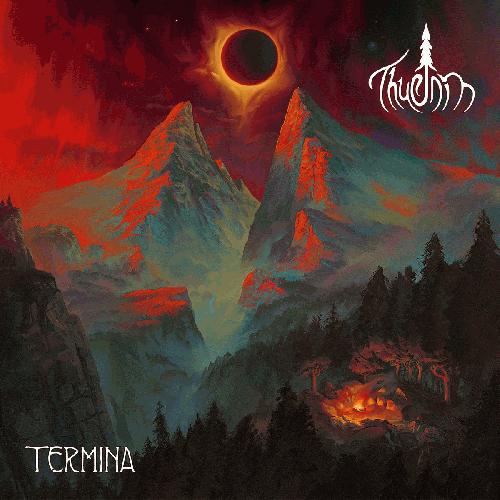
Termina’s creation. Aesthetically the gorgeous artwork and album title are obvious references to the game, as well as the album’s brooding sonic palette, but outside of this surface level analysis, if you cut through the weeds, the word “termina” means “end”. If you follow Jurre’s goings on via social media, he has transparently affirmed this could be the last album he ever releases in a professional capacity, throwing every ounce of creative energy he has into the project and seeing where the chips fall. For me I’ve followed Thurnin’s journey since 2023’s
Utiseta, and if you look at the scores I’ve given both
Utiseta and
Harmr it’s plain to see I think very highly of the work produced thus far. These two albums, as well as Jurre’s solo album
Fragmented, present a musical growth of micro progressions, refining his solid framework and delivering a slightly sharper experience than the last. Which probably goes without saying at this point, but if you never gelled with Thurnin’s scintillating brand of emotive dark folk, the likelihood is you won’t be won over here either. Nevertheless, if you’re a fan of this Dutch legend’s style you are about to embark on the most comprehensive iteration of his sound to date.
Not to dwell too much on the influences of
Majora’s Mask, but it’s such a perfectly fitting game for Thurnin to base his own ideas around, as that game’s themes of isolation, loss, grief, and death have always been core maxims of Thurnin’s work, which is probably why
Termina does such a resounding job of capturing everything Thurnin is about. It’s a perfect synergy of vast soundscapes – rich, haunted vistas with storied histories – being underpinned by a complex narrative that runs for sixty-three minutes. This is a long album that requires a level of tenacity from its listeners to get the most from the overall experience, but believe me when I say the rewards are profuse if you stick with it. Put succinctly;
Termina reflects on everything Thurnin has accomplished, rooting its sound in the quaint, parochial forests of
Menhir and marrying it with the expansive colour and flair of recent records. As I touched on earlier, it’s not something that breaks the mould, but it is the most definitive Thurnin experience you’re going to hear. The overall mood on this thing is easily my favourite of the four LPs – it's the most downcast, crushing and melodic, juxtaposed with this reverie-like quality which anchors the sound from falling into the abyss. It's difficult picking out any one track from this album as it flows so seamlessly.
Harmr was of a similar disposition, but there were at least songs you could potentially pick out and use as “singles”, whereas I feel like separating anything from this body of work becomes a disserve to the magic
Termina holds. There’s more emotive vocal harmonies on here, more gorgeous wind instruments and string arrangements, a heavier focus on mood and melody over the more riff-heavy approach of
Harmr, and a consummately paced record that makes this hour-long journey feel half the time. You can tell a lot of effort went into the arrangements, with effective peaks and troughs that ebb and flow throughout each track, keeping you engaged.
True to its name, without trying to sound hyperbolic, there is a sense of finality to
Termina; it feels like the end of an era.
Termina is the kind of record you get from a band that’s been in the trenches for two decades and many albums later, serving up a sound that blends the best parts from previous successes. The songwriting here takes the DNA from the last three albums (as well as
Fragmented) and delivers the highest-calibre songwriting devised by Thurnin up until now.
Termina basks in Thurnin’s humble beginnings but is always navigating forward while doing so. I really hope this isn’t the last we hear from Jurre or this project, but if this is Thurnin’s swansong, it’s one hell of a way to walk out the door.