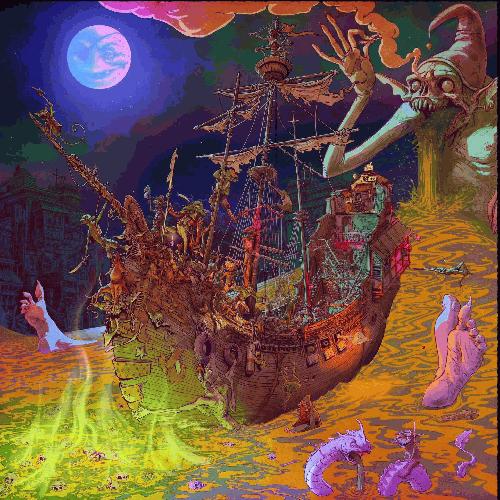
Review Summary: Let’s address the (secret) elephant in the room.
Since I broke my own prejudice and reviewed an EP… why not another? Yeah. Looks like the floodgates are open.
After Power, it makes sense to look at Boiling Sea, another short release by Nekrogoblikon that, much like its “brother,” works less as a definitive statement and more as another major transition.
But this time, the transition is far more delicate.
Boiling Sea arrives at a moment when the band loses not only its vocalist, but also a significant part of its creative core. And for any band, especially one with such a specific identity, that’s not a minor detail. That’s real risk.
Replacing a vocalist is already complicated on its own. It’s not just the voice that changes: the songwriting dynamics shift, the way choruses are built changes, the presence in the songs evolves, and, most importantly, the way the band communicates with the listener is affected. When that departure comes with a deeper creative disruption, things get even more unstable.
The danger is clear: losing identity and creativity.
Bands going through this kind of change often end up sounding generic — or worse, like watered-down versions of themselves. In Nekrogoblikon’s case, the risk is even higher, because much of what makes the band work lies in the balance between technique, humor, and composition. Something that depends directly on who’s behind the ideas.
So Boiling Sea is not just another EP. It’s a survival test. It’s the moment where the band needs to prove it can still be… itself.
And Nekrogoblikon’s answer to this situation couldn’t be more… peculiar.
Instead of simply replacing the vocalist and moving on, the band takes a curious approach: they establish two vocalists. And this is where things get even more interesting.
The new “human” vocalist, Dickie Allen, handles the aggressive side — growls and the more traditional extreme metal approach. Nothing unusual there. But on the other end, Nekrogoblikon makes a move that is both unexpected and completely in character: John Goblikon (portrayed by Grady Welch), previously a mascot and visual centerpiece, is promoted to official vocalist, taking on the clean and melodic parts.
Yes. That’s exactly what happens.
And, unsurprisingly, it works.
First, because it solves a structural problem: the band doesn’t try to replace what it lost, instead it reorganizes roles. Second, because it reinforces Nekrogoblikon’s unique identity instead of diluting it. And third, because this split allows each vocal style to do exactly what it needs to do, without compromise.
Of course, the risk is still there. This could easily have turned into something forced (too much gimmick, not enough music). But the real merit of Boiling Sea is showing that the band still understands where the balance lies. What looked like a crisis ends up becoming… just another strange (and insane) chapter in Nekrogoblikon’s own internal logic.
But what about the impact of losing a major part of that creative core with the departure of Nicky Calonne? That was always the biggest question mark.
That concern began to fade in 2025 with the release of the singles “Show Me Your Goblin” and “Fiends.” The former showed that Alex Alereza’s technical aggression and melodic riffing remain sharp, while Dickie Allen’s vocal intensity fits perfectly within the band’s goblin aesthetic, and John Goblikon handles the clean vocals surprisingly well. The latter reinforced that, even under a new dynamic, the band’s melodic and theatrical essence remains intact, still guided by Alereza alongside Aaron Minich.
Two strong singles can build hype, but they don’t sustain a narrative on their own. That’s where “Secret Elephant” comes in.
This track is the real highlight of the EP.
It’s a strange song — it takes a moment to adjust to the in-your-face ska elements. But once it clicks… it clicks hard. The track has groove, weight, melody, and, above all, personality. What really stands out, though, is the completely unexpected feature with Reel Big Fish. Ska and goblin metal? On paper, that should fail.
It doesn’t.
On the contrary, the feature fits surprisingly well, adding a layer of irreverence that aligns perfectly with the band’s DNA. It doesn’t feel like a gimmick thrown in for attention. It feels like a natural extension of Nekrogoblikon’s chaotic, self-aware identity.
“Closer to the Sun,” “Dead-ish,” and “The Boiling Sea” form a solid block within the EP. They’re not the absolute highlights, but they’re far from filler, interesting tracks that help sustain the record and give consistency to this new phase.
“Closer to the Sun” stands out through contrast. The foundation is still heavy, but the chorus leans unapologetically toward a more accessible (almost pop) direction. And it works. It works well.
“Dead-ish” takes a safer route. It doesn’t hit as immediately as other tracks, but it delivers consistency: strong groove, balanced vocal dynamics, and a performance that reinforces the idea that this new lineup knows what it’s doing.
“The Boiling Sea” is perhaps the most curious of the three. The clean vocals immediately stand out — they sound strikingly similar to Johannes Eckerström of Avatar. It’s genuinely surprising on first listen. The tone, delivery, even certain inflections feel very close. Most likely just a coincidence, but a welcome one, especially if you’re a fan (I am by the way).
In the end, the departure of Nicky Calonne could have been a much heavier blow. Instead, Nekrogoblikon responds with reorganization, identity, and, above all, a clear willingness to move forward without losing itself. Not everything here hits perfectly, but enough works to make it clear the band still knows what it’s doing.
Boiling Sea is not the strongest release in their discography, but it’s far from a minor entry. It’s a document of adaptation. A cautious, yet firm step forward. The band is still adjusting… but it’s definitely on the right path.
I wouldn´even bother reviewing the live tracks. They’re clearly filler. But what stands out, unfortunately, is Dickie Allen’s performance. It sounds aggressive to a fault, to the point where clarity suffers and parts become hard to understand. This becomes especially evident in “This Is It,” where the vocals feel out of place, too harsh for a more restrained, melodic track.
It’s a bit puzzling: it works in the studio, but here it comes off unbalanced. Why? I don´t know, but it was a little bit frustrating.