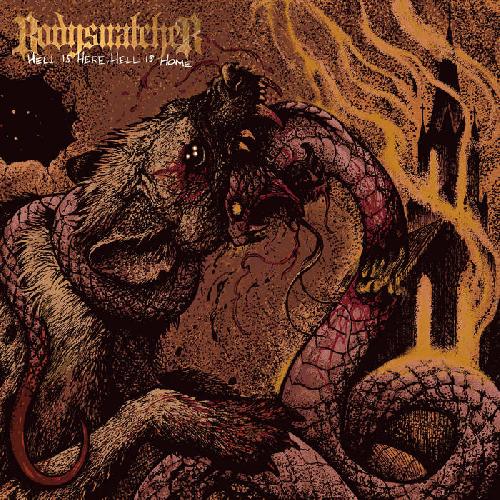
Review Summary: Blunt force catharsis.
I like to feel the full spectrum of emotions while listening to music. It’s important to experience that range to stay balanced as a person. What are life’s triumphs without its tragedies? Just as important is finding a release for those emotions, and music can be one of the most effective outlets. For music aficionados, it’s common to match what you’re listening to with how you feel. There are deep psychological reasons for this, but it often comes down to understanding and catharsis. Albums can provide a space to mentally unload your emotional baggage, making it easier to process and move forward. You’re allowed to feel heard without judgment, which is a big part of why music is so personal. My last review covered the latest Twilight Sad album, a deeply moving piece centered around the loss of the lead singer’s mother to dementia. If that record was pure sorrow in musical form, then
Hell Is Here, Hell Is Home is pure rage.
There are a lot of different interpretations of what the ideal expression of rage in music looks like, but I tend to lean toward something in the vein of Bodysnatcher. Musically, it’s almost entirely pummeling chugs, beefy, bass-heavy production, furious callouts, and towering breakdowns. It’s a classic case of simple but effective. If you’re thinking of mid-era Acacia Strain for comparison, you’d be right. They share so much musical DNA that they feel like cousins. Vocalist Kyle Medina delivers his shouts and lower growls with a comparable raw power to Vincent Bennett. The real connective tissue, though, is their shared love of beatdown hardcore. Hell, Scott Vogel, the legendary frontman of Terror, even shows up for a memorable feature, complete with a two-step, which tells you exactly where this band is coming from. Blending that influence with downtempo deathcore feels completely natural, acting like a steroid boost to a genre already defined by aggression. Sure, it’s pretty one-note, with only a few moments of respite, but its workmanlike approach does exactly what it sets out to do in an efficient 34 minutes.
That, of course, is being as pissed off as possible. Yet another aspect Bodysnatcher shares with The Acacia Strain is their penchant for lyrics centered around misanthropic fury, with opening track “The Maker” serving as the album's thesis statement. It posits that humans are violent by nature, tracing that violence back to our shared ancestry with Cro-Magnons and early hunters. It’s a straightforward, savage rejection of the evils of modern society, which the album expands on through loosely connected stories of contemporary monsters. “Two Empty Caskets” deals with a drunk driver killing someone, “May Your Memory Rot” touches on absent fathers, “Violent Obsession” centers on domestic abuse, and no deathcore record would be complete without an anti-religious anthem in “No Savior.” These are different expressions of violence, often told from the perspective of the enraged, offering the listener a chance to participate in a kind of righteous anger. There’s a clear logic to the pairing of the caveman-esque musical punishment with lyrics that hit as bluntly as a bloodstained hammer.
Much like people seeking emotional release, the music itself relies on that same kind of release. It builds tension that feels ready to snap at any moment. The musical equivalent of that release is, of course, the breakdown. No strain of hardcore exists without them, and Bodysnatcher has a keen ear for writing effective ones. The callouts here are not easily forgotten. Dynamics are used in a straightforward but effective way, with songs often slowing to a crawl before delivering a raw, vulgar vocal punch or abruptly picking up pace. “The Maker” features a section near the end that cuts to an isolated chug, drops into pure silence for a few seconds, and then builds back into a nuclear breakdown. During the escalation, the song asks “Are you scared?” before hitting with “You ***ing should be.” It does not get much more primal than that. That track is not alone, “Violent Obsession” ends with “You are nothing but a ***ing crime scene,” and my personal favorite line appears in “May Your Memory Rot”: “Happy Father’s Day Mike, *** you.” That personal edge makes it a line that I will remember for a long time. The production is deliberately hulking and overbearing, the kind of artificial weight that perfectly suits the obscene energy of the lyrics, with breakdowns that land with the force of a concussive grenade.
Hell Is Here, Hell Is Home isn’t trying to push boundaries or rewrite the playbook. It follows the tried-and-true formula of beatdown and downtempo to a tee. In that sense, it’s the Iowa football of music. You know exactly what to expect every year under Kirk Ferentz: ground and pound, a strong offensive line, great defense, and disciplined fundamentals. It might not earn widespread critical praise, but there’s a real beauty in that kind of consistency. This is a basic formula, refined to a sharp edge. It sets out to be heavy and angry, and nothing more. Mission accomplished. We might be living in a golden age of beatdown, with its brute force pushing into more corners of heavy music than ever before. So the next time you’re having “one of those days,” as Limp Bizkit once put it, reach for
Hell Is Here, Hell Is Home, and break something.