Review Summary: Dam-dam.
I don’t really like to judge a book by its cover, and I think Sputnik user base is particularly prone to paying too much attention and spitting too much venom about album covers. In my opinion, musicians don’t have to be connoisseurs of all forms of art. Their responsibility and my main investment as a listener is the quality of music they create. Cover art, good or bad, is an issue of tertiary importance at most.
That being said, sometimes an album’s package can tell you a lot about what’s inside. In Mika’s case, his album sleeves always tell you honestly what kind of music is contained therein. His early releases were adorned with these multicolored, garishly bright covers, proudly screaming the word “MIKA” in your face in white caps. And the music was up to par: all over the place, often wildly inconsistent, but always earnest and colorful, calling cheerfully for the listener to join the party. Later on, when Mika tried to show us the other side of that neon brightness, black-and-white palette started to prevail on the covers as well. What’s important is that while none of Mika’s albums up to this point were models of consistency, they all contained at least several genuinely great songs and certified hits.
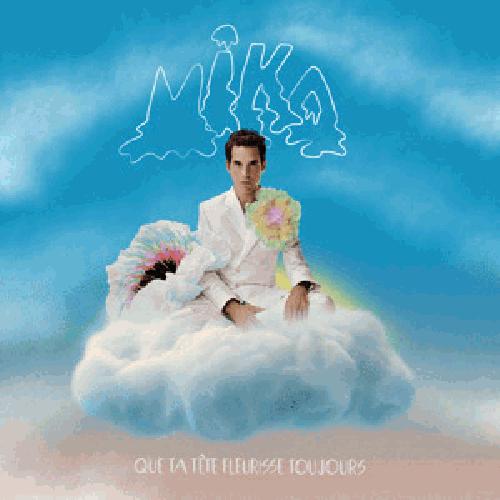
This one, however, is different, and that difference is apparent even before listening, if you take a good look at the cover. For one thing, this time Mika is sitting on a cloud, perfectly blissful and content with white and light blue colors dominating the picture and projecting a picture of total complacency. Secondly, his face on the cover is not exactly blurred, but sort of smoothed out in a strange way, so that you can of course make out its basic features like eyes, nose, and mouth, but none of the small details that define uniqueness of every human face. Normally, if Mika puts his face on the cover at all, it displays some emotions. This time there’s just blankness.
Well, I can congratulate Mika on one thing: for the first time in his life he has reached almost full consistency within a space of one single album. “Que la tete fleurisse toujours” contains eleven pleasant, sweet, and completely unremarkable songs. They blend into each other, they are fine while they’re on, and you forget them even before they are over. If you were wondering why I’m spending so much time talking about album covers, it’s because there’s not much to say about the actual music that Mika gave us this time. His decision to sing entirely in French is what prompted me to listen to this album when it was released. I’ve been trying to learn French properly for several years now, and since French metal bands staunchly refuse to sing in their native language, I guess a British pop artist has to carry that flag. But beyond that linguistic gimmick there’s almost nothing interesting or memorable about this album.
But not all is lost! The album’s lead single and statistically by far the most listened to track “C’est la vie” is extremely memorable, and I mean it in the worst way possible! Its memorability is related to the fact that it contains one of the most primitive and annoying choruses/refrains this side of Iggy Azalea’s “Bounce in the mother***ing house.” I felt my brain hammered into mush while I was listening to this exercise in mindless repetition, but that’s not the worst part. The worst part came after I was done with the song, because it wasn’t done with me. As you can probably guess…
It got stuck. In my
big dumb head. For days.
And yet, even that
wonderful impression evaporated eventually, leaving behind nothing but mild irritation and puzzlement. Yes, this album is consistent, but this is consistency of vapid plain porridge spread evenly over the surface of a plate. It’s edible, yes, but hardly nutritional or appetizing. If you don’t mind mainstream pop, you can find some fun in every other Mika album, but this one is a complete waste of time, unless you want to learn some basic French words and expressions in a digestible form.