Review Summary: This review may contain a lot of words.
We live in distressing times; constantly bombarded with bad news from all over the world, feeling obligation to follow up on the latest technological breakthroughs, still —still!— trying to make sense of a post-pandemic, climate-striken world, trying to navigate personal hardships, the list goes on: the world feels and, in a sense,
is uncertain. And uncertain times require hope. RAYE is aware of that and suggests that music can act as medicine, as hope!, for our troubling epoch. The medicine proposed:
THIS MUSIC MAY CONTAIN HOPE. — in all-capital letters, which is quite suitable for such a bold record. There are tempo changes, genre shifts, thunder cues and wolf howls, narrations and spoken-word verses, meta-commentaries and large ensemble vocals, all of it punctuated by forays into big-band and soul, occasional R&B concessions and RAYE’s ever-present flair for theatrics and stupendous performances. There are enough aesthetics and ideas, sweeping Hollywood strings and brass sections that could fill out a dozen other albums and, during
THIS MUSIC MAY CONTAIN HOPE.’s 73-minute duration, they pose more aesthetic enjoyability than consistently substantive engagement.
This thing is huge — and not just in terms of length; RAYE shoots for the stars here, with big musical grandeur and emotional gestures.
THIS MUSIC MAY CONTAIN HOPE. is a difficult album to unravel; similar to last year’s
LUX, there’s an austerity and rigor to its orchestral leanings and songwriting that seems almost impenetrable. Both albums are dense and sprawling; in total contrast with the mainstream’s penchant for standalone bite-sized thrills (*insert any recent pop record*), they reward front-to-back inspection. No matter how good their singles sound (which, for the record, they do), their grandeur doesn't make
complete sense outside the context of their respective albums. Thus, a breakdown is in order;
THIS MUSIC MAY CONTAIN HOPE. ostensibly structures itself around “four distinct acts”, representing the different seasons. Such a division however is too nondescript, since the album’s sonic and lyrical language bears many similarities across the supposedly different chapters. Fear not, dear reader(s), for the necessary unravelling is about to commence:
PART I: Heavy is the burdens that are weighing on me
Life’s hard, man! Just ask RAYE; her debut
My 21st Century Blues detailed an array of struggles, from climate crisis (‘Environmental Anxiety.’) and spiking (‘Black Mascara.’) to substance abuse (‘Mary Jane.’, ‘Escapism.’) and sexual harassment (‘Ice Cream Man.’), wrapped in shades of house music, R&B, blues and jazz. Her pen was candid and direct when it came to her anguish, her surrounding music was catchy and tasteful and her voice front and center in its versatility.
THIS MUSIC MAY CONTAIN HOPE. is no different. Every track here finds RAYE still aching; heartbreak is all-pervasive, but so are odes to struggles that were more eloquently put together on her debut. Case-in-point: ‘I Hate The Way I Look Today’ tackles body-image issues under a retro swing costume, all saxophones and call-and-responses; a pale echo of her disarmingly honest and uncomfortable ‘Body Dysmorphia.’, RAYE spends much too much time in slang-heavy lyricism (“It's giving trainwreck, it's giving unfortunate”) and vague descriptions to make this juxtaposition work. Similarly, finding solace in alcohol (“Tonight, I kissed a bottle on the lips”) was a theme explored in
My 21st Century Blues in far more competent (and memorable) ways than the forgettable pop-R&B dirge of ‘Winter Woman.’.
Still, heartbreak is all-pervasive and RAYE’s heart is calcified by its presence. Disappointed by modern dating (‘Beware… The South London Lover Boy.’, The WhatsApp Shakespeare.’), hardened by romantic loss (‘Goodbye Henry.’) and exhausted by social media (‘I Will Overcome’), RAYE just can’t catch her breath. High heels clatter all over ‘Click Clack Symphony.’’s escalating tempo, which is the culmination of RAYE’s cyclical depressive state, locked inside her house and in dire need of her friends.
THIS MUSIC MAY CONTAIN HOPE. spends a lot of time (mostly in its first half) in a fake smile, constantly convincing itself and its audience that everything is going to be alright, yet its tone is ice-cold and gloomy, lacking in descriptive language (‘I Know You’re Hurting.’’s balladry scans as a nice yet vague gesture) yet overflowing with general mantras (‘Life Boat’’s out-of-nowhere deep house aesthetics make the limited lyrics stick out more; ‘I Will Overcome’’s chorus). Suggesting that RAYE isn’t being genuine in her attempts to offer solace to any listeners afflicted by similar struggles is a big stretch. But where
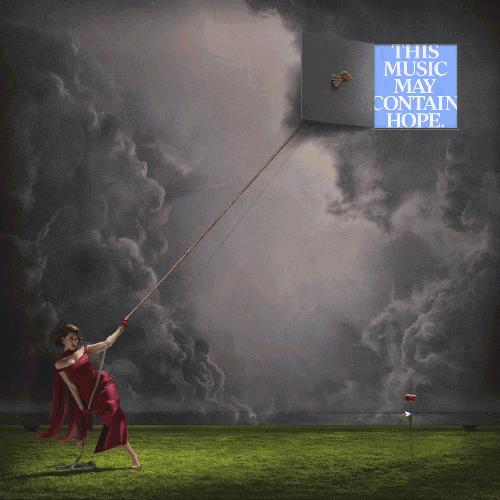
My 21st Century Blues was visceral, unflinching and hyper-specific (not to mention, consistently catchy), her sophomore record’s efforts to clear out the gray clouds of the album cover come off as broad strokes rather than thorough wipes.
PART II: Every burden that weighs on me will fall away like a soft rain
But there’s hope, right? Indeed, it’s right in the title. Every track here finds RAYE searching for those elusive silver linings. The one-two gut-punch of ‘Goodbye Henry.’ and ‘Nightingale Lane.’ are foremost in that regard. The former finds RAYE reflecting on a painful breakup in hopeful terms; despite the future she envisioned with this partner and the love she still has for him, she bids farewell, wishing love and happiness and realizing that things don’t always work out the way you imagined. “And I guess sometimes that's just how it goes / Sometimes love sticks around / And sometimes love hits the road” — what a refreshing, mature point of view, wrapped up in a beautiful, soul-infused, Al Green-assisted number. The latter charts similar lyrical territory but brings even bigger pathos(!); ‘Nightingale Lane.’ might bear her most impressive vocal performance in an album full of impressive vocal performances, backed up against a classy orchestral instrumental that turns almost opera-esque in its cathartic final moments. The aforementioned ‘Click Clack Symphony.’ is the apex, a reminder of sisterhood (the titular “click-clack”s of their heels) as a lifeline whose larger-than-life production actively recalls Hollywood; its
ft. Hans Zimmer tag is quite needless as his fingerprints are all over the track.
In contrast to the more fake-it-till-you-make-it moments on the first half of the album, the far-superior back-half is similarly occupied with words of affirmation (see also: ‘Happier Times Ahead.’’s title is repeated ad infinitum) yet transcends their tedium through more tangible, descriptive lyricism. ‘Fields.’’s ode to family and lasting memories (featuring her grandfather) and ‘Joy.’’s testimony to spirituality as a guiding force (featuring her sisters) are on polar opposites of the musical spectrum; the former’s a ballad, the latter’s a mix of soul and dance sections. Both, however, are pretty in their own right and find RAYE reaching a state of calm, finally exhaling.
We’re okay and even when we’re not, better times lie ahead of us — a sentiment reinforced by closer ‘Happier Times Ahead.’. Actually, no- *checks notes* ‘Fin.’ is the closer (!), a six-and-a-half-minute recitation of the album’s credits (no joke) and a thank-you (and a please-listen-to-the-album-again-and-again) to the audience backed up against a whimsical orchestra.
Ambitious is an apt descriptor for RAYE’s second album, but I can raise you one better;
THIS MUSIC MAY CONTAIN HOPE. is indulgent. RAYE chases *everything* all at once in order to give her admittedly boundless personality and talents a musical and lyrical backbone that best resembles her. There's a charm in that indulgence, mostly because RAYE is a wonderful captain on this ship and her admiration for all these influences is genuine. Look no further than ‘WHERE IS MY HUSBAND!’; no introduction needed for this instantly hooky anthem, chock-full of big-band and pop-soul influences, detailed production, humorous, blink-it-you-miss-it verses, an addicting bridge and a killer personality brimming on top of it. Such a sprawl and rebellion against editing is a burden, however. The first half of this album (or, erm, I guess its first two acts) comes off as superficial and shapeless in its descriptions of mental anguish (“I hate the way my arms do this / I hate the way my legs do that”). The album’s lyricism is sometimes too kitsch and reliant on slang to land as tastefully as its ornate production does and the overuse of narrations and meta-references throughout is often distracting and threatens to throw great songs off (‘Click Clack Symphony.’ and ‘I Will Overcome’ are the biggest examples). There’s an allure to those human flaws, but their constant presence is less quirky and more annoying, hurting the replayability of the album and its individual tracks. Toning those elements down and trimming down its tracklist would greatly benefit
THIS MUSIC MAY CONTAIN HOPE., but would it make for a RAYE record? Honestly, I’m not sure; heavy-handed solace through difficult times is part of RAYE’s brand and that can be critiqued for sure, but I don’t think it can be taken away from the complete package.
Sounding like a classic and being a classic are fundamentally different and this veers towards the former. Its musical ideas are grand, Hollywood-esque and executed to mere perfection, a wonderful enamoration with jazz and orchestral pop; another mention of RAYE’s killer vocals is needed, as she shapes them around many different genres in the blink of an eye. Yet many of its songs, by fault of the writing, will remain stuck in 2026 for their dated metaphors and overbearing, ham-fisted approach to their themes.
THIS MUSIC MAY CONTAIN HOPE. is unapologetically big and does contain
several moments of hope: not only that happier times are approaching, but that RAYE, signified by the album’s numerous bright spots, still has what it takes to craft timeless music.