Living in 2015 and being cognizant of the wider state of world politics, you could feel the very ground beneath you slowly begin to shift. The UK, having endured 5 years of unrelenting austerity, had few parts left to strip. Regardless, the Tories were given a mandate to keep the project going for a few more years. We were told by the press that if Ebola didn’t kill us, ISIS definitely would. There was a terror cell in every city and even your small market town. Maybe they’re operating in the flat below, maybe you should be more scared.
Two year-old Syrian refugee Alan Kurdi was found face-down on the beach of Turkish town and resort Bodrum. The world was outraged for the length of a news cycle but indifference soon took hold. By this point, we were used to daily stories of displaced refugees dying fleeing a war of our own nations’ making, could we really get
too upset over another? Besides, we were too busy turning those lucky survivors into folk devils and convenient culprits behind disappearing jobs and public services, thanks to the populism the UK had by then become a breeding ground for. Fascism was bubbling just beneath the surface and we were inhaling its acrid fumes, as /pol/ and similarly fringe corners of online media began to set the precedent for the next 10+ years of political discourse.
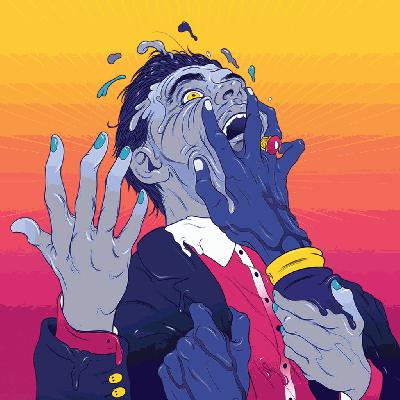
It seems impossible for any single artistic statement to begin to encapsulate, never mind explain, the litany of horrors and growing unrest of 2015. Get to Heaven, written primarily in 2014 and aptly described by frontman and lyricist Jonathan Higgs as “a horror bible”, somehow manages it. Not only that, but it raises the red flag for the cataclysmic year that was 2016, where the seeds of populism truly began to bear fruit. Ultimately, Jonathan wanted to document the simmering unrest he felt as society became further polarised, atomised and vulnerable to the grifters we live with today. For every person defeated and stunned into submission, another was becoming radicalised.
“But it’s interesting to look at those two sides: apathy on one side… and on the other side some people are willing to kill themselves.” - Michael Spearman (2015).
Everything Everything didn’t have the answers and had always shown some reluctance to pin the colours to their mast as a ‘political’ band. Reading interviews from the time, there is a palpable hesitance at the prospect of being perceived by the listening public as preaching to them what to think or how to live their lives. Conversely, it is equally apparent that Jonathan Higgs in particular became galvanised by the landscape around him, spurred out of complacency.
“There’s too much crazy shit going on right now and I have to reflect it somehow” - Jonathan Higgs (2016).
Understanding the world around you, or at least
trying to understand it, requires empathy. This can be particularly difficult for some when that requires empathising with those we’ve ostracised or turned our backs on, those we know to be ‘evil’ and would rather forget about. The virtues of empathy are extolled when we’re empathising with someone we can agree is worth empathising over, but what happens when we want to look across the aisle? Putting yourself in the shoes of, for instance, a terrorist can no doubt be an uncomfortable place for a writer, perhaps a dangerous exercise. What if you begin to understand them too much? What does that say about you and how can you rationalise your hatred for someone who, just like you, is a victim of circumstance? If you were pushed far enough, could you do something terrible? Get to Heaven stares unflinchingly into that abyss and is one of the few pieces of popular media in the 21st century, alongside Chris Morris’ Four Lions, willing to humanise a terrorist as a means of understanding their motives and how they were manipulated into doing the unthinkable.
“I’d rather try to understand it, doing awful things… do we bomb these people or try to listen to them? Could something happen to me that would ever put me in that position?” - Jonathan Higgs (2016).
Get to Heaven’s lyrics are dense, heavy and morally ambiguous. Higgs’ lyrics on 2010’s Man Alive and 2013’s Arc dabbled heavily in themes of depression, desperation, environmental collapse and alienation, explored through his unique turns of phrase and delivered with his characteristic quick-fire falsetto. Get to Heaven ups the ante in every regard, broadening its scope from the personal to the societal. On Warm Healer and Fortune 500, the recurring motif of feeling “split in half”, into two irreconcilable parts, perfectly conveys the aforementioned sense of polarisation, between being beaten into inaction and taking extreme action. Get to Heaven and Blast Doors paint a scene where modern life becomes war, when your peace of mind is constantly under siege and you become conditioned into hypervigilance, always looking for the next threat. Suddenly, the everyday feels less like moments of mundanity punctuated by bouts of terror and more like prolonged exposure therapy to increasing horror.
“People react to it because they get the same feeling I had of taking away the safety net.” - Jonathan Higgs, on Get to Heaven’s songwriting (2025).
Get to Heaven’s wider anxieties are often refracted through the prism of the personal, providing Higgs with the means to explore long-held fascinations like the fear of ageing, longing for youth and the deep-seated dread that
this is all your life will ever be. For all the lofty concepts Higgs introduces as a framework through which to explore wider societal woes, the listener often walks away with the sense that, beneath the surface of anguish at societal polarisation (Get to Heaven, A Fever Dream), the irreparable damage caused by corporations’ search for endless growth at the cost of all else (Mountainhead) and the reliance on technology as a means to obfuscate trauma (Raw Data Feel), Higgs is really singing about himself. His intensely personal writing grounds all of Everything Everything’s music and provides a base through which listeners can explore their own anxieties. Higgs’ fears are universal and his unwavering romanticism permeates everything he does. The overwhelming impact of life’s ugliness, terror, beauty and the desire for basic connection culminates here in the elegiac Warm Healer.
“Babe, I saw what you did tonight. It’s ugly but it is all I want.”
It doesn’t hurt that Everything Everything has pop songwriting down to a science. Get to Heaven is perhaps one of the most infectiously hooky, deceptively joyous, maximalist rock-adjacent albums you’re ever likely to hear. It has almost become cliche to comment on the dissonance between a song’s lyrical content and its musical presentation, a critical shorthand for glib profundity, cliche further still for artists to lean into this as their modus operandi. Everything Everything does it so naturally that you forget they’re doing it at all, because the result is always in service of a wider plea for empathy. Get to Heaven’s lyrical and thematic curiosity is mirrored beautifully in its musical approach, where electronica, house, angular dance punk, art pop and dance music blend seamlessly into one another.
Get to Heaven represented an inflection point for Everything Everything. The mathy post-punk revivalism of Man Alive, so emblematic of its time, is almost completely absent. When it does rear its head, particularly in To the Blade’s post-chorus barrage of noodling riffs and Blast Doors’ delicate balance of tense picking and knotty bass, it does so in near-unrecognisable fashion. On Man Alive, the band sounded undeniably galvanised from the outset, that hunger for sonic progression manifesting as an almost confrontational desire to produce genre hairpin turns so jarring, they required multiple listens to fully parse. Get to Heaven is equally immediate and impactful but does so in the form of melodic pop, choosing to warp familiarly packaged songs into enraged lamentations.
“For the first album, we were very keen not to be pinned down in any way, or pigeonholed… this one is kind of the best of both, in that it has some of the exuberance of that first record, with the strong melodic sense of the second. It’s a colourful record.” - Michael Spearman (2015).
Critically acclaimed on release and revered in the following years as a cult masterpiece from a band that never seemed to reach the levels of popularity they truly deserved, Get to Heaven’s stature grows with each passing year. It was perhaps the moment the band truly reconciled their desire for confrontation with their ambitions for mass appeal, paving the way for further musical explorations in the realms of modular synths and glitchy house. Thematically, 2017’s A Fever Dream navigated the guilt and the grim resignation of living in the worst case scenario you saw coming but were ultimately too powerless to prevent - the inevitable comedown.
Get to Heaven became the inescapable standard by which all future Everything Everything albums were judged and is still arguably the band’s most universally beloved album to date. Half of its tracklist remains a live staple and its resonance stands undiminished. Watching the band perform the album in full in 2025, the nerves it exposed 10 years prior were evidently raw as ever. In many ways, Get to Heaven felt predestined to stand as a bittersweet reminder of a time when cultural divides felt bridgeable and a weathervane for the new world waiting just around the corner.
“Do you want to know how far you’ve come?”