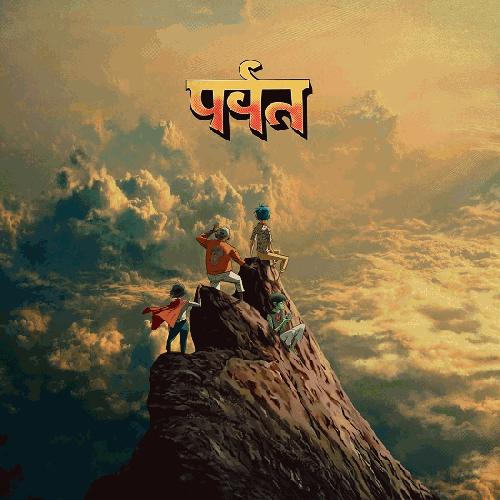
Review Summary: Gorillaz climb The Mountain
For several years it seemed like Gorillaz had been coasting. They were never downright bad, but they clearly settled into a bit of a sweet spot.
Humanz had bangers, yet sprawled in too many different directions at once.
The Now Now smoothed down any rough edges into a homogeneous blob of overpolished tracks – structurally safe, but sonically bland.
Song Machine delivered some flashes of brilliance but played out as an episodic content drip-feed.
Cracker Island… Okay, yeah, this one’s kind of indefensibly bad. For the most part, I’ve enjoyed every record of theirs post-
Plastic Beach to varying degrees, but none of them felt fully realized. None of them had particularly strong connective tissue; they felt more like collections of tracks. Until now.
The Mountain marks the first time in a good long while that Gorillaz sound wholly invested again.
That investment is immediate. The album wastes no time establishing its Indian aesthetic. It opens with sitar and flute, gentle and unhurried, before layering in acoustic strums and restrained percussion. It might register as unspectacular in those opening couple minutes, but it's less about spectacle and more about atmosphere and feeling. It sets the tone for everything that follows, not just musically but thematically. Recorded across India, London, and elsewhere, the record draws heavily from Indian classical instrumentation while still folding in Gorillaz’s electronic and pop instincts. The multilingual performances, drifting between English, Hindi, Arabic, Spanish and Yoruba, don’t register as mere ornamental additions. They feel integral to the structure. It would be easy to write the whole package off as a cultural gimmick at first glance, but it feels closer to a pilgrimage.
Damon Albarn has spent decades world-building through Gorillaz, expertly masking dread in cartoon excess, constructing dystopias and plastic islands to process political and ecological anxiety at a safe remove. But this time, the world he builds feels less fictional and more existential. In the wake of both Albarn and Jamie Hewlett losing their fathers during the album’s creation,
The Mountain transforms into a confrontation with mortality. It would have been easy to expect the music to sound heavy, even morose, following such tragedy. But some of the deepest wellsprings of renewal come from places of profound loss, and
The Mountain proves it. This is a rejuvenating record. A healing record. One that finds light without pretending the dark isn’t there.
Albarn put it plainly: “If we’re going to talk about the subject of death, I need some people who are dead to help me talk about it.” That framing runs through the album’s physical booklet, which dedicates the project not only to their fathers but also to a long list of deceased collaborators. These ghosts aren’t just contrived flourishes. In several cases, those voices are more than symbolic; they’re pulled from unused sessions and repurposed. Gorillaz have always been collaborative, and here that collaboration literally stretches across time.
“The Shadowy Light” makes that explicit. Asha Bhosle’s Hindi refrain invokes a boatman ferrying her across a river, a metaphor for life’s journey and eventual release. Crossing the river isn’t framed as some kind of collapse; it’s framed as transcendence. The imagery quietly underpins the album’s wider emotional logic.
The Mountain speaks openly about loss, but it never drags its feet in despair. It keeps moving forward, despite tackling heavy themes.
Even when the band lean hard into catty political commentary, the music is bright and exuberant. “The Happy Dictator” pairs unsettling lyrics with chipper digital whistles and stacked vocal melodies. “Oh, what a happy land we live in” floats above lines about shadows forming and velvet gloves hiding power. It’s classic Gorillaz irony: dread wrapped in ear-catching pop. The difference this time is in the cohesion. The satire feeds the larger narrative rather than splintering it.
At the record’s centre stands “The Manifesto,” one of the band’s strongest songs to date. Proof’s resurrected freestyle collides with kinetic percussion and Indian classical textures, including flutes and sarod, giving the track this cool, restless pulse. The title nods to Gorillaz’s original manifesto, where drummer Russel Hobbs was said to channel the spirits of deceased musicians. Two decades later, that mythology becomes literal. The song hums with existential tension and ego death, yet it feels like an awakening rather than some panicked breakdown. It’s the album’s towering centrepiece and the most obvious example of its world-building evolving into something spiritual.
There are softer moments too. “The Empty Dream Machine” glides along with a calm, almost meditative ease, Black Thought’s presence grounding the album across multiple tracks. “Orange County” pairs infectious melody with whistles and horns, quietly becoming one of the record’s most maddeningly addictive cuts. There really isn’t much here that flags as extraneous. Even the more filler-coded material facilitates the immersion.
The album closes with “The Sad God,” where the opening motif resurfaces, less pronounced at first, gradually revealing itself more clearly as an understated choir hums in the background. It feels like a full circle, yet not a neat resolution. The melody doesn’t signal an ending so much as a continuation.
In the face of personal tragedy and a world that feels increasingly more fractured by the day, Gorillaz have crafted a surprisingly spiritual experience. The cheery, upbeat, almost life-affirming nature of the music doesn’t come from a place of denial or mismatched theming. The album is littered with lines about numbness, loss, and the slow monotonous grind of life. It simply refuses to let those be the final word. The mountain may loom, heavy and immovable, but the act of climbing it is where renewal begins.
The mountain, it is high
Yeah, the mountain's sad so the mountain cry
Tin god, the braided day
But the mountain stays on still
Don't lose yourself
If you don't stop now, then you're never gonna be done
Living under your gilded sun
On the mountain