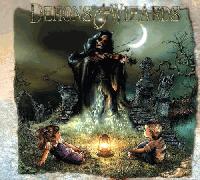
Review Summary: This is like that Schwarzenegger and Weathers epic handshake scene from the first Predator movie
The best thing about this collaboration between John Schaffer of Iced Earth and Hansi Kürsch of Blind Guardian, other than the fact that it actually happened, is its perfect timing. Just a couple years later, Blind Guardian will release “A Night at the Opera,” which always sounded too damn sterile to me, and not a long time after that Iced Earth will enter a period of turbulence with middling albums and fervent line-up changes. As we all know, much later Schaffer will kick himself in the ass, killing his career in an act of supreme stupidity. But, as of the year 2000, the future seemed bright for both parties to the project. Both of their main bands just released their most widely acclaimed records, and both artists were clearly elated and inspired by the prospect of creating music together. In short, not only was this collaboration exciting for the musicians and their fans alike, but it also happened at exactly the right time and under the most favorable circumstances.
The least surprising thing about this collaboration is how natural it feels. Both musicians didn’t really have to change much about their respective styles. Hansi just needed to add some aggression to his voice, which was not something completely new to him, if he still remembered the early Blind Guardian days. As for John, well, he didn’t really have to change anything at all.
Right after the typically forgettable intro, we are hit with a very distinct John Schaffer riff, where the standard metal galloping is twisted, twisted, and twisted out of shape. “Heaven Denies” lets us know from the start that the guys understood their assignment correctly, namely that it is to show us “What if Hansi sang for Iced Earth” rather than “What if John joined Blind Guardian.” So, we will not face an overabundance of symphonics and vocal layering characteristic for mid-to-late career Blind Guardian. Instead, for the first half of the record we are treated to a streamlined and focused version of Iced Earth songs crowned with passionate and melodic singing. In simple terms, what we get is three fast and furious power/speed metal tracks and two (semi-) ballads. One of those ballads certainly deserves a closer look.
Here’s a hot take: I never cared much about Blind Guardian ballads. Kürsch's voice may be perfectly suited for this type of songs, but, well… Let’s just say, “Bright Eyes” almost works for me, but you can keep “Bard’s Song” and the much of the rest of Blind Guardian’s ballad material. At the same time, while John Schaffer is widely celebrated as the master of convoluted riffs, his knack at writing slower songs is underestimated. A lot of “Something Wicked…” appeal lies within its slower, atmospheric parts, so I would also credit Schaffer as the main reason why the ballads and the softer sections of the heavy songs work as well as they do on “Demons and Wizards.” “Fiddler’s Green” is the prime example of that, as it remains a treat for your ears from the lush folky acoustic passages at the beginning to the closing heavy section which also provides us with some expressive but not overdone guitar soloing. It also helps to have a singer of Kürsch’s caliber, as Hansi expertly morphs his voice with the song, from tender crooning to mildly ironic “Poor old fiddler” touches to fierce outcries in the end. I mean, this just might be the single best ballad both musicians ever put their hands on.
One other less obvious way in which this collaboration is beneficial for both parties is the lyrical content. In my opinion, Hansi deserves almost as much praise as a lyricist as he gets for his singing. He likes to base his lyrics on some work of fiction, typically fantasy, but instead of cheesy retelling of the plot he normally offers his own interpretation of the original source or an insight into the mind of its characters. I for one would rather take Hansi’s musings on Tolkien or Stephen King over Schaffer’s ramblings about Sethians and stuff. Kürsch is the one who provides a sarcastic undertone to “Poor Man’s Crusade” or touching tenderness to “Fiddler’s Green,” going well beyond the usual limitations of Power Metal lyrics. His writing skills become especially handy for the second half of the album, which is a bit of a different beast.
“Path of Glory,” which happens to be the only track on the album I don’t really care about, serves as a clear dividing line between two halves of the record. It becomes clear that something has changed as soon as “Winter of Souls” kicks in with ceremonial drumming, guitars building up the tension, and Hansi intoning “Facing the storm, and there’s no one by my side…” This is how it goes for the rest of the way from the tense atmosphere of “Winter of Souls” to dark and moody passages of “The Whistler,” culminating with the downright chilly “Gallows Pole” which immerses you in a frozen nightmare from the start with sinister melodies and Hansi’s distorted voice singing “Endless stairs, the guiding light / it seems to shine bright, but it’s cold…” The guitar rarely and only very briefly rises to galloping speed, instead focusing on the “heavy/soft,” “sinister/pressing” dynamics, while the singer’s voice acquires a gravely dramatic presence. I will always love the unabashed headbanging joy of the first half of the record but, in my view, it is the latter half of the album with the more complex and twisted songs and overall wintry disposition that secures its staying power. The one song I’m not sure about is “My Last Sunrise.” It is a good enough song that fits with the general mood, but it doesn’t really say anything that hasn’t been said already by the preceding tracks.
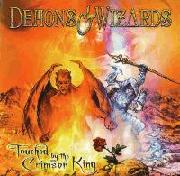
To be honest, any criticism I have for the album is just nitpicking. “Touched by the Crimson King” has the best opener in the history of openers, maybe ever, and a lot of other great songs, and I will forever be grateful for the mere fact that “III” was actually released after years of teasing instead of remaining forever in “what could have been” limbo. But the self-titled album stands tall as the band’s most consistent and rich effort and a perfect example of two renowned artists truly collaborating and merging their styles seamlessly without any ego clashing or anybody being underutilized or pushed to the background. Despite all the stupidity that transpired years later, I am still amazed that we got three proper full-lengths out of this project, and the first chapter of “Demons and Wizards” story was particularly glorious.