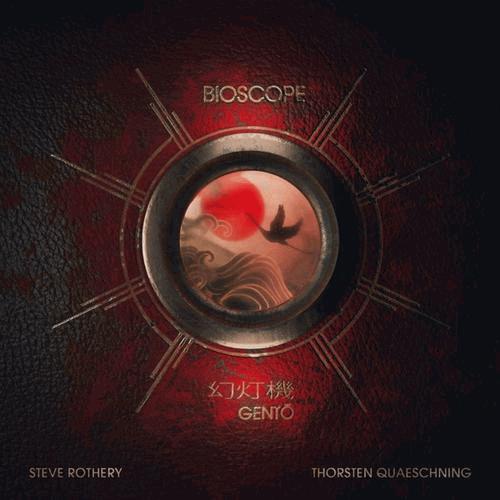
Review Summary: The Serpent of Synths needs guitars to grow wings.
This album is a snake. A three-headed snake, to be precise, with the three heads being Thorsten Quaeschning of Tangerine Dream, Steve Rothery of Marillion, and Alex Reeves of Elbow. I mean, you would expect that an album like this would not be easy to get into, but this one is particularly evasive. You’d think you got it by its tail, but it changes shape and gets away. You’d start admiring the colors of its scales, but they’d switch and blink rapidly and leave you blinded and confused. Like any snake, it is careful and patient, so it starts in a rather unassuming way with the first part of “Vanishing Point” trilogy treating us to some nice synthetic soundscapes but clearly serving as a mere appetizer before the coming attractions.
Your further impression of the album depends on whether you’ll find a vantage point to get into the music. It is not always going to be the most obvious one. One of the three heads of this snake is clearly bigger than the others with Quaeschning assuming control for most of the songs and the synths leading the way, while Rothery’s guitar does not indulge in any extensive soloing, instead focusing on providing or (most of the time) supporting overall mood and atmosphere of the songs with quite moderate and measured licks. Sometimes it even gets mostly excluded from the mix, like on the title track “Gento,” which is almost exclusively dominated by synths. As such, the only constant to this ever-changing album is its particular sparkling and shimmering synthesizer beat which persists through every song, sometimes taking the backseat, sometimes being front and center of a composition.
But to feel this album you need to get into its groove, and here it is time to give due credit to the smallest head of the snake. Alex Reeves was not involved in the songwriting, but his input is still important. For instance, my level of enjoyment of “Vanishing Point II” clearly depends on whether I’m able to get in sync with the drum rhythm of the song. Sometimes I can do it, and the whole song opens up for me. Next time I am not concentrating enough, and the song just passes by me. And this is not the only song that I keep reassessing with each subsequent listen. For instance, I thought that the title track would end up being my least favorite song on the album, as the synth here choke out most of the other instruments, and while it is the most driving and energetic song on the track list, it is also quite repetitive. But it does actually work once you manage to get into the melody and ride along with it. I just think that it shouldn’t be as long as it is, seven and a half minutes is way too much. At the same time, the duo of “Kinetoscope” songs faces the opposite problem. The synth melodies here are more atmospheric and reserved, but it feels like the song never takes off properly, ultimately fading into the background.
Then again, what if you’re curious about the album, but are not in an inquisitive mood and don’t feel like thoroughly searching for a vantage point to get into a song? In that case, I suggest performing a simple trick and flipping the album. Instead of starting at the beginning, check out the last four songs before anything else. This is where the album suddenly stops being a sneaky viper, as the first notes of the gorgeous piano melody that kicks off “Bioscope I” should get you hooked immediately. The whole trio of “Bioscope” songs flows equally well with a significantly more balanced and engaging combination of piano, guitar, and synthesizer melodies than some of the previous songs. And then, the closer “Kaleidoscope” comes along to seal the deal. It is the only guitar-centered song on the album, and while the melodies that Steve Rothery provides are still quite simple, they project a warm and hopeful feeling without overwhelming the listener. It’s not only about the guitar though, as synth and Moog soundscapes that fully blossom around the middle of the song are equally wonderful and emotional.
Anyway, see for yourself, if you want to listen to the album in the order envisioned by its creators, or if you want to cheat a little and go straight to its back half which contains the more immediate songs. Maybe then it would be easier for you to go back to the start and get into the sprawling goodness of “Vanishing Point III” or the relentless drive of the title track. Then again, maybe I am just a snake oil salesman. A lot depends on your willingness and curiosity to give a chance to a nerdy instrumental album which keeps morphing as it goes.