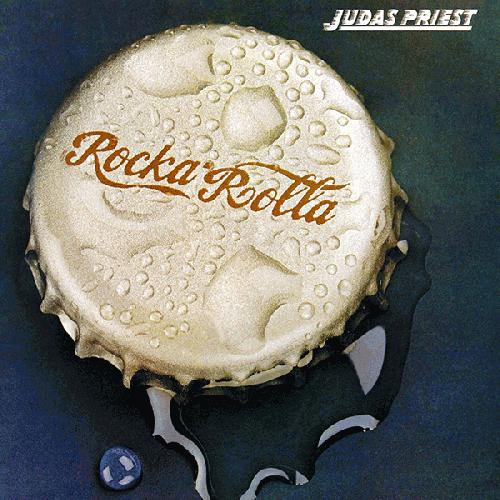
Review Summary: An awkward debut album turned protometal masterpiece.
For how much 1974’s Rocka Rolla comes off as out of step with what Judas Priest would later accomplish, I like to imagine the alternate universe where it was just another obscure early seventies protometal one-off. Connections to the most primordial works of Sabbath and Budgie are especially apparent, sharing a producer in Rodger Bain, and the intermingling of blues, psychedelia, and progressive rock triggers associations with Zeppelin, Hendrix, and Jethro Tull. The winter atmosphere also colors the proceedings with a wistful melancholia that emphasizes an antiquated charm.
But while much of that vibe may be rooted in the band’s original singer Al Atkins having a hand in several of the compositions, the vocals of his replacement Rob Halford were what first truly took them to the next level. He operates on the precedent set up by high-pitched wailers like Robert Plant, Ian Gillan, and David Byron with exceptional control over an incredibly broad range. His strengths are made more apparent by the soaring highs he reaches for seamlessly yet he carries enough of a rock swagger to match the swirling guitars and loose rhythms as well as a deep vibrato to match the darkest riffs.
As much as I absolutely love this premise, I must admit that the album’s first half is a little jumbled in actually setting it up. “One For The Road” aims for a strut ala “Good Times, Bad Times” though its off-time rhythm feels a little slow burning than it should, making one wonder if the title track could’ve made for a better opener with its breezy gallop, fast sing-alongs, and chipper harmonies. The “Winter” cycle of songs shows some prog ambitions with an appropriately cold aura fleshed out by doomy riffs, ramped up guitar fuzz, and airy melodies. It rides a tricky line of well-written parts contributing a somewhat slapdash whole, especially since I don’t know if “Cheater” should be a part of it, but it’s still compelling.
Once the album kicks into the back half, the signs of what Priest’s future become more apparent. “Never Satisfied” is an especially cooking number with a punchy groove that makes it easy to believe “Victim Of Changes” was truly waiting in the wings. “Run of the Mill” goes full winter prog-blues, having been written as a showcase for Halford’s range, mixing baritone pathos with a climactic set of wails that flow with the spacey sway and quirky swing riff. “Dying To Meet You” also works as another multi-part sequence, its first part foretelling doom with thematic bellows and drums rolls while charging into a sardonic set of chugs. The closing “Caviars and Meth” may be but a two-minute excerpt of a much longer epic, but this snippet is a pleasant enough comedown.
Overall, Rocka Rolla may be my favorite example of the awkward debut album that ends up offering its own unique character. That character may be doing some of the heavy lifting between the somewhat jumbled pacing and song structures that still seem to be in the process of solidifying. At the same time, the band’s chemistry is budding with who could potentially be considered the greatest metal vocalist of all time already making himself known. The band is still of its influences here but there’s an inkling that they have just as much to offer. Open-minded Judas Priest fans are encouraged to check this one out but those with seventies rock inclinations will be the most rewarded.