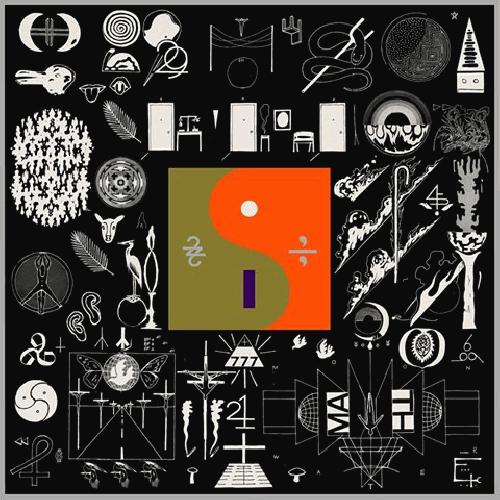
Review Summary: 'Cause the days have no numbers.
For the longest time, Bon Iver’s third studio alienated me as a huge fan of the group. I would listen to the album and then comb through the critical acclaim this album received, utterly perplexed by what I was reading. I couldn’t help thinking to myself, Am I crazy? How could I be on such a different wavelength than a large majority of the overall fanbase? The whole album wreaked of pretentiousness, from the heavy reliance on autotune to the incoherent song titles. It’s hard to believe that 22, A Million came out nearly a decade ago, but I have finally come around to the idea that this is a very good, even great, album at times. But what I’ve begun to appreciate about Bon Iver’s relatively small catalog is that each entry feels singular in its direction and sound. Justin Vernon seemed to have almost single-handedly ushered in a flannel-inspired folk era with his debut For Emma, Forever Ago and could have easily stayed in that particular lane for the rest of his career if he wanted to. Bon Iver, Bon Iver brought the band to the forefront, expanding on the sound with a lot of extra depth and character, at times pulling from the 80’s. 22, A Million refuses to set any boundaries for itself, veering in all different directions with the help of electronics.
The results, even after all these years, are mixed. The compression on “10 d E A T h b R E a s T âŠ* âŠ*” is still too grating. Some of the lyrics on these songs still make me chuckle due to their level of unseriousness, like “I’d be happy as hell, if you stayed for tea” and “God damn turn around now, you’re my A team.” I still can’t get over the fact that the horns on “____45_____” have been autotuned. As a whole, 22, A Million still feels a bit over-bloated and pompous for its own good, but I can admit now that there is a certain level of charm in its boldness. Still, my favorite moments come when Vernon and company decide to go for the more understated approach, like on “8(circle),” which features the electronic ambiance but in a more tasteful way. Then there is the closer, “00000 Million,” the closest Vernon comes to mirroring the beauty and lyrical depth that’s found on his previous two records with its graceful piano and confessional struggle of self-defeating habits.
Justin Vernon has proven himself to be a forward-thinker as an artist over the course of his career, never settling for a particular niche. Not all of his experiments have registered as great successes for me as a fan, but there’s a singularity to his body of work that I always find memorable.