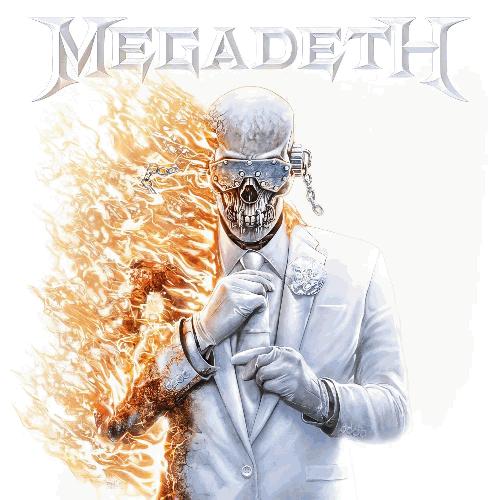
Review Summary: Regular album; classic band (did you get the Sputnik pun?)
Once, talking with my friend Sergio, we drifted into a conversation about how amazing it would be to access the multiverse, in true Rick & Morty fashion. Traveling through parallel realities where the Beatles never broke up, meeting Iron Maidens from other universes, where Bon Scott never died — and, of course, where Dave Mustaine was never fired from Metallica.
What kind of Metallica would that have been? What records would have come out of that specific universe where thrash metal was born without its most famous rupture? The complete answer, unfortunately, lies in some parallel reality inaccessible to us.
But in his final act, Dave Mustaine offered us a brief glimpse of that world — a quick peek into that alternate universe — by recording his own version of Ride the Lightning, which sounds less like a cover and more like a historical echo: an “what if?” turned into music.
Incidentally, calling this final album simply Megadeth is a decision that is as obvious as it is brilliant. After decades of records, concepts, phases, and reinventions, Dave chooses to end by saying only the name of his band — like signing the final work before leaving the stage. There is no subtitle, no slogan, no promise of a future. There is identity. It’s the kind of choice only a band with enough history can make: letting the name carry everything that needs to be said.
And that is precisely why talking about the final Megadeth album was never just about music. It’s about legacy, survival, persistence. It’s about a band that not only crossed decades, but helped shape them. As a member of the Big 4, Megadeth doesn’t occupy a place of respect because of nostalgia — it does so because it helped define what thrash metal is, aesthetically and ideologically. Now, that weight multiplies: we are in the final act.
And what can we say about this final act?
In terms of production, there is no radical shift up front. Megadeth maintains the same aesthetic choice of recent years, betting on a clean, defined, and extremely controlled sound — I would even risk saying, at times, polished to a fault. Each instrument occupies its space with surgical clarity, to the point of almost eliminating any sense of risk or organic dirt.
But what about the songs themselves on this legacy album?
I have to say that the four previously released singles didn’t impress me. The Tipping Point has its moments and an interesting riff. I Don’t Care reminds me a bit too much of Steve Vai’s *** Yourself and ended up being the best of the four. Let There Be Shred and Puppet Parade sounded too generic and uninspired to me.
Hey God!? has an interesting introspective and spiritual lyric. The Last Note features the classic narrated section by Dave. Still, frustratingly, the rest of the album sounds like one massive filler. A few interesting moments here and there and that's it.
But then comes the version of Ride the Lightning as the final act — not only of the album, but of Megadeth’s entire narrative. The circle closes there. Decades after being expelled from the band he helped found, Dave Mustaine returns to this song not to rewrite it, nor to dispute it, but to reclaim it. It doesn’t sound like revenge, nor provocation. It sounds like a quiet reconciliation with his own history.
But the question that won’t go away is: is it good? Does it sound incredible? Better than the “original”? I’ll leave that answer to you, dear reader.
But listening to Ride the Lightning through Megadeth’s hands is like peeking, for a few minutes, into that parallel universe where Mustaine never left Metallica. Not to imagine “how it could have been better,” but to recognize that the rupture was, in the end, what made everything possible. Without it, Megadeth might not exist. Without it, this final album wouldn’t make sense at all.
That’s why this track works as a full circle moment: the beginning and the end meet. The past is neither denied nor overcome — it is accepted. Megadeth ends its discography by returning exactly to the point where it all began, but now with control, maturity, and historical awareness. Few bands manage to turn an old wound into a final gesture. Fewer still manage to do it with such elegance.
A worthy ending.
In the end, all I have to say is this: Dave, from the bottom of my heart, thank you. Thank you for all your hard work and for all your creativity.