Review Summary: This is Dark Dungeon Doom.
Dungeon doom is a relatively narrow yet a clearly distinguishable style within the dungeon synth genre. Based on its defining traits, it can even be interpreted as an autonomous subgenre. Its most important representative is the Swedish project Ghoëst, one of the many endeavors of A. Virdeus (among which Werendia is perhaps the best known). The significance of Ghoëst lies in the fact that, through a series of demos and other releases issued since 2021, it laid down the aesthetic and musical foundations of what is now referred to as
Dark Dungeon Doom.
Musically, the dungeon doom style is easy to describe. It is characterized by a minimalist approach and strongly repetitive song structures. The core elements of the instrumentation are the distinctive synthesizer textures: a so-called pad synth functioning as a background layer, and a dominant lead synthesizer track carrying the main melody. These are accompanied by slow, "marching" programmed drums, which are unusual within the dungeon synth genre. The overall effect is a very slow-paced, melancholic, and dreamlike mystical atmosphere that, in several respects, can be associated with the world of doom genres.
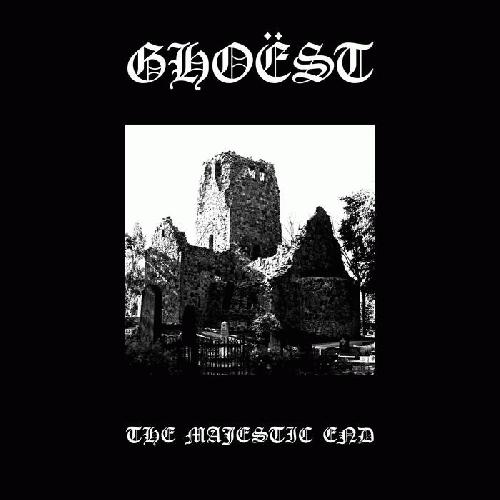
The Majestic End is a dungeon synth album consisting of four tracks, each running 12–13 minutes. The compositions differ only marginally from one another in terms of style and structure, which makes it reasonable to interpret the record as a concept album. The individual pieces are built from just a handful of melodies and minimalist drum patterns, unfolding as slowly drifting, almost suspended-in-time compositions. This reduced toolkit gives rise to an elusive yet distinctly magical musical world.
For me, the album’s opening track, "The Majestic End, Pt. I" stands out the most. Its honey-sweet melancholic melody effectively encapsulates everything Ghoëst represents within this stylistic direction. One of the project’s greatest strengths is its old-school, distinctly '90s-evoking sound aesthetic: the slightly muffled, "cassette-like stretched" synthesizer tones are lending the music a peculiar warmth. This warmth stands in an intriguing contrast to the sensations conveyed by the music itself. A few descriptors: monotony, slowness, mysticism, melancholy, dreamlikeness, funerary gloom. (
As if I were listing the defining traits of a funeral doom record. Hmm?) In my view, this exact contrast (the cold atmospheric elements combined with a nostalgically warm sound) and the melancholic melodies are the key elements (or together: the essence) of Ghoëst’s music.
The Majestic End is Ghoëst’s first full-length album within an otherwise remarkably extensive discography (to give just one example, there are 18 demos!). Not only this album, but the entire discography can be characterized by a strongly preserved stylistic framework, with individual releases fitting together almost like chapters within a larger, overarching concept. This consistency, however, has a dual effect. For those who find this aesthetic appealing, it offers the opportunity for complete immersion in this melancholic world. For other listeners, it may easily become monotonous, exhausting, or even boring. Nevertheless, if one analyzes Ghoëst's music in detail, a clear sense of directed evolution can be observed. And the highest point reached so far on this developmental curve is
The Majestic End.