Review Summary: "Oh, but I don't like lyrics in portuguese" said the Ramstein fan...
For decades, part of the Brazilian intellectual elite tried to sell to the world the idea of the “cordial man” as our great civilizational legacy to humanity: a figure shaped by emotion, informality, and personal relationships that override rules and institutions.
Sérgio Buarque de Holanda formulated this concept decades before the emergence of Matanza. That’s why I can say, without fear of being wrong: Brazil’s greatest contribution to humanity was not this elegant sociological myth — it was the creation of countrycore, the fusion of hardcore and country!!
Yes, you read that right: hardcore + country = countrycore. That's an equation that should never work, yet works perfectly. It’s where Motörhead meets Bad Religion, and where hatred, cheap booze, irony, mockery, and dirty riffs finally found an honest form of expression.
This musical translation of everyday brutality is only possible because Matanza has always been, first and foremost, a diabolical duo. On one side, Donida (the architect): dry, straightforward riffs, rooted in hardcore and contaminated with insane doses of country. On the other, Jimmy London (the mouthpiece of chaos): lyrics, vocals, and presence that turn cynicism, violence, hangovers, and failure into identity — not as caricature, but as conscious provocation.
It’s on this album that Jimmy becomes more than just a vocalist. He turns into a character. His voice gains the shredded rasp that had not yet been fully developed on Santa Madre Cassino; this is where his peculiar body language begins to take shape. And if you enjoy Bruce Dickinson’s “Scream for me,” it’s because you’ve never heard Jimmy shout “Puta que pariu” (free translation: "holy ***").
But perhaps Matanza’s greatest strength lies in its absurd lyrics. Whether telling hilarious stories or exploring rock bottom with pride and sarcasm, the band turns exaggeration into a method and lack of decorum into identity.
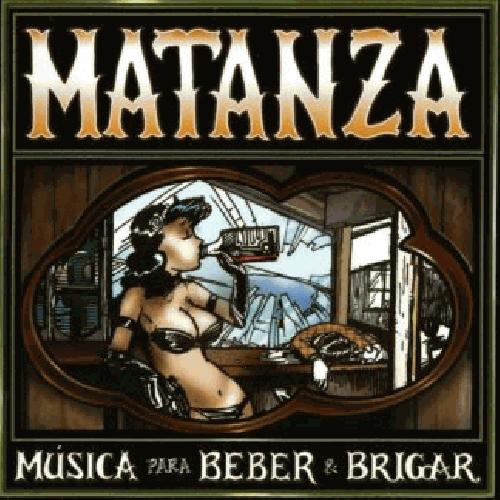
On Música para Beber e Brigar (Music to Drink and Brawl To), Matanza reaches a rare balance between immediate impact and authorial personality. The album asks for no context or explanation: it imposes itself. Straightforward riffs, bar-fight pacing, and lyrics that work like drunken bar tales told at the counter. One of the band’s greatest strengths has always been exactly this: telling absurd stories with frightening naturalness, as if all of it were just another badly slept night.
“Pé na Porta, Soco na Cara” (Kick the Door In, Punch in the Face) is the definitive manifesto. Its lyrics communicate with anyone because they dispense with elaborate metaphors or intellectualized subtext: it’s raw anger, immediate reaction, instinct. Everyone understands it — even those who’ve never listened to metal — because the song speaks to a universal impulse, that moment when the social veneer cracks. This is Matanza in its purest form: direct, unfiltered, and absolutely honest.
“O Último Bar” (The Last Bar), on the other hand, slows the punch to focus on emotional hangover. Here, the band shows it doesn’t live on aggression alone: there’s an almost melancholic atmosphere of late night, lights too bright, empty glasses, and accumulated bad decisions. It’s a song that expands the album’s universe, reminding us that violence and excess also carry fatigue, loneliness, and a twisted sense of romance.
"Every night there’s always someone to tell you
What woman would want to see you like this?
Big festival, girls everywhere, carnival — and here I am
With a bottle already near the end"
“Maldito Hippie Sujo” (Filthy Damn Hippie) is where the band’s narrative talent shines with the most humor. The story is deliberately exaggerated, almost cartoonish, but never gratuitous. Matanza understands that absurdity works best when told seriously — and that’s what turns the song into something hilarious without becoming a throwaway joke. It’s the kind of lyric you follow like someone listening to a friend tell an unbelievable disaster… and hoping it keeps going.
"In less than an hour, everyone was already dead
All of them spread across the floor
From all this, only hatred remains as an inheritance
No hope, Just one more hisotry that doens't end here"
Finally, “Bom É Quando Faz Mal” (It’s Good When It’s Bad for You) condenses an entire philosophy into just a few minutes. Self-destruction, guilty pleasure, and the glorification of error appear without moralism or artificial glamour. The band neither judges nor justifies — it simply states. And perhaps that’s where Matanza’s strength lies: they don’t try to teach anything, they merely expose the ugly, funny, and brutal side of the human experience, wrapped in riffs that sound like they were made to echo through smoke-filled bars.
At night, what’s good is going out
Even when it’s raining
I’m someone who never regrets
It’s wrong, I’m doing it anyway
Who knows what’s normal?
All I can tell you is
It’s Good When It’s Bad for You
In short: "Música para Beber e Brigar" works because its stories are bigger than the music — and at the same time, impossible to exist without it. It’s countrycore, it’s Brazil, it’s excess turned into identity.
"Puta que pariu, Sputinik!"