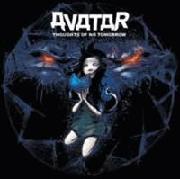
Review Summary: When the Third Time Isn’t the Charm: Avatar’s Awkward Adolescence.
I had promised myself I would review the entire Avatar discography. But let’s be honest: this is going to be the last one. The first two albums are so bland, so generic, so stuck in the standard melodic death metal of the time that there isn’t much to say beyond: “they exist.” And if someone from the band ever reads these lines… come on, guys, you know I’m telling the truth.
Besides, there’s an old saying in Brazil that goes: "if you don’t have anything nice to say, don’t say anything at all". So I’d rather stay quiet regarding Thoughts of No Tomorrow and Schlacht.
Curiously, Johannes Eckerström himself has commented on this era. In a Reddit post, he admitted — with a sincerity few vocalists ever display — that he struggled with the third album for a long time, and that he needed distance to appreciate it “for what it is.” He even compared it to that weird phase of adolescence: when your limbs grow disproportionately, your voice changes, and you have no idea who you’re becoming.
That might be the best metaphor to describe the band’s third outing. But musically, "Avatar" is a weak record. It’s the sound of a band that hasn’t yet discovered its own identity.
The biggest evidence of this is Johannes’s own voice — his growl here is completely generic, lacking the personality, the barking timbre, the theatrical aggression that would become his trademark starting with Black Waltz. It lacks identity, it lacks… I don’t know, it just lacks a lot of things.
Still, there are moments that shine — clear hints of what was coming. The only genuinely good songs, the ones that show flashes of the explosive potential of the later era, are:
Queen of Blades (I really liked the almost a cappella growl in the intro)
The Great Pretender (great riff and a track that felt “outside the box” for the band at the time)
Reload
Out of Our Minds
In these songs, you can hear Avatar starting to leave generic metal behind and flirting with bigger ideas: stronger melodies, less obvious riffs. You can feel them trying, stumbling, experimenting… and finally finding something interesting.
The rest, however, gets lost in passable songs, competent but unremarkable production, and arrangements that sound more like band practice exercises than tracks with real identity. It’s not a bad album — it’s just a record that could have been made by dozens of Swedish bands from that era.
And that’s precisely the point: Avatar is the last album before the full reinvention. Before the costumes, before the performance art, before the organized madness, before the circus. It’s the end of childhood and the beginning of puberty.