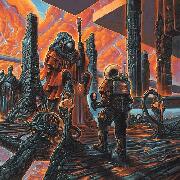
Review Summary: With the addition of vocals, Alpha Male Tea Party take a leap of faith and a step forward into a captivating new era.
If you want to stir some serious *** online, enter a progressive rock forum and mention the vocalist. For those uninitiated in these types of conversations, vocalists regularly serve as a serious trigger point, and the discourse surrounding them often oscillates between complete adoration to pure loathing, to the point where one’s perception of a band is seemingly ruined because of one member’s performance. The amount of weight that singers like James Labrie, Ross Jennings, and Claudio Sanchez bear is truly monumental, and it lends itself well to a conversation about the purpose of vocalists, especially in your progressive genres that tend to be more complex and layered. Many bands have approached this conversation (or at least, their fan’s disdain for vocals) by either releasing instrumental versions of albums or even abandoning their vocals altogether (ala Night Verses), but very rarely do we see bands take on the task of incorporating vocals into previously instrumental music.
There's a good reason for it. When your music is already a slew of heavy, dizzyingly complex riffs, the addition of vocals could lead to a muddying of the waters of sorts. I certainly can’t perceive a band like Animals as Leaders or Plini adding a vocalist, as there would be nothing extra to add. If you’re going to add vocals, there has to be a purpose.
I imagine this conversation arose among the fans of Alpha Male Tea Party, a Liverpool rock group whose music dances somewhere between the manic energy of Tera Melos and the heavy riffage of The Physics House Band, as singles from the newest project started to drop. While, up until their most recent release, this group has been purely instrumental, their songs have always demonstrated an understanding of tension and atmosphere as well as a mature comprehension of how to write a hook without words. This attention to songwriting as a craft has landed them squarely in the middle of this conversation, as the band has decided on Reptilian Brain to hand guitarist Tom Peters and bassist Ben Griffiths vocal duties. It was a bit of a gamble. To add vocals might add an extra layer of emotional depth and warmth. It might help the band express messages that, in this tumultuous era of miscommunication (or lack thereof entirely), often get lost in instrumental music. It might also result in an album that feels jam packed with too many ideas.
To cut to it, this decision pays off in spades.
Reptilian Brain is a masterclass in the blending of chaos and order, intricacy and atmosphere. Each song is an amalgamation of rock genres and sounds with its own arc, unique climax, and energy. Songs like “Hostess Imperial” and “Battle Crab” bounce and stumble through math rock riffs while closers “Sniper’s Dream” and “All Become One When the Sun Comes to Earth” ascend with triumphant post rock riffs and space rock atmosphere. And while these songs would stand on their own, the strength of this album lies in the combination of these massive instrumental moments with vocal hooks that are just as infectious and weighty.
To understand the strength of their decision to add vocals, look no further than album centerpiece: “A Terrible Day to Have Eyes.” On its own, the instrumentals of this song serve as the backbone of a chugging, punchy, midtempo banger. With the inclusion of vocals, however, this material is elevated into a heartbreaking story of a violent, childhood experience, and subsequently a song about trauma and grief. It’s a slow burn that builds to one of the most gratifying sing-a-long portions of any song from this year, but it’s also a strong example of what makes this album so fantastic. The vocals are simply another layer that adds chaos and heart to an album that would otherwise be a strong, if unassuming, rock album. Beyond the stellar, mature musicianship (the topsy turvy riffs, the groovy basslines, the hyperactive drumming), this is an album that sees a band reaching their full potential because of the addition of lyrics. Each song serves as a breakdown of our modern social and political hellscape, one that attempts to reduce us to our reptilian brain. This album, with its tongue and cheek lyrics, is a statement fighting against that.
If you haven’t checked AMTP’s previous work, none of this matters. What does matter, however, is that this is one of the best rock albums of the year. It’s a collection of smartly crafted, fun, unique rock songs that dances between progressive, math, grunge, and space rock, and an album that solidifies AMTP as one of the most criminally underrated acts of the past decade.