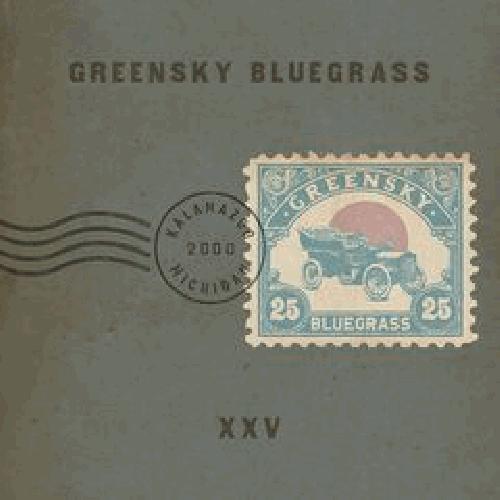
Review Summary: Celebrating their 25th anniversary,Greensky Bluegrass revisits and reworks past gems to deliver an overstuffed bouquet of roots-rock.
Has it been 25 years already? I feel too young for my hometown heroes to grow so old. But if this is your first time hearing the name "Greensky Bluegrass," pour some beer, mull some wine, and pull up a chair: you're in for a treat.
For the uninitiated, Kalamazoo's Greensky Bluegrass are a seasoned set of players who delight in dancing between the bounds of folk, psych, jam, roots, and indie. The band has enjoyed a healthy career flexing their technicolor roots rock chops to ever booming festival audiences - spurning any notions of major label involvement. Their collective mentality has been their most enduring strength - wherein each member has opportunity to shine. Sharing infectious and virtuosic call-and-response passages that evoke a choral kinship, bonds forged by furious finger picking, set to a warm autumnal atmosphere.
Put more simply, the Greensky Bluegrass experience asks a bold question: "what if Fleet Foxes wanted to SHRED?"
As bluegrass exceptions to the rock-biased jam scene Greensky Bluegrass shares the same curse as the likes of Phish, Umphrey's McGee, or Moe: an outstanding live presence that struggles to adapt to a studio setting. Struggles that are amplified by the fact that the XXV is a wide-reaching compilation first, an indulgent victory lap second, and a cohesive album coming in a distant third. Despite the crisp musicianship and clean production it cannot shake its inconsistency - giving it a scattershot listening experience, particularly for first time listeners.
But your patience here IS rewarded - uneven as the album is: there are treasures hidden in these trees.
You'll spot its glimmer halfway through in the dusky, tarnished golden gleam of "Winter In Copper Country." Clocking in at a bold 14 minutes it is the album's towering centerpiece. Leveraging a balance of keys delicate and strings acoustic the track builds its momentum with grim intention - firm in its insistence in setting the scene upon which it weaves a forbidding tale:
"Spring is life returning, summer wide and wild and free..."
"Fall is a tale of what's to come - which is full of frozen tragedy."
Wailing the tale with the fading conviction of a man scorned, front man Paul Hoffman weaves glimmering mandolin arpeggios in and around moody minor key guitar lines. They serve to paint rugged and rocky reaches that flank Michigan's northern coast - a place of harsh beauty matched by "Winter In Copper Country." These lengthy jams are intentional in stretching and exploring their space as instrumental expressions of heady rumination and the haunting creep of loneliness on the cusp of the long, cold dark.
In those spaces are crossroads of self and song: where dusty strings strain with such misbegotten feeling that they bleed into psychedelic distortion - like an instrumental fourth wall break. The band engages you; grasping and fraying your heartstrings through auditory back doors. As heady as this sounds - the compositions remain reliably straightforward: iterating and sprouting at different angles but building towards linear end points that, while not always surprising, are always satisfying and often exhilarating in their delivery.
Its to XXV's detriment, then, that so much of its runtime is comprised of short form retreads of earlier, less ambitious work.
"Who Is Frederico," as an example, sticks out as a perplexing dub-samba hybrid that functions only on the level of a technical exercise. And their revisit of 2014's "Windshield" - the closest thing the band has gotten to a mainstream hit - falls flat. Unlike the anthemic roots rock of the original, XXV's cover is re-imagines it as a stark, morose piano ballad. Although the band was wise to leave the original's dated stomp-clap-hey stylings in the dustbin - Paul Hoffman just doesn't have the tonality or control to carry the song in such a stripped down, dirge-like setting. His voice and pitch are best suited to wailing choruses and dusty crooning - but this has the approach of Peter Gabriel's cover of "My Body Is A Cage:" naked & straightforward - it simply doesn't play to his strengths.
Unfortunately - the above criticism can be applied to nearly half of the material on XXV. While several tracks are buoyed by excellent collabs - most notably Billy Strings on the searing "Reverend" - too many of them dodge the band's core strengths while indulgently dabbling in odd directions. But for all of that, the high points on XXV are soaring - as high up as the Michigan north country skies the band conjures in their best moments.
And after 25 years, the band has earned the right to stretch and the room to roam.