|
| |
|
|
|
Review Summary: One of the underrated prog works of the 80’s. A nice Camel Album. “Stationary Traveller” is the tenth studio album of Camel that was released in 1984. The line up on the album is Andrew Latimer, Ton Scherpenzeel, Paul Burgess and Chris Rainbow. On the album was also the collaboration of Haydn Bendall, Mel Collins and David Paton.
Predominantly instrumental and with melody in prime, Camel’s music combines elements from rock, pop, jazz, blues, folk, classical and electronica. Without achieving mass popularity, the band gained a cult following over the years with their first four albums, “Camel”, “Mirage”, “The Snow Goose” and “Moonmadness”. In the end of the 70’s, due to the advent of punk rock, Camel moved into a jazzier and more commercial direction and released more six albums, “Rain Dances”, “Breathless”, “I Can See Your House From Here”, “Nude”, “The Single Factor” and “Stationary Traveler”.
With “The Single Factor” featuring several different pairs of hands on the keyboards, Latimer felt that he needed a more stable sparring partner for their next release, entering Ton Scherpenzeel, the keyboardist of Dutch prog band Kayak. If the previous album had been the lowest point in the band’s career, “Stationary Traveller” put them back on the prog road to recovery. So, the line up was more consistent which in addition to Latimer and Scherpenzeel saw the return of David Paton, Chris Rainbow and Mel Collins and the addition of the ex-Jethro Tull and 10cc drummer, Paul Burgess.
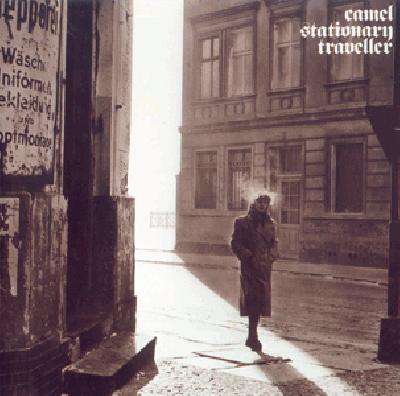
So, by this time, and as happened with their previous ninth studio album “The Single Factor”, Camel was essentially an Andrew Latimer’s band. And as happened with many of Camel’s studio albums, “Stationary Traveller” is another conceptual album. This time the story of the concept is about the Cold War and is centred on the trials of the East German refugees attempting to cross the famous and shameful Berlin Wall who divided the city between East and West. I’m perfectly convinced this was a very nostalgic matter for Andrew Latimer that made him release this album. The nostalgia is present all over the album, and the cover itself invokes a very desolate, desperate and despondent post war Germany, a solitary young woman amidst the aging architecture of a city scarred by the war and its numerous effects.
“Stationary Traveller” was the last album that Andy made with Camel before he moved to America. This is a rather strong conceptual album. It has some mechanical sound, because they may be programmed with some keyboards and drum machines. These things were done in a lot of albums of the 80’s. But, it doesn’t matter, because the quality of the songs is great. It has excellent production, good and decent oriented rock songs, well balanced vocals and of course, a perfect execution by all musicians. It’s not easy to mention any highlights because all songs are of a high level.
Except for Scherpenzeel’s solo music piece “After Words”, Latimer and Susan Hoover were again responsible for all compositions. The scene setting instrumental “Pressure Points” with its pulsating synth line and Latimer’s usual searing guitar work grabs the attention and holds it right through to the majestic finale “Long Goodbyes” which boasts one of the most compelling choral hooks I think Latimer has ever written. In between up-tempo songs like “Refugee”, “Cloak And Dagger Man” and “West Berlin” keep the momentum going with their driving almost trance like rhythms and edgy guitar and keys work. Of the rest, the superb instrumental title track “Stationary Traveller” is by far the album’s peak with an evocative classical guitar and piano intro. The stately guitar solo that follows is one of Latimer’s best in years. The laidback “Fingertips” for its part is most notable for Paton’s brooding fretless bass lines and a silky smooth sax break from Collins. The two bonus tracks are for once quite noteworthy including the nostalgic “In The Arms Of Waltzing Frauleins” which could have been lifted from the musical Cabaret. The extended “Pressure Points” improves the album with the addition of atmospherics and dramatic blasts from every producer’s favourite of the 80’s.
Conclusion: Somehow, I like Camel’s sound of the 80’s. Camel knew how to cope and introduce the new technology into their music. Probably only Camel and Genesis, of the greatest prog bands of the 70’s, were capable of doing that so well. “Stationary Traveller” is an album with a very modern sound, for those times, clearly influenced by the pop and the new wave music with a touch of the traditional Camel’s sound. So, this is a nice album of the 80’s with some very good songs. “Stationary Traveller” is undoubtedly their best second studio album from the 80’s, after “Nude”. “Stationary Traveller” is also their last studio work of the 80’s and we may say that Camel passed with a certain elegance by those terrible years for progressive rock music. But fortunately, great things would happen in the following years, for Camel and for progressive rock in general. Their four next studio albums are all great and represent the returning of Camel to their classic roots. “Stationary Traveller” is an album that must be checked by all prog rock fans.
Music was my first love.
John Miles (Rebel)
| other reviews of this album |
clairvoyant (2.5)
Another former progressive rock band does the 1980s, and success is nowhere to be found....
|
|
Album Rating: 3.5
By the time that “Stationary Traveller” was released, Camel was very much Andy Latimer's band. It followed their previous work, “The Single Factor”, a critical failure work. Stronger in many ways than its predecessor, “Stationary Traveller” has some great tunes, and we can even say this is an album practically without weak points. I like Camel of the 80’s, especially “Nude”. Even “The Single Factor”, the weakest work of the band, is a nice album. “Stationary Traveller” is another concept album, the story is set in Berlin in the cold war. Musically, this is a modern and melodic album, maybe a bit poppy but very pleasant to listen to. We can’t forget that we were in the 80’s, the troubled times to prog rock music.
I agree with the comment of linguist 2011 on the previous review. This album isn't quite as bad as that review suggests. So, it’s time to have a review with a better rating.
| | |
nice review. think it'd be awesome of if you used the 'List' feature to rank some Camel albums with little soundoff blurbs to guide people (myself :D) past the entry level albums, there's just so many and of different eras to sort through
| | | Album Rating: 3.5
Thanks. True. There's an immensity of different eras to sort through, if we only talk about prog. Maybe one day I can do so. But I've no time at the moment to do that. At this moment I'm too focused on writing my reviews to expand the prog works on this site. Unfortunately, I'm almost the only one to do that and there's so many albums without any review, which is a shame. Sputnik needs more prog.
Anyway, thanks for the tip, Azazzel.
| | |
Great review, and for a Camel album I've never heard. Guess I'll give it a try!
| | | Album Rating: 3.5
Thanks, trickert. It's not a masterpiece but I think it's interesting enough to give it a try.
| | | Album Rating: 3.5
Always like that you do these prog reviews man. Haven’t checked this one but I’m a big fan of early Camel, gotta give it a spin.
| | | Album Rating: 3.5
Thanks, Scuro. Since you're a big fan of the classic era of Camel, like me, maybe you can like this one too, if you don't have problems with the addition of a bit of pop in the usual prog music of the band.
Cheers, buddy.
| | | Album Rating: 3.5
Nice to see another review of this album and with a fair rating. It needed it. Since I am busy during the day I will read your review tonight.
| | | Album Rating: 3.5
Ok, pal. Have a nice day.
| | | Album Rating: 3.5
An excellent review as always. Finally the review it deserves. Pos.
| | | Album Rating: 3.5
Thanks, pal. I think the same.
| | | Album Rating: 3.5
Started listening to this a few times (for whatever reason I keep getting interrupted) but hey the first few tracks are lovely haha.
| | | Album Rating: 3.5
If you like the first tracks, I'm sure you'll like the others. As a concept work, all tracks are in the same mood.
As a whole, this is a lovely album.
| | | Album Rating: 3.5
Soooooo, not my favourite Camel album…but there’s some good tracks on here, it’s a vibe for sure, kinda reminds me of late-era BOC (before they returned), more on the poppy/synthy side and less adventurous, but it’s pretty good. I like the extended version of the opener as a bonus track.
| | | Album Rating: 3.5
Nice, I'm very glad you like it. And true, this isn't clearly one of their best albums but good enough to please us.
I advise you to check their last four studio works, "Dust And Dreams", "Harbour Of Tears", "Rajaz" and "A Nod And A Wink", if you haven't done that yet. All are great and are a return to the classic sound of the band.
| | |
Great review. I'm not familiar with that one yet, but I do love Nude. On my to-listen list.
| | | Album Rating: 3.5
Thanks, pal. I also love "Nude". But since you like it, maybe you can like this one too. Both have the similar 80's sound of Camel, which isn't a bad thing.
| | |
I gave it a try, will need to try again, I didn't immediately love it like I did Nude. It's definitely more synth heavy.
What I really need to do however is try out his 90s records, which aren't on Spotify.
| | | Album Rating: 3.5
Of course. We both agree. Stationary Traveler isn't as good as Nude. I think Stationary Traveler sounds too much like the 80's synth sounds. I've no problems with that but I admit that many have. Nude is clearly their best work of the 80's. I love it.
The 90's are all simply excellent, the return to their classic era, in my opinion. So, check them, buddy.
| | |
| |