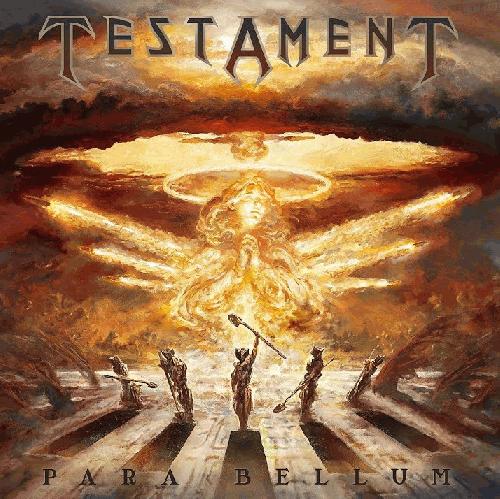
Review Summary: Showing a few cracks in the foundation, yet still standing defiantly, Testament revisit both the angst of their mid-90's rebirth as well as the melodic thrash of their early 90's heyday
Long in the tooth, yet bearing sharpened incisors, Testament returns after a five year absence, clearly pissed off at how the world currently burns, splaying out some of their most venomous offerings to date within album number fourteen, Para Bellum. This is a record that’s served up raw, from the buzzsaw guitar tone of Eric Peterson to Chuck Billy’s razor throated rasp, and the warpath they have chosen to tread is no better exemplified than by the scathing opening salvo of “For the Love of Pain”. Raging out of the gates with a Campbell’s chunky riff that teases some groove initially before the wheels come off, we’re lead down a rabbit hole to hell where unrelenting Death Thrash clears the brush, making way for a wacky 180 into Cradle of Filth/Emperor territory; Black Metal shrieks replace Billy’s Sasquatch barks, while the musical accompaniment flails madly like a band playing their way down a mineshaft. It’s possibly the biggest departure in sound that these ‘Frisco boys have ever tried on for size, and it’s nice to see them not resting on their laurels. “Infanticide AI” tackles the incoming storm of artificial intelligence with a more realistic cynicism than Fear Factory’s “Terminator” redux, another heavy foot on the accelerator, but more akin to vintage Testament. Skinsman Chris Dovas steals the show here, hitting everything in sight, propelling this full tilt thrasher in through the front door and then right through the back wall, taking out the sumbitch like the Kool-Aid Man on bath salts! Ohhh Yeah!!!!
After that one-two donkey punch, things begin to settle into a more recognizable aesthetic. The mid-paced groove of “Shadow People” could be a lost track from The New Order, a punchy yet overcomplicated set of dynamics that occasionally takes sharp turns into weirdly understated momentum killers and sections of stock mediocrity. And this is one of my pet peeves with this album as a whole. There are multiple tracks that come out firing on all cylinders yet wind up taking too many unnecessary detours. Peterson does nail the best guitar solo that Kirk Hammett has written in the past 15 years for whatever that’s worth. “Meant To Be” is a rich (but sleepy) ballad that continues the legacy of songs like…well…”The Ballad” and “The Legacy”. Chuck’s vocals feel slightly more weathered here (as they should), adding gravitas to this poignant slice of teen-swallows-antifreeze melodrama. Still, as hard as it aims for epic status, all I can think is “wake me when it’s over”. “High Noon” is a modern update on the Wild West hi-jinx of Aerosmith’s “Back in the Saddle”, only this time they’re trading bullets and not bodily fluids. “Witch Hunt” is a careening locomotive barreling through Salem (or maybe Washington DC), a frantic tick-tocking speed ball with Billy’s rapid fire vocals hitting like a brick bath! The scenery shifts into more deliberate heaviness, with strange twists and turns around every corner, including a weirdly unsettling chorus vocal. Alex Skolnick plays his axe like a witch’s broom, flying up and down the fretboard, throwing some of his most tasty licks in to the cauldron. And then just like that, Ding-Dong, the Witch is dead.
The album’s final act begins with the anti-gambling warning shot of “Nature of The Beast”, which could probably slip unnoticed into the track listing of Metallica’s 72 Seasons. This NWOBHM throwback is fairly nondescript and doesn’t really fit the mood of the rest of the album, but the cymbal heavy drums and simplified forward motion groove has its merits and serves as a bit of a palate cleanser while you delete your “Draft Kings” account. “Room 117” limps along unimpressively save for Skolnick’s acrobatics once again stealing the show. The high octane thrash of “Havana Syndrome” acts as a wake up call down the stretch, Dovas’ dextrous drumming really pushing the pace while Chuck sounds as vital in this context as he did back in the late 80’s. The musical backdrop zig-zags between speedy crunch and liberal doses of Maiden-ish noodling that can actually be found in several of the tracks throughout (always highlighted by the fleet-fingered skill of iconic bassist, Steve Di Giorgio). Testament closes things out with the title track, Perra Bellum, which builds from a militant march into one of the most intense verse sections in the band’s catalog. Once again however, the transitions are at times abruptly executed and often feel detrimental to the overall composition. The guitar work has to be lauded though, hyper-active waves of mind-bending precision that will likely be revisited in several Youtube tutorials to come. When the festivities finally wind down, we’re treated to a tasteful bit of Rhodes/Iommi introspection as a calming finale to this turbulent ride.
I give kudos to Testament for still injecting this much testosterone into their throwback Thrash. The album as a whole is as frustrating as it is exhilarating, but there are several high points to come back to for a jolt of that old Bay Area magic. Chuck Billy never ceases to impress, the old man still delivering the goods and even surpassing some of the rage that he first started incorporating into the band’s DNA 30 plus years ago. There may be a few subtle cracks in the foundation now, but this Metal landmark still stands defiantly, if not as vitally as it once did before.