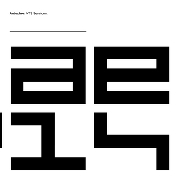
Review Summary: Glowing in the half-light
I first listened to
All That Must Be by George Fitzgerald sometime last year. Preparing to relisten to the album for this review, I viewed the tracklist for the first time in over a year. I immediately recognized the third track on the album, “Burns.” I recalled the echoing vocal sample, repeating repetitiously from the first moment of the song until the very end of the track, as layers of swirly electronic textures and percussive beats crescendo in the background. Upon relistening to “Burns”, I found that my memory of the song did not deceive me: just a solid tune with an extremely memorable hook. But what about the other songs on this album?
Although “Burns” was the only song that I could specifically recall from the first time I listened to
All That Must Be, it was certainly not the only enjoyable track to be found on this album. The opening track, “Two Moons Under,” opens the album in an effectively engaging way. Featuring bright synths that build up over glitchy vocal samples and a funky bassline, Fitzgerald uses the first track of the album to paint a picture of what each song on this album has to offer. The following track, “Frieda,” serves largely as a tonal continuation and melodic extension of the previous track. However, the track lacks the punchy bassline that appeared in “Two Moons Under.” When the following track, “Burns,” begins to play, it becomes apparent that “Frieda” is not a particularly memorable song, especially compared with the tracks that this song finds itself sandwiched between.
Unlike the other tracks on this album, “Roll Back” and “Half-Light” feature lead vocals from singers Lil Silva and Tracey Thorn. While these tracks are enjoyable overall, the decision to include lead vocals with discernible lyrics on these two songs is rather questionable. One particular question comes to mind: why feature these lead vocals in the forefront of these two songs if the singers are not bringing any especially interesting vocal stylings or lyricism to the table? In my opinion, the answer is likely that Fitzgerald wanted to prove that he
could successfully work with talented singers on this project. However, Fitzgerald failed to prove that he
should do that. Case in point: the vocals on the song “Nobody But You.” This track includes a prominent, low-pitched, indecipherable vocal sample which weaves back-and-forth between the layers of electronic instrumentation in the background and forefront of the song. Despite its simplicity, I found this vocal sample to be interesting and enjoyable to listen to. At no point during this song’s runtime did I think to myself: “dang, I wish I knew what he is saying in this vocal sample”, or “gee, I wish that this vocal sample was louder,” or “***, I wish that this vocal sample was being sung by the lead singer of the band Everything But the Girl.”
The final two tracks on the album are clear highlights. “The Echo Forgets” is arguably the best-written song on the album, with a dancey synth melody and beat that immediately grabs the listener’s attention. Throughout the song, bright synth melodies swirl around echoing vocal samples in a very effective way. With closing track “Passing Trains,” Fitzgerald provides the album with a relatively surprising conclusion. The track begins with a harmonious synth melody akin to a music box. Although a driving beat appears in the background of the tune as the synth melody continues to loop, the song does not gradually crescendo like the previous tracks on the album. Rather, an explosive beat switch occurs at the song’s one minute mark. Given the expectations set by the previous songs on this album, the sudden beat switch at the beginning of “Passing Trains” is bound to catch listeners off guard in a positive way. Perhaps Fitzgerald could have utilized jarring beat switches in more of the songs on this project? Regardless, “Passing Trains” stands out as a unique track that concludes the album on a strong note.
All That Must Be is a thoroughly enjoyable release from George Fitzgerald. Despite the questionable lead vocals present on a couple tracks, each song on this album is entertaining in its own right. However, the strengths of the tracks “Burns,” “The Echo Forgets,” and “Passing Trains” showcase the potential for Fitzgerald to create a style of electronic music that is much more memorable and interesting. Hopefully, one day, Fitzgerald will live up to his true potential, and he will drop an album of back-to-back bangers.