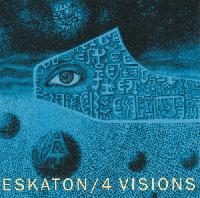
Review Summary: Another great work from the French prog scene. One of the easiest works to get into Zeuhl.
“4 Visions” is the second studio album of Eskaton that was released in 1981. The line up on the album is Amara Tahir, Paule Kleynnaert, Alain Blésing, Gilles Rozenberg, Eric Guillaume, André Bernardi and Gérard Konig.
As many of us know, the name Zeuhl comes from a word in the Kobaïan language created by Christian Vander and used by Magma. It’s a mix of classical and contemporary music, jazz, heavy metal and Jazz fusion. It has a melancholic and intense tone in the songs, hypnotic bass lines, ethereal keyboards and metals, and complex vocal harmonies.
And as many of us know too, Magma is a French band led by the classical trained drummer Christian Vander. The band is known for the vocals sung in Kobaïan (language created by Vander), for the live performances and for its intensely idiosyncratic sound. This unique style has a strong influence on the music scenes in Japan and in continental Europe.
So, let’s talk a bit about Eskaton. Eskaton is a French progressive rock band formed in Paris, France, in 1970, under the name Eskaton Kommandkestra. But, in 1974, they became simply Eskaton. In the 80’s, Eskaton recorded three albums that bear a similarity to Magma, no doubt helped by the fact that several of the band’s members were also members of Magma, “Ardeur” in 1980, “4 Visions” in 1981 and “Fiction” in 1983. But, despite Eskaton keeping the Zeuhl tradition, they dispensed with the made-up Kobaïan language. Instead, they sang in their native language, the French.
Besides the use of their native language, there is another significant difference between Magma and Eskaton. Magma writes lengthy epic compositions in a made-up language that tells a story. But Eskaton, on the other hand, writes songs that are long, yes (all songs on “4 Visions” are roughly ten minutes long), but that are individual pieces, not part of some larger whole. There’s no mystique aura that was replaced by down to earth music. But, that is invigorating too.
“4 Visions” is one of the greatest French progressive music successes. The rhythm section is certainly in the Magma style, circa 1975, yet the melodies and dissonances of Eskaton’s music are entirely their own. Vocalists Kleynnaert and Tahir often express themselves in unusual sounding chromatic scales that come closer to the sound to the new music groups like Univers Zero and Art Zoyd. The keyboards also have a distinct Magma influenced style with a conglomerate of influences. The four long tracks are very dynamic and filled up with an incredible spiritual intensity that ranges from ethereal to a harsh angst. All four songs are incredibly intense, only in “Pitié” there are moments of rest, but at the same time, this is sophisticated music showing the great possibilities of all these musicians, which they skillfully use.
The four original tracks are: “Eskaton”, “Attente”, “Écoute” and “Pitié” with between 8 and 13 minutes long. “Eskaton” starts and ends with overwhelming energy with analog synthesizers, Fender Rhodes, female vocals, mind-blowing rhythms, heavy bass and drums. This is what awaits you. “Eskaton” is one of the best compositions of the band, with the recording of the drums with incredible stereo. “Attente” has apocalyptic atmospheres, with a sharp wind at the beginning of the track until the attack of synthesizers, vocals, guitar, bass and drums ready for battle, phrases repeating vocals, dotted by the electric piano. “Écoute” starts with female vocals, without accompaniment, until the guitar enters followed by the overwhelming rhythmic session. A difference from Magma is the use of synthesizers to make electronic effects and noise here and there. But, the best is its growing development with a guitar propulsive solo with a truly annihilating ending. “Pitié” is calm and brings some peace to the album, with an intoxicating kaleidoscopic development of great beauty. This lasts only up to half of the track, when the vocal game starts to intensify, the rhythm gets heavier, the strident noises are noticeable and the strength of the music too. That’s Eskaton with the best of Zeuhl.
“Le Cri” is a piece added to the re-edition from 1995 to 2003. It doesn’t stand out in terms of level, but differs in sound with a much wider use of a synthesizer. At first it’s characterized by a more melancholy feel that is emphasized by nice bass lines and single synthesizer sounds. But with time it gets more intense, getting closer to the music of “4 Visions”.
Conclusion: Eskaton was one of the greatest of all French progressive rock bands. Magma references seem incidental in the light of the very powerful music that they created for themselves and their audiences. “4 Visions” is one of the few Zeuhl albums that can actually be placed in a row with the greatest achievements of Magma and is among the best progressive rock releases, in general. “4 Visions” is almost the perfect introduction to Zeuhl. It’s more accessible than Magma, but still conveys the trademark Zeuhl sound. And for those who might not enjoy the general weirdness of Magma, at least in the beginning, may still appreciate Eskaton, especially “4 Visions”. It’s highly recommended to both Zeuhl newcomers and Magma fanatics alike. If you are interested in knowing Zeuhl, this work is the right place to start.
Music was my first love.
John Miles (Rebel)