Review Summary: The abandoning of the long suite formula. It has some great material from the band.
“War Child” is the seventh studio album of Jethro Tull and was released in 1974. The line up on the album is Ian Anderson, Martin Barre, John Evan, Jeffrey Hammond and Barriemore Barlow. The album also had the participation of David Palmer and The Philomusica of London conducted by Patrick Halling.
Jethro Tull is a British band formed in Blackpool, Lancashire, in 1967. Initially, they played blues rock, but later the band developed their own sound that incorporates elements of hard and folk rock to forge a true progressive rock signature. Jethro Tull became one of the pioneers of what would be known as the progressive rock music. Jethro Tull has been referenced in popular culture and they became one of the best and most influential progressive rock bands ever.
“War Child” was originally supposed to be another conceptual album by Jethro Tull. The story of “War Child” was written as a metaphysical black comedy and was based on a teenage girl in the afterlife who meets some characters based on some religious Christian figures like God, St. Peter and Lucifer, depicted as if they were shrewd businessmen.
Originally, the music of the album was meant to accompany a film project. On the other hand, initially, “War Child” was planned to be a double album. But, in the end a final decision was taken. It was decided to release a single album with only ten tracks, after some failed attempts to find a movie studio that was interested in financing that film.
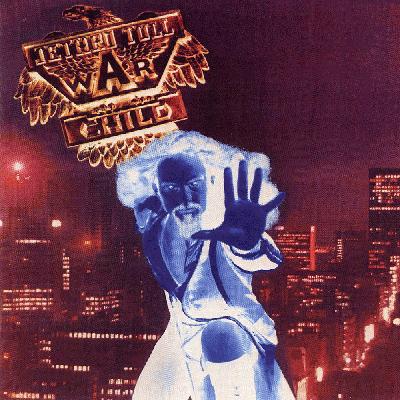
The front cover of the album is a picture of Melbourne in Australia, with a photo of Ian Anderson in negative and the back cover of the album features photographs of people, connected to the album, including the five band members, and people related with the titles of the songs, such as friends, wives, girlfriends, staff and even the manager of the band.
After two albums with only two side-long tracks each, Jethro Tull returned to the song format for “Warchild”. The music is just as diverse as the instrumentation suggests making it a diverse album with a distinctive sound. This is probably due to two things. In first place, as on “A Passion Play”, Ian Anderson plays a relatively large amount of saxophone alongside the inevitable flute, a component not usually associated with the typical Jethro Tull sound. Another unusual instrument used extensively here is John Evans’ accordion, also not exactly a typical prog sound. All this made “Warchild” a diverse and colorful album, whose mood forms a stark contrast to its predecessor, “A Passion Play”.
The title track starts with sounds of an aerial bombardment. It’s a classic song with weird instrumentation. It has good piano and saxophone works. “Queen And Country” is a good folk song but is a bit repetitive. It has good orchestration and a nice violin and accordion. “Ladies” is a good classic Jethro Tull ballad with a medieval style. It has good guitar and violin works, good acoustic parts and nice vocals and choral parts. “Back-Door Angels” is another classic Jethro Tull song. It’s a hard rock song with heavy parts and acoustic parts. The lyrics attack some religious concepts. It’s in the vein of “Aqualung”. “Sealion” is in the traditional Jethro Tull style. It has a folk rock atmosphere with good electric guitar sections and accordion parts. It has fine acoustic guitar parts too. “Skating Away On The Thin Ice Of The New Day” is a great acoustic song with a fantastic orchestral arrangement. It’s one of the favourite songs of the band, usually performed live. It’s with “Back-Door Angels” one of the two best tracks on the album. “Bungle In The Jungle” is a melodious song composed and orchestrated in a pop style. It's simple, humorous and nothing pretentious. It’s the typical hit song to sell an album. “Only Solitaire” is a short, sweet and nice acoustic ballad with good lyrics, enjoyable voice and nice acoustic guitar work. “The Third Hoorah” is a song with a folk rhythm in the style of a military march. It has good performances by all the band’s members. But the song is repetitive and boring. It’s the weakest song on the album. “Two Fingers” is in a fairly straight rock style. It’s interesting the constant changes from the acoustic to the electric passages. It’s a powerful song with good rhythm and well orchestrated. It’s a nice way to close the album.
Conclusion: I really never paid much attention to “War Child”, especially because of three reasons. First, I never liked soundtracks for movies made by progressive rock bands. Second, I never particularly liked the cover of the album. Third, the album was released in the middle of two of my favourite albums of theirs, “A Passion Play” and “Minstrel In The Gallery”. However, I must confess this isn’t a bad album, really. It’s an album well balanced with two great songs “Back-Door Angels” and “Skating Away On The Thin Ice Of The New Day”, and where all the other songs are somehow interesting with the exception of “The Third Hoorah”. Just one last word about the seven bonus tracks. As usual, I don’t review bonus tracks. However, I must say that they are very good and they’re an excellent addition that increases the global quality of “War Child”. So, in my opinion, this is an excellent pretext to buy the digitally remastered CD version.
Music was my first love.
John Miles (Rebel)