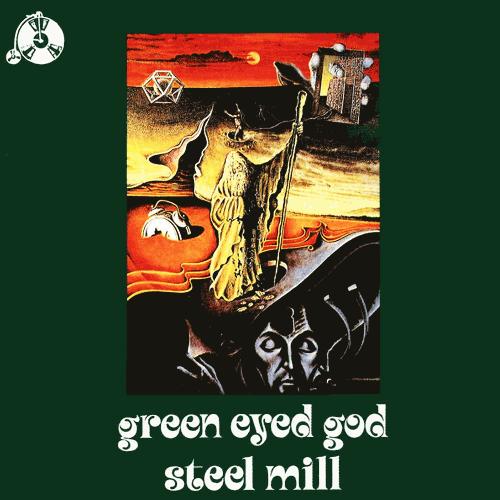
Review Summary: One of the most obscure releases from England. It’s a bit dated but still great.
“Green Eyed God” is the debut and only album of Steel Mill that was released in 1972. The line up on the album is David Morris, Terry Williams, John Challenger, Jeff Watts and Chris Martin. The album also had the participation of Graham Parker and Derek Chandler.
It’s really impressive the number of progressive rock bands, mostly unknown, that emerged in the late 60’s and during the 70’s all over the world. And the United Kingdom wasn’t an exception. Like every prog scene, the 70’s British progressive rock movement had its bands that came and go without creating a ripple, some justifiably but some others inexplicably. Unfortunately Steel Mill was one of those cases. Steel Mill made excellent music, mixing progressive, folk, hard/heavy rock and blues and like so many other bands they didn’t get the real recognition that they truly deserved.
Steel Mill was formed in Wandsworth, a working-class district of south London, during the late 60’s. The nascent band rehearsed for about one year, playing very few live gigs, before cutting demos in April 1970. Despite some influences of the blues, their sound was miles away from the British blues blueprint that then dominated London. Their sound was more influenced by the hard/heavy rock beneath their pastoral prog with some hints of folk. After the release of their single “Green Eyed God” in 1971, Steel Mill released in the next year their only studio album with the same name of their single. At the time the album fell through the cracks of consumer tastes. So, this was the reason why it was originally released in Germany. Curiously, it was only released in the UK in 1975, three years after the group’s demise.
Steel Mill released a highly modern prog rock work with “Green Eyed God”, at the time. However, for many people the whole thing sounds pretty old-fashioned and should therefore only be of interest to people with a soft spot for the oldies like we have some on Sputnik. Still, this thought can be a little bit reductive. On “Green Eyed God” we can hear a well-playing band that moves somewhere in the field of tension between classic blues rock, the early Rolling Stones and the psychedelic Pink Floyd early phase. The last but not the least, because of the cleverly interspersed saxophone and flute passages, the comparison with Jethro Tull comes to mind, to which Steel Mill comes close stylistically and qualitatively. This is a fascinating and schizophrenic number boasting as much in inner city bluster as pastoral purity.
“Green Eyed God” has eight tracks. The opener “Blood Runs Deep” alternates between the bludgeoning riffing of Black Sabbath and keyboards that spark the refinements of Uriah Heep or Atomic Rooster. This is one of the best examples of the heavier side of the band. “Summers Child” is a very different sounding number. It’s a beautiful, if not a naïve, soft ballad with some nice flute work floating wistfully along, that transforms itself into a driven mid-tempo rocker with some guitar soloing and vocal harmonies. “Mijo And The Laying Of The Witch” has an intriguing mysterious atmosphere. It begins with some portentous lines before settling into an insistent heavy trudge marked by histrionic vocals and a gentle sax work. It continues sounding completely different from the previous two tracks. “Treadmill” is punctuated by rhythmic chants, grunts and dragging chains. It’s probably the hardest/heaviest track on the album, even if it’s one of the fewer originals too. As a whole it’s great and keeps the quality of the album in a high note. The title track with its eastern-sounding prefaces its own proto-metallic style featuring wooden blocks and woodland flutes sounding like Jethro Tull at their most eerie. This is probably the track that gives the album its most prog content. “Turn The Page Over” offers yet another stylistic shift with its piano driven. It’s the most commercial song on the album that shows some single potential thanks to its memorable vocals and snaking guitar lines, underpinned by driving piano chords. “Black Jewel Of The Forest” is very strong. It’s another ritual sounding track with some heavy pastoral flute, tribal drumming and eerie hauntingly atmospheric background vocals. This is a track with a grandiose almost satanic mood. The album ends with “Har Fleur”, a strange unusual instrumental, again sounding different from the rest of the album.
Conclusion: I’ve no doubt that with Steel Mill and their “Green Eyed God” we are in the presence of a great album of a great band that unfortunately had also a very short life, as happened with so many others. “Green Eyed God” remains an enticing slice of little known prog, unjustly ignored at its time of creation. Steel Mill possessed a recognizable spark of imagination and talent that can be appreciated even decades later. Steel Mill most certainly deserved more than their fate gave to them. Anyone into heavy rock with a prog, jazz, and folk feel from that era would be well advised to check this release out. Finally, the front cover of the album. That cover painting is beautiful. I remember reading it was commissioned from a German painter, which makes complete sense. You can make out the influence of Salvador Dali.
Music was my first love.
John Miles (Rebel)