Review Summary: With Zora at the helm, Blackbriar can refine their sound without losing their allure.
Blackbriar has long been one of symphonic metal’s best-kept secrets. As an independent act, they released three EPs and an excellent full-length debut, all of which largely slipped under the radar despite their quality. What many fans of the genre overlooked was a band that stood apart from their peers—one that blended symphonic metal with eerie folk melodies and a distinctly gothic sensibility. While their peers were pushing the bombast to its limits, Blackbriar was quietly crafting a sound both nuanced and macabre, elevated by the hauntingly beautiful voice of Zora Cock. On the strength of her voice, Blackbriar has experienced a slow rise in popularity, but it wasn’t until
A Dark Euphony that their momentum truly began to build.
It is no wonder that
A Dark Euphony marked a turning point in Blackbriar’s career. With its refined production, diverse songwriting, and assured performances, it demonstrated the band operating at the height of their craft. What made it especially effective was its balance: the eccentric gothic flourishes that defined earlier releases were still present, but they were now integrated into songs that could more effectively resonate with a wider symphonic metal audience. For longtime listeners, the album retained its macabre charm; for newcomers, it offered a point of entry without demanding too much patience for the unusual. Central to it all was Zora Cock, whose voice and lyrical vision transformed the record into something unmistakably Blackbriar. So, what does this history lesson have to do with
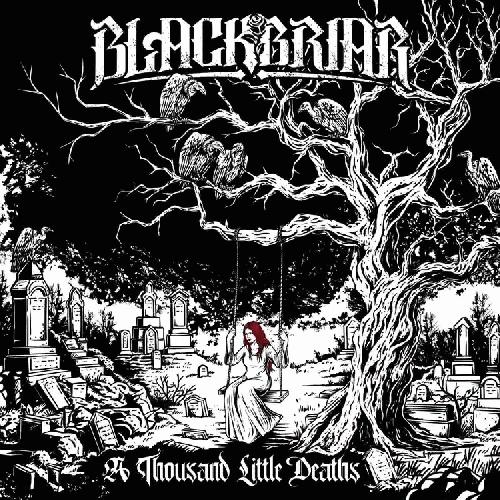
A Thousand Little Deaths?
A Thousand Little Deaths picks up almost exactly where
A Dark Euphony left off. The production, tone, and overall aesthetic remain consistent, continuing the polish and refinement that its predecessor began. The most noticeable shift comes in the near-complete removal of the band’s eccentric quirks. Where
A Dark Euphony still carried hints of their stranger impulses,
A Thousand Little Deaths leans fully into accessible gothic melodies, sweeping symphonic passages, memorable choruses, and a riff-driven foundation. The album still maintains Blackbriar’s signature atmosphere, but it feels more romantic than unsettling, more elegant than eerie. Zora’s vocals, too, are mostly played straight without the melodic acrobatics she is known for. It’s a trade-off—greater cohesion and accessibility on one hand, but fewer flashes of warped unpredictability on the other.
Another noticeable shift on
A Thousand Little Deaths is the increased dominance of the guitars. While guitars have always been a part of Blackbriar’s sound, they previously served more as a supportive layer, tucked behind the vocals and keyboards. Here, they are far more prominent—chunkier, heavier, and often driving the songs forward with near-equal importance to Zora’s melodies. On tracks like “My Lonely Crusade,” the riffs stand toe-to-toe with the vocal lines, demanding as much attention as the singing itself. In some cases, such as “A Last Sigh of Bliss,” the guitar presence is so pronounced it almost feels like an alternate-universe experiment: what if Zora fronted—and wrote for—Epica? All joking aside, these moments underline just how prominent the guitars have become, giving Blackbriar’s sound a more forceful edge than ever before, but at the expense of the Blackbriar quirkiness.
So, does
A Thousand Little Deaths deserve the same praise as its predecessor? I believe it comes close. While the band’s refinement has tempered some of their fantastical, gothic quirks, and Zora is less indulgent with her eccentric vocal flourishes, there is still enough of the classic Blackbriar essence woven together with the newer elements to make this a compelling release. And let’s be honest—any longtime fan will tell you that Blackbriar rises or falls on Zora’s shoulders. Unlike many bands, where a vocalist swap might be survivable, without Zora there is simply no Blackbriar. It is her voice, her lyrical vision, her melodies, and her enigmatic presence that create the haunting allure and strange mystique at the heart of the band. Ultimately,
A Thousand Little Deaths is a beautifully produced, emotionally resonant work—and as long as Zora leads the band, Blackbriar will remain uniquely compelling.