Review Summary: This is another amazing work from this band, probably the best.
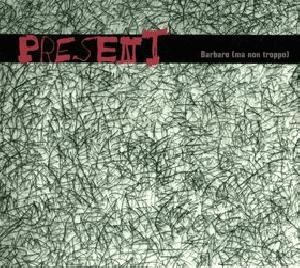
“Barbaro (Ma Non Troppo)” is the seventh studio album of the Belgian prog band Present. The line up on the album is Roger Trigaux, Reginald Trigaux, Pierre Chevalier, Matthieu Safatly, Pierre Desassis, Keith Macksoud and Dave Kerman.
Despite Belgium not being one of the most known countries in the prog rock world, there are many prog bands that were born there. In the 70’s, it comes to my mind Univers Zero, Present, Cos, Aksak Maboul, Julverne, Lagger Blues Machine and one of the most known of all, Machiavel. But, after what became known as the classic prog rock era, many other names appeared in that country like Hypnos 69, Battlestations, Aranis, Quantum and Mindgames, only to mention some of them. But, of all these bands, there are two that deserve a special mention, Univers Zero and Present. Univers Zero is one of the most unique and influential bands ever to be associated with prog rock music and one of the bands that founded what became to be known as the RIO movement. Present is a side project from Univers Zero.
So, as mentioned above, Present is a side project of Univers Zero and was formed in 1979 by Roger Trigaux, a founding member of Univers Zero. Roger left Univers Zero after the release of their second studio album “Hérésie” in 1979. He left Univers Zero to concentrate on his own vision and to have more space and scope for his own compositions. In terms of sound, Present also moves away a bit from the sound of Univers Zero, despite the involvement of some ex-members of Univers Zero. The sound is overall more electric, rockier and less “classic”, even if the compositional inspiration from the modern classics has certainly remained with its oblique and gloomy sound, which is very much the case in Present as well. Even a strong Zeuhl influence can be discerned. Present has reinvented themselves as a band.
It took eight years for the RIO fans’ hunger for the new material from the band to be satisfied by Present. The Belgians’ new work, I’m talking only about the standard edition with only the CD, is a bit short for what we would expect. The CD has only a playing time of less than forty-five minutes. And for those who are familiar with the scene, will notice that the sixteen minutes of “Jack The Ripper” is by no means a new track. It’s actually a composition for Univers Zero released on their 1979 album, “Hérésie”. That leaves less than half an hour of new music as a result of an eight year break. But I don’t want to complain because the music on the album is all great, even the version by them of “Jack The Ripper”.
“Barbaro (Ma Non Troppo)” has three extended suites that demonstrate the ensemble at the peak of their playing abilities. “Vertiges” was composed by Roger Trigaux and his son Reginald. In the twilight of the electric moans, of the rolling piano chords of Pierre Chevalier, cello passages by Matthieu Safatli and rare saxophone reflections of Pierre Desassi, the track flared up with a characteristic Middle Eastern intonation. Not to mention the virtuosic technique of the bassist Keith Maksoud and the power of the drummer Dave Kerman. The viscous density of rock dissonances is interspersed with ominously atmospheric chamber notes. Every sound nuance is perfected to the smallest detail. The free fantasy on the theme of Hitchcock’s movie “Vertigo” is full of furious energy, pouring out gradually, but eventually flooding all living things. “A Last Drop” composed by Pierre Chevalier is close to academic standards in its musical structure. Its nervous excitement is skillfully maintained by the forces of the all leading players. An emotional break occurs in the middle of the track, when aggressiveness is replaced by apathy. And the finale is marked by a slowly fading symphonic flourish. “Vertiges” and “A Last Drop” are wonderful pieces of music full of darkness, power and still heavy riffs, even if the music seems much more relaxed than before. For the admirers of Univers Zero, the famous opus “Jack The Ripper” from their album “Hérésie” from 1979, one of Univers Zero’s best pieces with its gloom and sinister atmosphere, is reserved “for the dessert”. At this point, the team led by Roger sets off into a real breakaway, at first disguising itself as aesthetically pleasing philharmonic players and then reaping a storm in the form of many dislocated atonal parts. This version of “Jack The Ripper” is maybe its definitive version that is already impressive in the original.
Conclusion: This is the latest studio album from one of the masters of the avant-prog. Some may find the amount of new music on this album disappointing because the album has only three songs, forty-two minutes in total, and one of which is a new interpretation of the song “Jack The Ripper” of Univers Zero. However, it doesn't bother me because the compositions are again of the first class level. Besides, the original track of “Jack The Ripper” is an unknown track for me because “Hérésie” is an album that I don’t have yet. The music continues largely on the same lines as the band’s previous studio album “High Infidelity”, which means, extremely complex mathematical rhythms, dark moods, heavy metal church and precise playing together by all musicians. However, this is an album not as heavy as “High Infidelity”.
Music was my first love.
John Miles (Rebel)