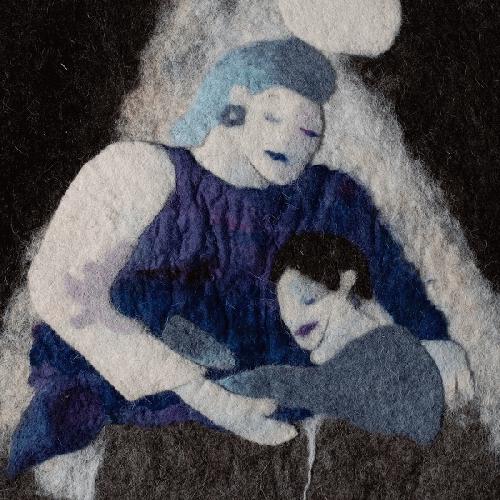
Aging’s always been in the picture for Tindersticks. Not front and centre, maybe, but lingering—in the corners of the room, in the way things settle. But Soft Tissue doesn’t just suggest it. It’s made of it. Many tracks feel like they’ve been diffused through the kind of quiet you only get from years wearing you down. The muted weight of time pressing in from all sides. For a band so historically steeped in malaise and elegance, it’s saying something that this might be one of their most hushed and hypnotic statements yet.
Still, calling this album minimal feels a little off. It gets pretty quiet, and sure, it drifts more than it moves. But there’s breath in it. Life, even. The kind that doesn’t shout but lingers in the bass lines, in the rustle of brushed drums, in the way a horn appears halfway through a track, like it wandered in uninvited and decided to stay. It’s not like it’s just space and silence—there’s a pulse here, a low, steady one, like the sound of someone thinking out loud.
And there’s a looseness, too. Not sloppy, but unforced. Like “Don’t Walk, Run,” which lounges more than it strolls, carried along by this lowkey groove that could almost pass for jazz if it wasn’t so sleepy. Or “New World,” where the double bass hums beneath everything like an old engine that just won’t quit. They don’t break the spell—they stretch it, blur the edges a little. But a lot of the record moves like it’s underwater, like it forgot what momentum even feels like (like in "Fallen, the Light," a track that moves as though it's treading on glass, Staples poised to be swallowed by the stillness around him). And that’s not a complaint—it’s more like a posture. A kind of surrender. This isn’t minimalism for the sake of sounding refined, and it’s not that sterile hush a lot of older bands settle into when they think “mature” means “lifeless.” This feels frayed in places, but there’s warmth in how tired it sounds. Not dead, just... slumped into itself. It’s not just age—it’s erosion, the slow wearing down of big declarations into mumbled reflections.
Staples doesn’t sing here so much as exist in the mix. His voice—already more ghost than guide—leans further into decay, barely rising above a whisper in some tracks. It’s like he’s mumbling to himself and the mic just happens to be there. And yet, somehow, he still hits like a brick when he wants to. Because that sigh, that hesitation, that moment where the sentence just trails off—it holds more weight than a full monologue ever could.
Every arrangement is subtle yet surgical. The strings curl around Staples’ voice like smoke. They don’t announce themselves. They just drift in and out, punctuated by quieter moments. But even when the songs feel skeletal, there’s this density to them—like the silence itself is doing heavy lifting. Conversely, there’s also some much-needed warmth provided via Gina Foster’s soulful singing, leading to some surprisingly uplifting moments—particularly in “New World” and “Turned My Back,” which almost feel like outliers. And then there's the centerpiece, "Always a Stranger." This one's the most viscerally emotional track here. The Rhythm section pulses like a heartbeat that's learned to live with being broken, but it's that chorus—aching, cyclical, and strangely radiant—that latches onto something more primal
The closing stretch almost unravels entirely. “The Secret of Breathing” barely clings to song-form, with Staples’ voice fraying into something closer to breath than melody. The lines he sings feel half-remembered, more like internal repetitions than clear statements — like he's mumbling them to himself in the dark. And then there’s “Soon To Be April,” the kind of closing track that doesn’t resolve so much as exhale. Staples murmurs his lines like he's letting go of something, not stating it. There's a gentle pull toward renewal, but it never forces the moment. The piano and strings lift just enough to hint at change, but always retreat before it lands.
And then it’s gone. Not with a bang, not with a fadeout—just a kind of stillness, like walking into a room after everyone’s already left. That silence after is part of the album too. It hangs around longer than it should, and maybe that’s the point. Soft Tissue doesn’t demand anything. It just leaves enough behind that you start to wonder why it’s still sitting in your chest an hour later.