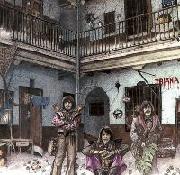
Review Summary: An exciting and interesting mix of prog and flamenco.
“Hijos Del Agobio” is the second studio album of Triana that was released in 1977. The line up on the album is Eduardo Rodriguez Rodway, Jesús De La Rosa and Juan José Palacios. The album also had the participation of Miguel Angel Iglesias, Antonio Pérez, Manolo Rosa and Enrique Carmona.
Triana is a Spanish progressive rock band. It was formed as a trio in the early of the 70’s. The three musicians came more or less battered to play around and seek life, the drummer Juan José Palacios, the guitarist Eduardo Rodriguez and the keyboardist and singer Jesús De La Rosa. Jesús De La Rosa was the poet and the absolute soul of the group. Unfortunately, in 1983, he died in a tragic car accident, and with him the group died, for more spurious play-offs that have seen the light since then. The band remained under the name of Triana, without any original member in its ranks.
In their origin, Triana practiced a unique and incomparable mixture of musical elements of marked Andalusian roots with others from newly discovered progressive paradises and which weren’t strange to them. It was not in vain they were called “The Andalusian Pink Floyd”. It’s still admirable even today how they were able to mix the psychedelic atmospheres, with the Spanish guitar, the bulerias rhythm, the cadence and the typical cante Andalusian with palms.
The first three albums of Triana, those of their progressive/psychedelic era or as we want to call it, release a parsimony, a tranquility and a certainty in what is said and in what is done. Triana’s first album, “El Patio” of 1975, already had everything it had to have. Without promotion, without any support, it spread like wildfire among the youth, among the progressive lovers, among the hippies. However, economically it was a disaster because it only sold 75 copies. The fact is that their second album, “Hijos Del Agobio” of 1977, wasn’t anything more than a logical continuation of what was made in “El Patio”. In its turn, “Sombra Y Luz” in 1979, took beyond all what was proposed on both two first albums.
Triana is perhaps the best known and most successful prog rock band to come out of Spain and it’s really not hard to see why. Certainly the band was off to a slow start with their debut, but their second album sold better than their debut thanks to a high profile festival held in Madrid. There’s a big reason why Triana was so popular in their home country. Their music was quite accessible, included local cultural elements in their music, and unlike Gentle Giant’s albums, you don’t need to listen to it many times to get on it. It’s actually pretty accessible prog. In fact, someone had pretty much described them as a flamenco version of The Moody Blues. I notice some Pink Floyd and King Crimson elements as well. Like the more obscure earlier 70’s British prog rock acts, Triana was more interested in writing and recording great songs, and giving it that Spanish touch which obviously differentiate them from those British acts, than going for tons of tempo changes every second. Yet, the music is progressive enough for the prog rock fan that doesn’t always need Gentle Giant’s complexity to enjoy it. Triana has that instantly recognizable sound, helped by the vocals.
On the title track, the poetry of Jesús De La Rosa, always full of symbolism and enigma, is deep and heartbreaking. It has flamenco guitar and tasteful keyboards. “Rumour” has a wonderful melody that rides on the trepidante and subtle battery work, one of the architects of the peculiar sound of the band. “Sentimento De Amor” is a calm and nice ballad more oriented towards the classical guitar sound than to the gypsy spirit. “Recuerdos De Triana” is played almost entirely in the same line and is accompanied by the end of voices unleashed. Everything here reflects the magic of the album. “Ya Esta Bien” shows their most “energetic” side. It isn’t very complex or challenging, but it’s nice. “Necesito” is the continuation of the previous song. The music is flamenco, heavy as psychedelic music, with interesting lyrics. “Sr. Troncoso” is a nice ballad, with a rhythmic curious concept, accompanied only by Spanish guitar. It can bring to us a balsamic climax, beautiful and unique. “Del Crepusculo Lento Nacera El Rocio” closes the album with some variety that blends excellent guitar solos and a great synthesizer work. The lyrics are great. It’s a perfect end to a nice album.
Conclusion: “Hijos Del Agobio” is a very good and balanced album. It has some very good tracks, especially the title track, of which standout, in terms of prog, the title track, “Sentimiento De Amor” and “Necesito”. But, in general, all tracks on the album are good. They played quite simple soft symphonic prog rock with a strong flamenco-influence. Wonderfully positioned, it provides a sublime sound that characterizes the entire album. The recipe for emotional flamenco prog rock known from their debut also works on this second album and envelops the listener with a yearning melancholy. “Hijos Del Agobio” is one of the highlights of the playful, highly flamenco prog music style. Triana can be added to Carmen, as one of the best and most representative prog rock bands with a cross between prog and flamenco.
Music was my first love.
John Miles (Rebel)