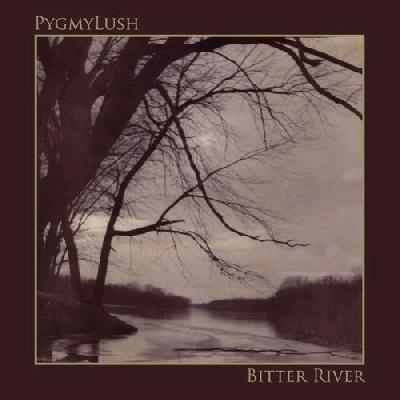
Review Summary: In which noisy hardcore and folk-rock intertwine in dark matrimony...
Has a piece of music ever terrorized you in your sleep? I've had plenty of "can't stop the car" dreams in my life, but only two legit nightmares that caused me to wake in a panic, and one of those nightmares occurred shortly after I discovered
Bitter River at 17 years old. The dream was in black and white, and there was a hooded figure ringing the doorbell of my home as I lay in bed terrified, watching myself from an outside perspective and knowing that I was about to die. Lightning flashed and the rain began pummeling my window as the doorbell ominously rang again, and I woke up to the noisiest part of "September Song" (the 25-minute drone track that lives on side B of the record) blasting on the computer beside my bed. Dream state and reality briefly overlapped as I scrambled in fright to turn down the volume, and I remember just sitting there in a surreal daze for a minute to recover. The album has stuck with me ever since.
But let's back up. For the uninitiated, Pygmy Lush formed in Sterling, Virginia, from the then-ashes of screamo revolutionaries pageninetynine.
Bitter River was their debut release, and it has always stood out as the oddball "Jekyll and Hyde" entry in their discography due to its split personality. It was the band's only record to retain the influence of their abrasive punk roots before going all in on the gloomy folk-rock side of their sound in 2008 with their sophomore follow-up,
Mount Hope. The original concept for Pygmy Lush (as I understand it) was to be a shapeshifting collective with enough loud and quiet material that they could switch up their setlist at will to suit the vibe of any bill they could get on, and
Bitter River fully represents both extremes of that idea. It's a boon or a curse depending on how well you get on with each personality.
Bitter River has been cited as disjointed, and I can see where the criticism comes from, but disjointed implies a failure to connect ideas in a cohesive fashion, and I don't see that as the case here. Is it throttling? Absolutely—but in a way that makes the album feel like less of a disarray and more like a scripted conversation between wind-ravaged peaks of hardcore and the old-growth valleys of acoustic dread that sit below.
I'll concede that the whiplash from the first two songs is jarring, with "Nonsensical Tremor" tearing into existence with a blood-curdling scream and 36 seconds of noisy hardcore before segueing straight into two somber acoustic tracks, but from there out the album flips effortlessly between states of mania and despair. The folk songs are simple in structure but lush with ghostly melodies, tired croons, and a rich, oaky bottom end from the bass and kick drum, and the loud songs (while more methodical and groove-oriented than their earlier material with pageninetynine) blare with distortion and layered screams that sound like the god damn lashing double tongue of hell. The contrast of styles is intense, but the overcast sense of doom works to connect each song to a central theme. If we set up a Venn diagram, we would find "Send Bombs (I)" as a great example of their vicious side at its most narratively and melodically developed, and "Hurt Everything (II)" holding up the inverse as their most raucous, swashbuckling folk-rock song that borders on being a sea shanty for drunk pirates. The two reimaginings of "Send Bombs" and "Hurt Everything" also show the band blurring the lines between their two identities with different expressions of the same idea, which, along with the undulating nature of the tracklist, almost makes the album feel like a hall of mirrors that could fold in on itself. And there is still enough variation amongst the outer reaches of the Venn diagram to keep the album from ever feeling stale even in relation to its specific mode.
There is one outlier, however, which brings us back to where we started this review: the random 25-minute drone track. "September Song" is for all intents and purposes an optional B-side piece that you can listen to or skip, but I strongly implore you to let it roll and wash over you; let it cleanse your spirit after the whiplash of emotional states that you just experienced. If you enjoy ambient drone music at all, it's a pretty captivating piece, with some really dissonant and serene movements to work through. I think Pygmy Lush ultimately made the right choice to go all in on fully developing the gloomy folk-rock side of their sound, as their two follow-ups to this are both best-in-class examples of that genre, but
Bitter River will always have a special place in my heart for its scruffy character and brazen refusal to pick a lane. It's a classic because it represents two (technically three) styles of music I love, done exceptionally well on both ends of its sonic spectrum, and wrapped up in a dark mystique that never fails to draw me back in—or give me nightmare flashbacks.
Bitter River forever.