Review Summary: “ a casual reflection on the idiom of the murder ballad, and how fucked up it was that we have a tradition of song that is basically dedicated to men murdering women” - Steve Albini
The beauty of Artemisia Gentilischi’s painting Judith Beheading Holofernes is in stark contrast to its subject. Judith’s story doesn’t have quite the redemptive quality of Esther’s, and its relegation to the Apocrypha makes it one of the less known biblical tales, but it is rife with a psychosexual depth that makes it one of the great subjects of the premodern art world. In brief, the invading Assyrian general Holofernes invites Judith, a Jew, to his tent. There, she seduces him, and, while he lies sated and slumbering, she beheads him with his own sword.
Gentilischi’s painting is itself, a masterwork. The rich crimson of the velvet cloths draping the body of Holofernes. The arc of the arterial blood jetting out from his opened neck. The disgust and determination lining the face of the heroine as she grips the hair of her victim and saws away as he frantically pushes against the maidservant holding him down. The work itself has been theorized to be a depiction of Gentilischi herself enacting an artistic revenge against her rapist; if this theory is to be believed, it represents an artistic reclaiming of her agency and power.
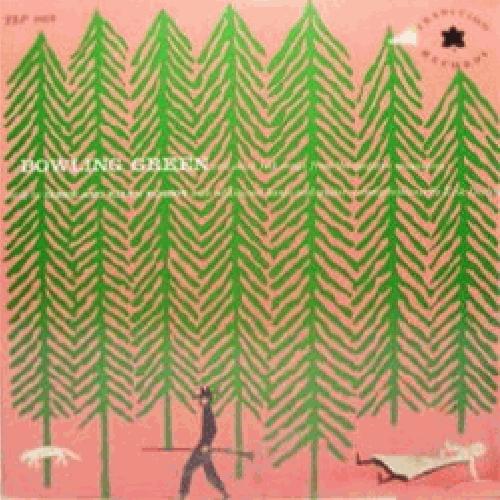
If we contrast the painting of Judith with the stark, primitive art of
Bowling Green…, a starkly opposed visual story takes place: a man in black carrying a gun in a forest of towering pines, behind him, the inert corpse of a woman. The postmortem of a violent act hanging in the air betrays the tranquility of the pine forest, the childlike primitivity of the art divesting as much as possible aesthetic appreciation to display the most bare elements of a dynamic which has existed time out of mind. This is no revenge fantasy. This is a stark and hopeless realism, where the humiliation of the male figure is answered with lethal violence.
The themes of the Kossoy sisters are the reverse of Gentilischi’s depiction of feminine vengeance, but they share a common root. Female victimization is the running theme of their music, the lamentation of the woman murdered at the hand of her lover, or, less romantically, consigned to the domestic drudgery of the wife and mother, envious of the comparative freedom of the single girl. That these songs were recorded at a time when the second wave of feminism was just roaring into gear can hardly be a coincidence. When one is not born, but rather becomes a woman, one is socialized into the world of desire’s object, a world to which the woman is forced to submit. The luminosity of the Kossoy sisters’ music doesn’t make this bleak resignation something to be celebrated, but gives it a dignity, and a sense that this state of things is in no way limited to the hills and hollers of the foggy mountain backwoods.
The songs stab like a knife in no small part because the Kossoy sisters’ voices are so lovely in and of themselves. I’ll Fly Away’s wistful longing for eternal peace is as sweet as birdsong, its harmonies so effortless and beautiful they almost seem so inhuman, as though the intangible world could be brought within reach through these songs. In The Pines, divested of the stormy blues sound imbued by Leadbelly, is given a sense of tension by the album art, as an unfaithful lover is confronted by her wounded man. The ending of this encounter is left open, but given the themes of the rest of the album, how can we interpret the song except through the aftermath depicted on the cover?
Ending with the morbidly abusive humor of What Will We Do With The Baby O is almost a stroke of genius if we look at it as drawing directly from the themes of the preceding songs. As the sisters sing cheerily of visiting torments on a crying baby, the accusatory finger isn’t pointed at the singers, but rather to a social arrangement in which the choice to have a baby isn’t a choice at all. There’s a resentment under the macabre humor, a resentment towards a child, yes, but also to motherhood as a crushing reality, one which suffocates all potentiality until only that of the mother submitting to her child’s needs remains.
The album isn’t entirely made up of the plight of women, but its thematic focus on death and longing, whether for temporal happiness or the eternal hereafter, is colored by the kind of fatalism that defined the experience of the Appalachian approach to life. Death is not a sudden rupture, but an expectation, and in many ways, a welcome release. The Darby Ram is as doomed for his vitality and strength as the butcher and his boy are, as the victim at the banks of the Ohio is likewise doomed for her devotion and weakness in the face of male rage. The confrontation with this inevitability is what makes the disjunction of beauty and inexorable mortality somewhat alien and disturbing to the modern mind. The tragic dignity of this acceptance of death’s inevitability is perhaps the only escape, the only power to be found in a world of almost complete powerlessness, even against the mere facts of nature.
Artemisia Gentilischi was much more than the narrative of her rape and her artistic revenge, of course. To reduce her to the simply a woman who painted her own vengeance is to flatten her legacy, to make her another victim rather than the masterful artist she was. Judith Beheading Holofernes is not simply an act of retribution; it is a display of mastery, a reclaiming of space within a world that sought to erase her. Likewise, the Kossoy Sisters, in echoing the sorrows of the generations of Appalachian women who had lived before them, give new voice to a stark reality of a working poor woman that’s far more universal than its idiom might have you believe. The likes of Lingua Ignota can claim a direct heritage from this album; small wonder that this is the idiom that Kristin Hayter has turned to in her later career. The weight of generations rests in this music, and it would be too easy to shrug it off to appreciate its loveliness. But then, you’d fall into that same trap we’ve been caught in time out of mind, and that would be a grave disservice to every experience depicted by this music.