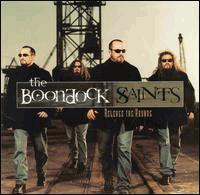
Review Summary: "The next Metallica...the next Beatles..." the next 90's Trivia question: "which rock band, helmed by a filmmaker, was named after his first film and got dropped from four major labels due to said filmmaker's attitude problems?"
The Boondock Saints's first and last album, Release The Hounds, is certainly an interesting one, though 95% of that intrigue comes from its tumultuous production history than it does anything else. In fact, the few who purchased this CD back in 2000 probably found little to be fascinated about unless they recognized the faces on the album cover. In all fairness, there really isn't much terribly wrong with this album, but its background is basically the only thing worth discussing when it comes to The Boondock Saints, and it raises a ginormous looming question: why did this band come so close to making it big?
Now, filmgoers may look at that band name and say "hey, they named themselves after that cult movie from the late 90's?" The connection runs much deeper; this band is the creative child of Troy Duffy and his brother Taylor, the same Troy Duffy who wrote, produced, and directed 1999 cult classic The Boondock Saints. Which came first? Technically, this band went by the name The Brood for its first couple of years, but failed to find success outside of playing a few local bars and taverns. When Troy Duffy became noticed as "Hollywood's next Tarantino" for, more or less, being Harvey Weinstein's go-to bartender, Duffy was given $15 million to produce his dream project, The Boondock Saints. Despite never having gone to film school, or never even have made a single short film or commercial, Duffy was given full creative control over a major studio project, and part of that control included his band, The Brood, doing the film's soundtrack and getting signed to a major label.
Unfortunately, personalities ended up stirring the pot and few things worked out in the end. Although Duffy claims the film was hindered by the Columbine Shooting of 1999, most claim that the film was hindered by Duffy's egomaniacal narcissism and anger issues. The film would ultimately be released in 1999, but only after Weinstein backed out, several others studios backed out, the film's budget was reduced from $15 million to $4 million, and nobody wanted to distribute it due to the myriad of long-stemming controversies associated with Duffy. The Brood similarly were passed around and dropped by several major labels, including Maverick, Dreamworks, Roadrunner, and Atlantic, mostly because people saw the potential there, but realized how difficult it was to work with Troy Duffy. Maverick head Freddy DeMann even called The Brood "the next Metallica" and "the next Beatles."
I find myself a bit perplexed, wondering why so many record labels were willing to give The Brood a chance. Whereas his screenwriting holds quite a few interesting ideas that could understandably have producers intrigued, Duffy's songwriting doesn't. The Brood were a fairly atypical grunge band ripped straight from the late 90's, lifting heavily from early 90's acoustic grunge like Alice In Chains and Temple of the Dog, and from the newer post-grunge movement like Seether and Default. Even for grunge fans, what's so unique about that? Especially by 2001, this sound was oversaturated and been-there-done-that, and The Brood add far too few drops of originality to the pot. Perhaps the most unique thing about the band are the vocals, with dual-leads delivered by Troy and Taylor Duffy similar to Alice In Chain's dual efforts from Staley and Cantrell, though these vocals are light, tenory, and oftentimes nasally. There are quite a few moments where Duffy's vocals sound closer to Weird Al Yankovich than a tortured grunge vocalist, a statement I'm sure he'd challenge me to a bar fight for suggesting.
Yet there isn't much to tear apart here. The album is musically completely adequate and standard, with straight forward songs and straight forward structures. Most of the riffs and guitar parts are simply okay, and few moments really stand out as being above the crop. The few songs that do include "Invincible", which has a pounding waltz beat and makes good use of the harmonizing vocals in what sounds like a rockified working-class bar drinking shanty, and "Pipes", which I incorrectly assumed was a rock cover of a millennium-old Celtic folk anthem. In writing that statement, I've realized perhaps that's the sound they were aiming to go for, and the sound they should've tried harder to achieve. Troy Duffy, as a barebones personality, was obviously always trying to appeal to the tough-guy jean overalls-wearing dockworker type, and that appeal seeped into his filmmaking and songwriting. He may've found a solid audience had he leaned fully into making "dockworker rock" than the eighteenth-billion Alice In Chains clone. I mean, what's more interesting: grunged-up sea shanties sung by drunk blokes who just worked a 14 hour shift, or a hard rock band that sounds identical to every other short-lived hard rock local band from 1999?
After the album had already been recorded, Duffy changed the band name from The Brood to The Boondock Saints in an attempt to tie his quickly-fading career back together. It didn't work, and The Boondock Saints's first album would become their last. Although Duffy's attitude and behavior was inexcusable, it's quite tragic to read how close this band came to potentially becoming a rock radio darling. Instead, the same band that so many major industry figures desperately tried giving a chance ended up fizzling apart after a single album that only sold less than a thousand copies. There have been quite a few legendary bands that broke up after one album, but you can listen to that one album and hear the genius flowing. Save a few moments, the same simply cant be heard on Release The Hounds.