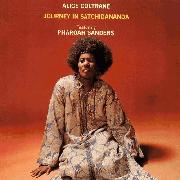
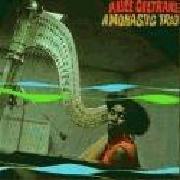
Spirituality is a deceptively rocky field, just as susceptible to tranquility and composure as to violence and disquiet — that much should be obvious to anyone who's ever pondered inner balance long enough to realise how much struggle it takes to obtain. We owe a lot to the transcendental jazz experience for its willingness to bring this duality into startling focus – the likes of Pharoah Sanders and Sun Ra were never shy of finding their peace in the eye of the storm – but Alice Coltrane is hardly the first name that comes to mind when it comes to clashing extremes. Many will associate her first and foremost New Age mysticism and lethargic incense-burning, far moreso than of tumultuous cosmic reckonings — and understandably so! For all its innovations and refinements, it's easy to approach her supposed opus
Journey in Satchidananda as a
sui generis meditation aid. It's to that record's credit that it still holds such appeal in that vein, but to anyone glancing over Coltrane's initial oeuvre, from the harp rambles of her debut
A Monastic Trio to the steadier reveries on her sophomore record
Huntington Ashram Monastery to the sophisticated devotional fusion of
Journey…, it's tempting to view her as on the other end of the rainbow, too wrapped up in a zen daydream to dish out the spiritual ignition many look to jazz for, aesthetically or otherwise.
You'd be wrong! That hazy, mind-dilating collage of vibes does little to explain
Ptah, the El Daoud: the image of Alice Coltrane the spindly devotionalist fails to account for the sheer muscle she leverages across this magnificent album's four tracks, and whatever semblance of thunder Sanders himself brought to
A Monastic Trio (specifically the expanded edition) is but a distant echo compared to the pealing rapture he raises here, paired to great effect alongside the tauter stylings of co-tenor Joe Henderson and rivalled at every turn by Coltrane's own hammerings.
Ptah sees her first and foremost as a pianist – the only turn she takes on the harp is the pensive "Blue Nile" (recognisable to many from its interpolation on Flying Lotus'
Cosmogramma) – and the Egyptian god of the title offers her license to approach spirituality not with contemplation and fragrance, but as a rollicking show of force that affirms the most vitalising, terrifying qualities of higher realities. Coltrane herself described the title-track as a march to purgatory, intended to produce a feeling of purification; the upshot is more a baptism of fire. Bold and bracing, it stands as one of her finest moments and in many senses preferable to
Journey in Satchidananda, not just for offering a more tactile approach – I certainly won't oret nd not to find this album's robust blues foundation more appealing than the sprawling harp frittery on earlier Alice Coltrane records – but for its juxtaposition between the palatable and the pyrotechnic: it's rare an album that reaches out so assertively, so convincingly to the beyond that you can all but feel the sparks fly as it grazes its fingertips against the sublime.
We get a hint of this on "Turiya and Ramakrishna", an extended piano showcase where Coltrane seizes upon the kind of melodious blues ruminations you could hear from any cocktail-friendly background band, only to leave her own imprint in a series of mystical cadences that flow through the piece like quicksilver wrapped in stone pipes, but it's the album's bookending opuses that offer a most bracing confrontations with the arcane.
This brings us to the almighty title-track, the central motif of which is the kind of thing that makes heads turn and knees quiver. By itself, that dual-tenor sax refrain could just as easily herald a showtune villain, but with Coltrane's thunderous piano chords undercutting it, the effect comes far closer to a occult invocation worthy of the titular deity. The piece hits its swaggering, lurching groove within seconds, and the rhythm section upholds this so vigorously that both Henderson and Sanders' incensed solos and Coltrane's increasingly obtuse chordal backdrop slot neatly into place. The track's dramatic thrust pays off: the unfathomable has been given shape, swagger, colour and vim, its spiritual overtures rendered both abrasive and gloriously tangible. Light an incense stick, and it'll struggle to pierce this piece's sulphuric haze; the tension sounds utterly fantastic. By the time Coltrane finally launches into her own solo seven minutes in, her slew of diminished horrors and augmented annihilations of my never-so-humble musical vocabulary are par for the course, and when that refrain rolls back in all its heft and mischief for the piece's close, it comes practically grinning with satisfaction for what it's put us through, with wry awareness that, since its first iteration, we truly have seen it all.
Though it is carried with comparable heft, the closing "Mantra" goes further still, introducing its refrain so slyly you'll likely miss it on first pass, and paring back every one of the middle tracks' palatable touches to make way for a tonal fraying for the ages. Sanders, Henderson and Coltrane waste no time reprising the dialogue they initiated on the title-track, egging each other on as though they were like-minded mystics, each locked in their own respective tussle with a supernatural antagonist. Sanders eventually pulls ahead as chief exorcist and we could marvel all damn day at the lengths the rest of the band go to sustain him while all forms beyond that rumbling, all-anchoring groove crumble away around them. Needless to say, this can't last forever — but the relish with which the piece finally dissipates entirely, only to gather itself and step back from the aether in one final blues coda (a reprise of the earlier refrain) is perhaps the most gratifying touch of the record.
Hooray for order out of chaos. However many dissonant splinterings, eerie cadances or otherworldly howlings the soloists tear through,
Ptah… grounds itself time and time again in something earthy and reassuring, and even its most extreme contortions keep the flow of their piece firmly within view. Does that count for spiritual affirmation, or is it just the mark of a riotously good jazz record? Is there more to be gained from the thunderous communion of the bookend tracks or the relatively contemplative middle pair? Is this album ultimately a work of turmoil or peace? Why bother deciding, when it offers such rich insights to each and every lens you could view it through.