Review Summary: I just wanna go back, I don’t wanna hear it.
From time to time, your reviewer goes down memory lane and more often than not, recalls something a science teacher once said in class, in terms of traveling to the past. In his words, our best bet might be a machine that could capture and translate all the light ever reflected from Earth, making it possible to relive everything that has come to pass. Back then, your reviewer was not aware of the works and days of Trurl and Klapaucius, the formidable engineering heavyweights in Stanislaw Lem’s Cyberiad collection of not-so-short stories, in order to aggravate the science fiction at hand, in real time. Only these steampunk Da Vincis could have built such a contraption, but cold pragmatism dictates that their craftsmanship remains a history of a time that lies light years ahead, if at all. What’s also pragmatic is that Earth and its telescopes stand in the way of cosmic projectors, commonly known as galaxies, solar systems, planets, and everything in between and beyond, which narrate their comings and goings by means of light. To that end, some kind of frustration lurks, considering that most of that storytelling remains elusive, despite the huge leaps of telescope technology over time; nature has an unmatched work ethic, in terms of guarding her secrets.
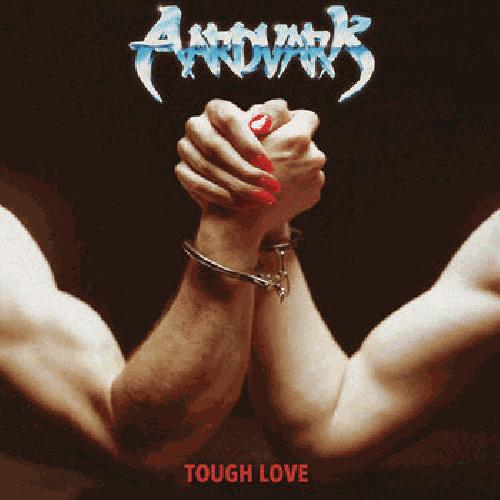
The above said, one does not need to be a rocket scientist or even a metalhead, to take in and communicate the early ‘80s metal aesthetic of the album art in Aardvark’s debut full-length. The more your reviewer looks at it however, the more difficult it becomes to shake the notion that the cuffed bras de fer of the sexes is a snapshot emerged out of elapsed time, analogously to the spectacular captures of ancient light from the articles of deep space. The proverbial social contract, while far from perfect (for same sex relationships, nowhere near the premise), bounded men and women to cope through life in unison, while rivalling one another within the enclave of nuclear family. Nowadays however, the segregation of the sexes, supposedly a counter reaction to mend the norm of old, is known to exacerbate the deprecation of what was previously considered as social coherence. The situation has been ascribed to a number of entangled realities, namely increasingly entrenched political dispositions, stark differences in formal education, the lidless anti-woke and woke movements, the deleterious effect of influencers and social media, and an idleness in fleeting the zone of social comfort/discomfort. If the album art in
Tough Love were to tersely map the combined effect of all those troubling trends, it would most probably lack at least one of the bras de fer contestants, whereas the cuffs would be effectively omitted from the setting, due to political correctness.
The lyrical content relevant to the front cover, a cluster of three songs (“Tough Love” up to “Fire”) plus "Too Old To Cry", touch upon the conundrum presented in the previous paragraph, in an abstract manor. Vocalist Ed Vaark (also the lead guitarist) dubs the pillars of social simplicity that are men, and their perennial struggle in understanding and nearing the idiosyncratic nature of the opposite sex. When things go south, the only solution appears to be going back in time and the era of splendor within the relationship (“I just wanna go back/I don’t wanna hear it […]/Move through time and space” Vaark sings in album highlight “Fire”). Well, one can’t help but wonder about the whereabouts of fun (even its most surreal aspects of it), if everything about intimate relationships, were to be easy and predictable. Candidate partners give a hard time to their other halves, either because they deeply care about them and put them to multiple tests over time, or because they don’t care at all; therefore, the training process in telling the difference, besides being inherently necessary, can’t be anything other than hard. Going past the aforementioned trifecta of songs, lyrics extend to traditional topics regarding ‘80s metal, which in earnest, do not move the needle as much nowadays.
The music falls right below the early ‘80s metal tree. Vaark’s vocals are crude for the most part, on par with the band’s kind of metal throwback, but there are several pockets where his cadence sounds like a tribute to the wry demeanor with which Mark Knopfler sung in
Dire Straits, and that gives an unexpected lot of commendation. What’s more, in “The Dream Is Nearly Over”, the album’s power ballad, he proves that he can croon and vibrato to great effect. While there’s not a single song that falls behind, every note, every turn and every twist is reminiscent of the era and its multitude of musical juggernauts such as Accept, Saxon, Iron Maiden etc.. Depending on the prospective listener, if the goal is a solid retrospect of the sort,
Tough Love is an excellent choice; or a rather lukewarm affair, if the boundaries of ‘80s metal and metal in general, are sought to be transcended. Regarding the former end, the differences of the main riff in “Tough Love” to that of Accept’s “Princess of the Dawn”, are infinitesimal, but surprisingly Aardvark’s song, sounds fresher (besides being an obvious live concert banger) also due to the album’s lively sound work. Vaark and Sorcha Wilcox are nothing short of effective in their rhythm and lead guitar duties. With respect to the rhythm section, while its pedigree extends to a genre such as jazz, both Danny Smith (bass) and Dylan Lieberman (drums) are nothing but the firm (if a bit uneventful) substrate upon which the guitars fall upon.
All in all,
Tough Love is a critical tribute to early '80s metal in terms of sound and aesthetics, and people in the corresponding loop, have rightfully placed Aardvark on the lookout. Under the hood and unlike most albums of kin, the album is a shrewd stimulant for reflection on the grim situation regarding the social interaction of the sexes. Here’s to sincerely hoping that it will not take too long before the next album.