Review Summary: Pain is the language that was spoken to me, now it’s my time to answer.
Brian Warner is an artist who has spent his entire professional career living in the moment. It’s a music career made up of dizzying highs and gloomy lows, all entirely predicated on the environment he finds himself in at that moment in time. Marilyn Manson is the type of personality that will, having overcome adversity, accept the willing embrace of apathy and decadence if there’s nothing else challenging him in real life. Way back in the late-nineties, prior to the Columbine High School massacre, Manson was in the throes of carving out a music career for himself, using as much controversy as he could garner. The gambit worked, but it would ultimately backfire on him, as that very same reputation he’d fought so fervently to attain would be wielded against him by the media, who sought to pin the horrific incident onto him. This turn of events cornered Manson, promptly channelling his emotions into 2000’s
Holy Wood: a record that clapped back at not just the media, but American culture as a whole, commentating on its deep-rooted obsession with guns and celebrities and interweaving it into his crusade on religion. The album is arguably his crowning achievement and one born on the biggest hardships he’d faced hitherto. Indeed, it’s easy to see why his relevance waned from this point on; Marilyn Manson’s career was met with his indolence and complacency, and were the root cause of his decline. A bloated Manson serving up toothless albums and infamously awful live shows would be the new standard for the next decade.
Fourteen years after
Holy Wood ushered in a new era though, one where apathy would, for the most part, take a backseat. While Manson didn’t have anything to really point his crosshairs at, his creative hunger was beginning to manifest again. Collaborating with Tyler Bates and Shooter Jennings respectively, as a means of developing a more mature facet of his persona, the next few albums would experiment with brushstrokes of country and blues rock to achieve his goals.
We Are Chaos is the apex of those lofty ideas – I thought it was the best thing he’d done since
Holy Wood, because it unequivocally affirmed this new version of himself. While I still prefer the vigorous heavy side of his music, 2014-2020 was a period that acknowledged his roots but smoothed out the abrasive angst for a (mostly) more sophisticated approach to his writing style. However, shortly after
We Are Chaos’ release, allegations of sexual abuse came to light and squashed any potential for promoting it. His record label, Loma Vista, dropped him, leaving him to seek refuge in the shadows, caught in a web of lawsuits. For four years Brian Warner remained deathly silent while he fought his legal cases, and while the dust hasn’t quite settled on it all, in August of this year Marilyn Manson returned to the public eye transformed, looking twenty years younger, clean, and the most invigorated he’s looked and sounded since
The Golden Age of Grotesque. The album’s first single, “As Sick as the Secrets Within”, wasn’t a full-frontal attack on his detractors either: it wasn’t about someone else, it was about Brian Warner internalising and confronting his own vices and demons head on. The artwork for the track is equally telling of where his headspace is at – holding a broken, serrated shard of mirror up to his stern but not unsympathetic visage, affirming to us he has a lot to face up to, whilst making it clear no white flags will be waved around either.
Like
The Pale Emperor did for the next decade,
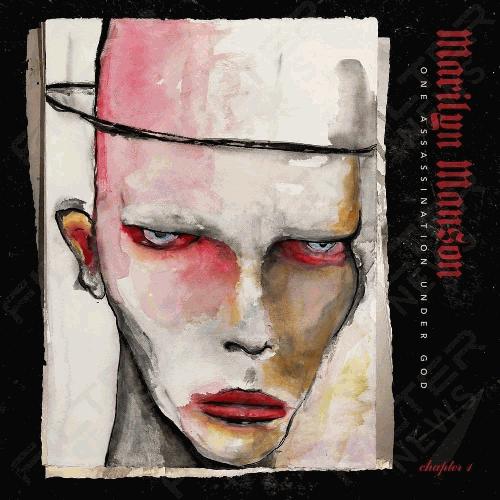
One Assassination Under God - Chapter 1 is the impetus for a new era, one that has seemingly come full circle. The main problem I’ve had with the last three albums is that, while mostly excellent records, Manson lacks the same agency he had on the triptych records. Even
The Golden Age of Grotesque, while instrumentally fantastic, suffers from a frontman without purpose – controversy and pressure are the fuel that ignite Marilyn Manson into action, and through his trials and tribulations he’s able to harness some truly fantastic music out of it. As such,
One Assassination Under God - Chapter 1 forms the bridge between Marilyn Manson’s two greatest eras. The last three albums appropriate elements from the triptych era, but they were put through a filter and used to bolster the aspirations he had for the time. Here, considering what has transpired in the last few years, it’s almost forced Manson to welcome in the formative years of his sound again, in order to fully convey what needs to be said. As such, the composition of Marilyn Manson’s twelfth studio album is a perfect synthesis of the triptych and
The Golden Age of Grotesque eras, with an effective blend of Tyler Bate’s blues-rock style being added into the mix. The end result is a more mature handling on his old industrial rock/metal sound, with furtive elements of latter day works. The groovy “Sacrilegious” and “Meet Me in Purgatory” lean more on what Manson and Bates were building together in the last decade, but even here, the sinister vocal croons and creepy industrial electronics hearken back to his heyday, giving the style an upbeat presentation with a dark lacquer finish over the top. “Raise the Red Flag” is a full-blown rock anthem that blends
Holy Wood and
The Golden Age of Grotesque together, and “Nod if You Understand” goes into full-blown
Antichrist Superstar mode. I could write off how effortlessly this album uses his most revered era, but suffice to say it’s a well-balanced selection of songs that have a genuine understanding of his greatest attributes.
The biggest positive I can give the record though is, like
Holy Wood, the adversities Manson is facing has forced him to write music with real meaning behind it again. Gone are the cringe hedonistic and decadent themes which obstinately, albeit seldom, plague even his best albums from the last ten years.
One Assassination Under God - Chapter 1 is steadfast in its message and really tries to internalise Manson’s flaws, the people around him, and his adversaries. Album opener “One Assassination Under God” wastes no time in talking about his recent infamy being a lynching and used as entertainment for the masses, “Raise the Red Flag” and “Nod if You Understand” are a declaration of war on all his detractors (the latter seeing Manson embracing a rebirth of the antichrist of sorts), “Sacrilegious”, despite being one of the most upbeat songs on the album, feels like a cryptically virulent assassination on Evan Rachael Wood, and, as I touched on earlier, “As Sick as the Secrets Within” takes a good, hard look at where Manson’s life was four years ago, acknowledging it was wrought in addiction and not worth much of anything. This is probably my favourite song off the whole album – easily being the best thing he’s released in twenty-four years. The impeccable production and implementation of styles from
Mechanical Animals,
Holy Wood and
TGAOG form the buttress needed to convey the most emotionally charged track in nearly a quarter-of-a-century. Manson’s vocal approach utilises a banquet of subtleties, most interestingly are the raspy croons used at the bridge and the end of the song, which represent his inner demon provoking him, while the verses carry this tender vulnerability which perfectly complements the poignant choruses.
I could wax lyrical about the lyrics and the excellent implementation of ideas and styles from a bygone era, as well as the thoughtful run time, but I’ll condense it down to this:
One Assassination Under God - Chapter 1 is an explosive return for Marilyn Manson. I can’t say it’s a return to form, because, honestly, Manson’s last album was stellar in its own right. However, as a long-time Marilyn Manson fan, this is the album I’ve secretly wanted from him for decades now. It encompasses every chapter of his career, with “No Funeral Without Applause” even tapping into that ropey era in between
TGAOG and
The Pale Emperor, with great efficiency I might add. The record just feels meticulously constructed; you can tell a lot of thought and effort went into every track here, with the overall vibe of the album irrefutably lending
Holy Wood’s oppressive atmosphere to set the tone. When Manson returned earlier this year, sporting his signature white contact lens and leather garb, and a font and colour scheme on the album cover that derives from
Holy Wood, I knew, building up to its release, this was going to be a reflective project. Being that it’s focusing on death, betrayal, addiction and healing, the creative decision was a wise one. The risk with this, of course, is that it could sound and feel phoned in, lazy, or a desperate attempt at tapping into nostalgia. Thankfully, none of this is the case.
One Assassination Under God - Chapter 1 is a well-rounded experience that embraces the gamut of sounds from Manson’s career, with plenty of little new additions to the formula to add spice – most pertinently, the post-rock vibes that creep into tracks like “Death is Not a Costume”.
If you’re a Marilyn Manson fan, you are going to be eating very well here. If you’re a casual listener or a fan of industrial rock with a twist, you’ll still thoroughly enjoy what
One Assassination Under God - Chapter 1 has to offer. This is a thoughtful, well-crafted album with a lot of stuff to unpack if you’re wanting to dissect its secrets. I wasn’t too sure if “Chapter 1” was more of a statement pertaining to the album’s themes than an actual indicator for one or more follow-ups, but after picking the bones off this thing, it’s clear there is going to be at least one more album to follow, and frankly, I can’t wait to see what he has lined up in the future. Like a lot of the elements here,
Holy Wood has been the blueprint used to create this record, and with how much effort and thought went into that record, if Manson and Bates have a trilogy or something planned out, this could be Marilyn Manson’s greatest achievement to date. Regardless of my digression and the fanboy in me getting ahead of itself,
One Assassination Under God - Chapter 1 is easily one of the best rock albums of 2024, and one hell of a return.