Review Summary: The Great Leap Forward
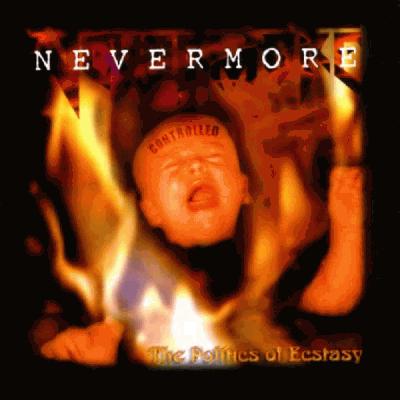
Nevermore was always a unique band, but 1996’s The Politics of Ecstasy is where they truly came into their own. The stage was set earlier that year as the In Memory EP saw the recruitment of guitarist Pat O’Brien pre-Cannibal Corpse and scrubbed away the debut’s muddy production and grunge-isms. The musicians’ skills have also expanded considerably in that brief time, getting their chemistry even tighter while adding even more flourishes to an already broad sonic palette.
The songwriting certainly shows this ambition in action, arguably marking the band’s official foray into progressive metal. This is made most obvious by the songs getting longer, culminating with the ten-minute epic closer “The Learning,” as well as in the ways that the structures are toyed with. Just about every song will throw in some sort of side tangent, the dynamics and tempos will build or shift at a moment’s notice, and the melodies are full of weird phrasings and odd note choices. It also makes for some fun stylistic outliers as the crashing epic doom on “The Passenger” feels like a Candlemass song updated for the mid-nineties and “Precognition” is a busy acoustic guitar-driven spotlight.
This approach could come off like directionless tech-metal drivel, yet the songwriting also ends up being even catchier in its own eccentric way. This is best exemplified by the opening “The Seven Tongues of God” as the verses’ vocals demonstrate a broad range with wacky scale jumps across a hefty mid-tempo chug that are balanced out by the chorus’s more straightforward yet grandiose refrain. “This Sacrament” and “Next In Line” also stand out for their driving momentum and “Lost” may be the album’s greatest bid for accessibility between its faster paced riff set and almost wistful hooks. Even a lesser track like “The Tiananmen Man” keeps from feeling too clumsy thanks to its own stirring chorus.
But at its core, The Politics of Ecstasy is an album primarily driven by anger. The instrumentation is more aggressive between the weightier rhythm section and O’Brien’s presence giving the guitars an almost death metal bent at times. The lyrics are also more pointed toward systemic issues in contrast to the debut’s more introspective outlook, attacking religious and political institutions between moments of contemplative cynicism. Whether it’s the title track’s pounding bluntness or the constant turbulence of “42147,” the mood is always caustic.
While The Politics of Ecstasy may still be a hair shy of Nevermore’s absolute best efforts, it shows them pulling off an excellent leap forward. The band’s growth in a year’s time is insane to consider in itself but it’s also commendable to see just how they’re able to keep in check with memorable songwriting and a focused attitude. Of course, it’s still ultimately an acquired taste and even enticed listeners may still need a couple extra plays to properly feel it out. At this point, any connections to Sanctuary are dead and buried.