Review Summary: "I don't cater to all these vipers." - The Biggest Viper Who Ever Lived
Taylor Swift has become an economy, enterprise and enigma all unto herself. It was only five years ago that her reign atop the pop culture sphere was seemingly winding down; she couldn't keep an album at number-one past its opening week (good job Tool), and the mainstream pop zeitgeist, as it glossed from one cult upstart to another (Post Malone, Billie Eilish), was leaving her in the dust at an accelerated clip. Then the pandemic shut the world into its homes, and Swift went back to the drawing board. With new collaborator Aaron Dessner pushing her out of her comfort zone, she crystallized the isolated and escapist themes of the time with a one-two punch of surprise albums:
Folklore and
Evermore. Lauded by the media as a "sonic palette cleansing" for the oft-embattled and heavily scrutinized superstar, Taylor Swift propelled herself back to the vanguard of the contemporary pop landscape. From there, she began her meteoric ascent to
unprecedented levels of fame and notoriety; the
Taylor's Version re-release series that arose from her Scooter Braun-masters controversy, another studio album (the nothing burger known as
Midnights), a nauseatingly well-publicized romance with Chiefs tight end Travis Kelce and, most notably, the
Eras Tour, which quickly became the highest-grossing concert trek of all-time, and solidified Swift as, according to TIME, "the main character of the world."
For Swift and her
legions of diehards fans, who have consummated an obscenely creepy and unhealthy relationship with each other, this is great. The 'Swifties' are vindicated for their years of hailing Taylor as artistically and even
personally infallible, and are rewarded for their toxicity, cyber-bullying of others and death threa-err...I mean brainless cultlike worshi-err I mean...
love and devotion, with an unceasing onslaught of content. There's
always a new song to stream to the top of the Hot 100, a new cardigan or vinyl record variant to spend money on in an era of record consumer-based inflation, or a new story or beef to keep their unassailable queen at the front of everyone's minds and at the top of every news feed.
All of this necessitates one simply formulated but increasingly common question:
When will Taylor Swift go the entire God damn f*ck away already????!!!!!
For those of us not trapped in the vortex of all things Swift, this whirlwind of new developments is mind-bending, vomit-inducing and sometimes, even a bit angering. Just when you thought things would finally grind to a halt by way of Swift's net worth vaulting past $1 billion while her fans empty their bank accounts in the name of a couple bonus tracks, we get
this.
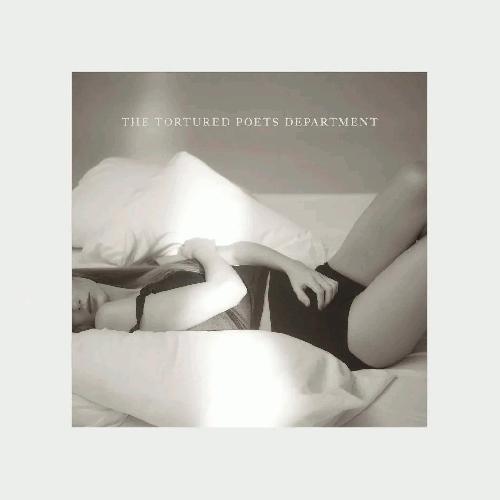
The Tortured Poets Department is the perfectly ugly soundtrack to the life and current musings of a criminally mega-wealthy woman so drunk on her own hubris and mystique, 'poetic' only in the sense that it's an inversion of everything most people, superfan or otherwise, have held true; that Swift was, generally speaking, a very intelligent, clever and emotionally forthright songwriter. A bit diaristic in form and skewed almost exclusively to her point of view, sure. But Swift could, in most cases, weave palpable tales of love and lust, and supplement the top 40 with a decent hook, too.
This album is
anything but that.
Tortured Poets is a bloated and oversized amalgam of half-baked ideas and incomplete premises that are sorely and almost stunningly lacking in thematic or artistic ambition. I wouldn't call Swift a 'concept album' artist historically, but I would go as far as to wager that the bulk of her previous studio albums, even 2017's controversial-by-design
Reputation had a concrete and slanted internal logic. In the case of
Reputation, it was about Swift having to address, however introspective or not, her own bad habits and polarizing persona, and then feeding into it. 'You've been calling my bluff on all my usual tricks,' she taunted on "End Game." Dock points for appropriating urban stylings if you want, but
Reputation was what happens when you put someone under a microscope and poke and prod relentlessly until they're forced to respond.
The Tortured Poets Department by comparison, is what happens when someone is allowed to become so insular, so one-note, and so full of themselves, that they are acutely aware that there's no need to grow or expand. Swift knows she doesn't need to take any home-run swings. The cacophony of blind praise from her fans will more than carry even the most abhorrent turd sandwich out of the park. What's more is that this still rings true even when Swift is ostensibly past the point of defending or making excuses for. 'We would pick a decade we wished we could live in instead of this. I'd say the 1830s but without all the racists,' she tellingly opines on "I Hate It Here." What justification can you mount for romanticizing an era marked by slavery, oppression and atrocity? The shoe-horned caveat of "without all the racists" is supposed to pass as a sufficient enough rejection of bigotry, a dog whistle for her droves of foot soldiers to herald her as progressive and forward-thinking, despite it being a barely-surface-level attempt at trying to jettison her proximity to any kind of racist sentiment, certainly in the wake of her brief fling with 1975 frontman Matty Healy.
On the title track, Swift seems to be rubbing shoulders with the prospect of marriage. How does she strive to define the sensations attached to this momentous development? "At dinner, you take my ring off my middle finger, and put it on the one people put wedding rings on."
I...I just...moving on.
As far as the compositions go, it's more calculated synthpop produced, in part at least, by Jack Antonoff. For an album released in the run-up to summertime, Swift doesn't seem to be having too much fun. Even lead single "Fortnight" with Post Malone" falters where it could have been something, had Posty's role been more prominent. On "Down Bad," she's continuing to chase down her infatuation with her teenage years, which, y'know, ended half of her life ago. 'Cryin' at the gym, everything comes out teenage petulance,' she bizarrely laments. On "So High School", which according to my limited TikTok experience seems to be a fan favorite, she somehow manages to rhyme "Aristotle" with "Grand Theft Auto."
I...
I can't do it anymore.
The Tortured Poets Department has no right to exist. The canon and ethos of Taylor Swift have officially been cracked and broken with this one. With an ivory tower persona she can't or won't do away with, our too-big-to-fail protagonist sneers and revels in the fact that no amount of criticism will ever meaningfully put a dent in her facade. Even if she'd chosen to provide her own perspective on this unique and singular juncture of her career in a serious way, there'd be no reason to. Maybe I'm too harsh, but this white, ultra-wealthy billionaire who queerbaits the LGBTQ+ portion of her fandom ("Lavender Haze", "You Need To Calm Down"), pollutes the environment whenever she needs a glass of water from the kitchen, and refuses to say a God damn word about Palestine, despite having an unconscionable platform and amount of power, has completely lost the plot. Her music, and her persona in general, could and should be an essential tool in positively affecting the world around her. Instead she's chosen to retreat into deafening silence when it matters, and lazy, half-assed songwriting when it doesn't.
Hollow, pointless, and tortuous for the listener and not the other way around; these are just a few of the adjectives you can betoken on Taylor Swift's worst album yet, and one of the worst pop albums of the 2020s decade thus far.