Review Summary: With tis album, Carmen continues to explore their unique territory, but it’s more rock and less Flamenco.
“Fandangos In Space” is the second studio album of Carmen that was released in 1975. The line up on the album is David Allen, Roberto Amaral, Angela Allen, John Glascock and Paul Fenton. The album also had the participation of Mary Visconti, Chris Karan, David Katz, Tony Visconti and the Pop Arts String Quartet.
Carmen was a project of the Los Angeles based sibling couple Angela and David Allen, whose parents ran a Spanish restaurant on Sunset Boulevard, in which the flamenco guitar playing of David was the main focus. In 1970, both formed Carmen, which quickly became a popular local live act, but that couldn’t land at any record label. In the early of 1973, therefore, a large part of the band moved to the UK, where they stabilized as a quintet. There, the lineup of Carmen was added by two British musicians. It included the future bassist of Jethro Tull John Glascock and Paul Fenton, an English drummer best known for his work with T. Rex. They managed to be produced by the famous Tony Visconti. Under his aegis, the first two Carmen albums emerged, “Fandangos In Space” from 1973 and “Dancing On A Cold Wind” from 1975 that can be attributed to the small genre “Flamenco-Prog” that can almost only be found in Spain.
The style played by Carmen broke new ground in the rock territory. It combines the British flair for prog rock with the traditional Spanish folk themes into a very fresh, energetic and powerful new mix. The sound of their music is centered on the classical guitar. The keyboards are also used, subtly, but with a good effect. The Carmen’s stage performances featured Roberto Amaral and Angela Allen dancing on a specially amplified stage floor, so that their flamenco tap dance, “zapateado”, became an integral percussive addition to the music. The Spanish influences into their sound included acoustic guitar interludes in the flamenco style, occasional Spanish lyrics, themes of betrayed love reminiscent of Federico GarcÃ*a Lorca, and castanets, all supported by a traditional and rich rock rhythm section.
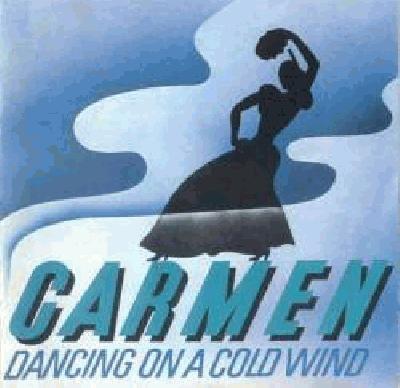
“Dancing In A Cold Wind” is as good, or almost as good, as “Fandangos In Space”. Once again, the music features the male/female vocals of brother and sister, David and Angela Allen, with strong harmonies and excellent guitar work. This is a conceptual album, with a cheesy story about a prostitute turned into a dancer who lost her lifetime love. If anything, the music is even more diverse than on their debut. It has good song writing, maybe an improvement of their debut.
“Dancing In A Cold Wind” opens with a fantastic track called “Viva Mi Sevilla”. The vocal part features some references to the track “Bulerias” recorded on their debut “Fandangos In Space”. Besides the vocals, the track goes into a bunch of instrumental passages and ends with a beautiful synth vibe theme that builds up to an incredibly powerful finale. “Purple Flowers” includes some very heavy bass lines and the usual flamenco influences in the middle of the track. “Drifting Along” and “She Flew Across the Room” are both more laidback, acoustic tracks that float into each other. “I’ve Been Crying” sounds to me almost like a flamenco version of Curved Air, with some catchy vocal harmonies. The second side of the album consists of a 24 minute suite “Rememberances (Recuerdos De Espana)”. It’s very vocal orientated with few instrumental parts, but the themes and melodies are all really nice. This suite characterizes the penultimate album of Carmen as a sprawling long track and unites all the strengths of the band. It has catchy grooving vocal harmonies, crisp rhythm lines, dreamy uses of the acoustic guitar and gently built-in symphonic smouldering unite here to form a small epic. Angela Allen, the sister of the bandleader David Allen who is responsible for the dance element and delicate keyboards, contributes with more convincing lead vocals in self confident mania. The Flamenco music also appears, but only sporadically in its finale, which is characterized by some emotional contrasts. Angela’s voice reminds me sometimes of Sonja Kristina of Curved Air. Overall and however, the individual parts flowing into each other also lack a bit of the connecting element in order to produce the right dramaturgical coherence.
Conclusion: “Dancing In A Cold Wind” remains, for me, an excellent album too. Personally, I’m not sure about which album I like the most. “Fandangos In Space” is probably a more immediate album and more catchy than this one is. But perhaps we can say that “Dancing In A Cold Wind” is more “serious” and more prog than the previous one is. Overall, “Dancing In A Cold Wind” is more complex than the first one is, but as a whole, is perhaps less enjoyable. It also has less influences of Flamenco and more influences of traditional progressive rock music. Having said this, I’m perfectly convinced that “Dancing In A Cold Wind” has more positive energy to satisfy even the most critical and demanding prog fans, than their debut. But, can you prefer the first one or the second one, “Dancing On A Cold Wind” is the perfect companion to “Fandangos In Space”. I highly recommend the double CD with both albums, really.
Music was my first love.
John Miles (Rebel)